VCP-DCV vs VCP-VVF and the vSphere Skills Each Exam Actually Tests
By ExamDumpster Editorial Team· (updated Nov 18, 2026)

A useful VCP-DCV vs VCP-VVF certification comparison starts with the exam code. The two credentials share virtualization foundations, but your preparation changes with the product version and operational scope. For an administrator studying after work, that distinction affects which labs deserve attention and which older materials remain useful. This guide separates the vSphere administration covered by DCV from the broader platform work in VVF, then explains how to choose a route without buying overlapping preparation.
Start with the exam code and product version
VCP means VMware Certified Professional. DCV identifies Data Center Virtualization, while VVF identifies VMware vSphere Foundation. Those abbreviations describe certification families; the exam code identifies the assessment you need to prepare for.
The version distinction matters within VVF itself. Broadcom’s vSphere 8 exam guide, dated January 25, 2024, describes the DCV assessment. Its current VVF exam listing identifies 2V0-16.25, while the earlier VVF 5.2 exam guide describes 2V0-12.24.
| Certification route | Exam code | Product scope | Published English exam details |
|---|---|---|---|
| VCP-DCV, vSphere 8 generation | 2V0-21.23 | VMware vSphere 8.x | 70 questions; 135 minutes |
| Earlier VCP-VVF Administrator | 2V0-12.24 | VMware vSphere Foundation 5.2 | 55 questions; 115-minute appointment |
| VCP-VVF Administrator, 9.0 generation | 2V0-16.25 | VMware vSphere Foundation 9.0 | 60 questions; 135 minutes |
These specifications identify different assessments. The older guides document their respective versions; confirm booking availability and appointment details before purchasing a voucher.
A course labeled simply “VCP-VVF” leaves an important question unanswered: which code does it cover? Check that before comparing its price.
Keep specialist material separate, too. A bank of VCF deployment specialist questions targets another assessment. Match every resource to your chosen exam’s objectives.
DCV develops the vSphere administrator’s view
The DCV blueprint centers on administering a vSphere infrastructure. Its objectives cover architecture, networking, storage, security, configuration, lifecycle concepts, and operational tasks. That makes it a useful skills reference for work centered on ESXi and vCenter.
Compute decisions need an operational reason
The published objectives include High Availability, Distributed Resource Scheduler, and Enhanced vMotion Compatibility. HA addresses host-failure recovery; DRS concerns workload placement and resource balance.
For preparation, connect each capability to a requirement. Can you explain which problem it addresses, what it depends on, and how you would verify the result?
Consider a hypothetical cluster awaiting host maintenance. Describe the workload movement, capacity checks, and validation you would perform before changing anything. Then change one assumption: a destination host lacks a required resource. Explain how that affects your plan.
A useful lab note records the starting condition, selected action, expected result, and observed result. Keep the explanation beside the procedure so you can reconstruct the reasoning later.
Networking and storage require connected thinking
DCV objectives distinguish standard and distributed switches, VMkernel networking, storage protocols, datastore types, and storage policies. They also include vSAN concepts.
Practice these as connected systems. Sketch a workload, its virtual network connection, the host, and the storage it needs. Mark each dependency you would inspect if the workload became unavailable.
Then describe a controlled change to that diagram. What configuration must exist first? Which observation would confirm success? Where would you look if the result differed from your expectation?
Use your lab to answer those questions before recording an objective as complete.
VVF expands preparation into platform management
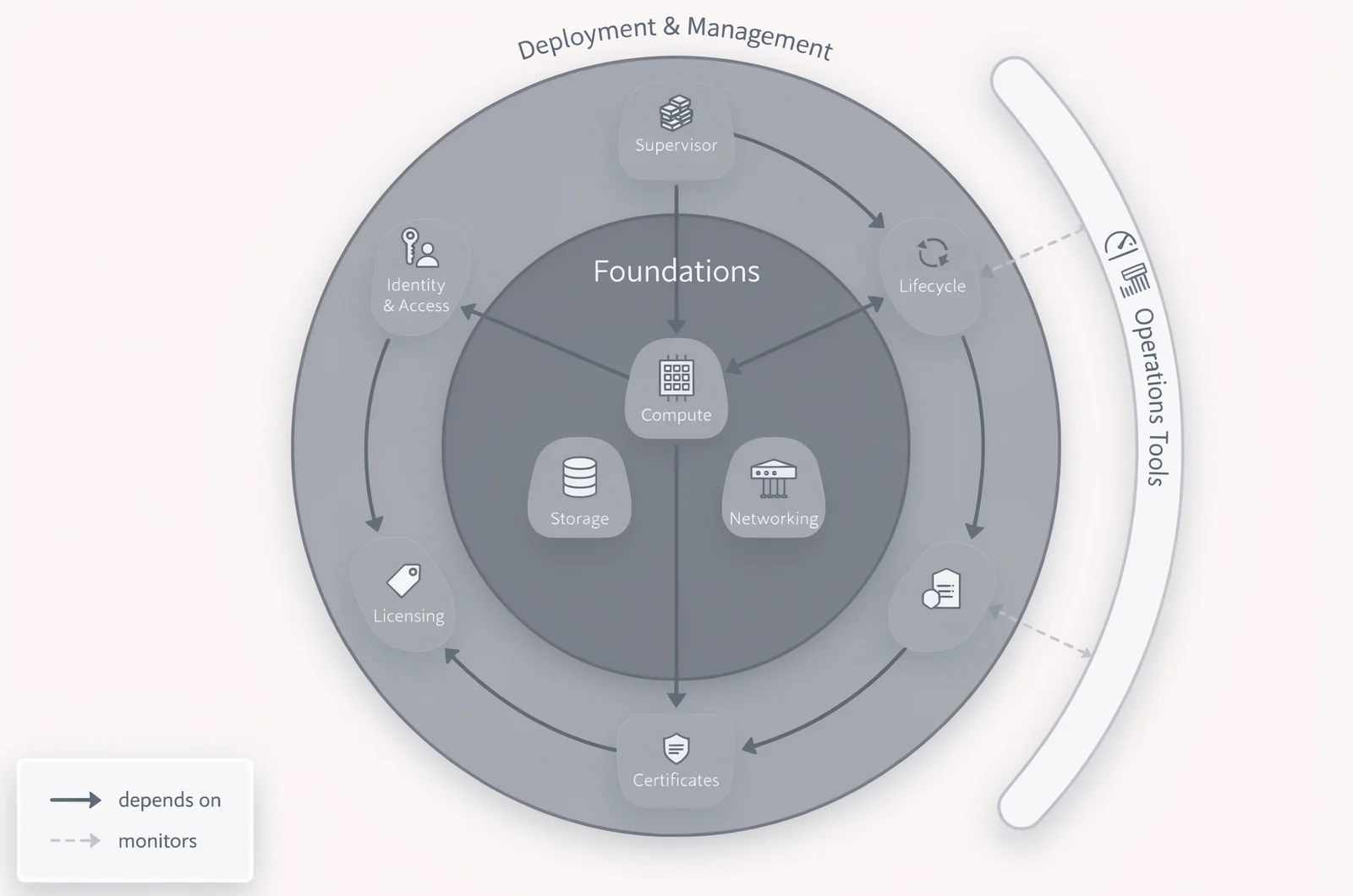
VVF preparation retains compute, storage, and networking foundations while extending into management and operations across the Foundation environment. The additional work matters most when your experience stops at routine vCenter administration.
Account for the services around the cluster
Broadcom’s VVF 9.0 exam objectives include virtualization, compute, storage, and networking fundamentals. Deployment and management objectives include Supervisor configuration, identity and access control, licensing, certificates, and lifecycle management.
Build your study notes around dependencies between these areas. For a hypothetical deployment exercise, record what must be available before installation and what access you need afterward.
For an identity exercise, define the intended administrative task before choosing permissions. State what the user should accomplish and how you would test that access.
Certificate and lifecycle exercises deserve the same treatment. Identify the intended state, the change you plan to make, and the evidence you will collect afterward. Repeating a successful installation leaves these management decisions unexplored.
Include the operations tools in your preparation
The 9.0 blueprint also names VCF Operations and VCF Operations for Logs. Older VVF 5.2 material uses Aria product names, so version matching affects the terminology you encounter.
Do not discard an operations topic because its product name contains “VCF.” Follow the objectives for your exam code.
For a hypothetical capacity alert, describe which observations you would collect before recommending a change. Explain what each observation would establish and what uncertainty would remain.
A useful study record contains the symptom, supporting evidence, proposed action, and validation. If you can describe the deployment but struggle to explain its operating condition, schedule another operations exercise.
Domain lists do not establish exam weightings
The DCV and VVF guides organize their objectives differently. Neither guide provides a percentage allocation that supports a reliable domain-weighting chart.
The VVF 9.0 guide places testable objectives in Sections 2 and 4. Sections 1, 3, and 5 have no testable objectives listed. Reading every standardized section heading as an assessed domain would misrepresent that blueprint.
A long objective list also cannot establish how many scored questions a topic receives. Subobjective counts measure how the document was written, not the distribution of your examination.
Use objective coverage to organize preparation, then let demonstrated gaps determine your time allocation. For each objective, record whether you can explain it, perform an appropriate exercise, and validate the result.
Suppose you have six study hours available this week. Assign extra time to the tasks you cannot complete without instructions. Keep some time for reviewing explanations and revisiting earlier work. That allocation is your study decision, rather than an official exam weighting.
An objective-gap checker could accept an exam code and completed exercises, then flag uncovered objectives and resources written for another version.
Maintain a dated copy of the objective list used for your plan.
Training and renewal belong in the preparation budget
Course requirements and certification validity can change the total cost of either route. Separate eligibility, recommended preparation, and maintenance of an existing award before deciding what to buy.
Recommended training and mandatory training are different
Broadcom removed mandatory training and prerequisite certifications beginning May 6, 2024. Its certification program update documents that change. The current VMware certification guidance also states that there are no mandatory prerequisites for the role-based certifications it describes.
Training can still be a sensible purchase. Evaluate it against your gaps and its coverage of the exact examination.
An experienced administrator might need structured help with unfamiliar platform services. Someone with limited practical experience may need broader instruction and guided exercises.
Ask what the course includes: product version, objective coverage, lab access, and access duration. Check whether an exam voucher is included before comparing package prices.
Build your budget from the examination, preparation resources, lab arrangements, and a possible additional attempt. Use the amounts shown during registration and purchase.
Check the validity of the award you actually hold
Renewal planning should start with your certification record. Record the exact credential name, issue date, displayed expiration date, and applicable renewal instructions.
Exam availability and certification validity require separate checks. One determines whether you can obtain a credential through a particular assessment. The other concerns the status of an award already issued.
An older policy article cannot establish the terms of every later award. If your certification record and published guidance appear inconsistent, obtain clarification before paying for an examination intended to maintain that credential.
Keep the response with your certification documents and add a reminder before the recorded expiration date.
Match the credential to the work you want
The useful choice between DCV and VVF depends on your responsibilities, available environment, and intended role. Start with a concrete task list from your job or target position.
For vSphere administration, compare your daily tasks
If your work centers on hosts, clusters, virtual machines, networking, and datastores, compare those tasks with the DCV objectives and the relevant VVF objectives.
Existing vSphere experience gives you a starting point. Mark tasks you perform independently, tasks you follow from a runbook, and tasks you have only read about.
For a new certification purchase, confirm which available assessment matches both your environment and your employer’s requirement. Have the exact credential and exam code recorded before committing to a course.
For platform operations, identify the missing responsibilities
If your intended work includes Foundation management and operations tools, use those responsibilities to assess the VVF preparation gap.
Later specialization should remain a separate decision. The advanced VCF administrator questions concern another qualification. Likewise, VCF 9.0 support questions belong to a separate support assessment.
Compare those blueprints when the corresponding responsibilities become part of your development plan. Choose one examination target for your present study schedule.
For architecture, examine the design responsibilities
Administration experience can support a move toward architecture. Assess design work separately: gathering requirements, documenting constraints, comparing alternatives, and defending decisions.
Broadcom identifies a separate VCF Architect route. The VCDX-VCF certification page concerns an expert credential and should also be considered separately.
If architecture is your goal, write a design rationale for a lab environment. Include requirements, rejected alternatives, and validation criteria.
Make practice expose the gaps between the exams
Practice questions help compare your current understanding with your chosen objectives. Their value depends on version alignment and what you do after reviewing an answer.
A free DCV-2024 sample on Exam Dumpster can help identify weak vSphere concepts. First establish which vendor exam code the sample supports, then compare those topics with your own target.
An older sample may still reveal an explanation gap. It cannot establish coverage of additional objectives in another examination.
Record why an answer failed
For each missed question, distinguish unfamiliar terminology, a missing concept, a misread requirement, and a version mismatch. These problems need different responses.
Explanations in Exam Dumpster’s study mode can support that review. After reading one, restate the governing principle in your own words and identify an exercise that would test it.
Also review correct answers reached through guessing. Record what evidence would let you choose confidently when the wording changes.
Keep notes organized by objective so you can resume a short evening session without reconstructing the previous one.
Use timed sessions after repairing coverage gaps
Timed practice measures how you work under a time limit. Review it alongside your objective record and lab evidence.
A rising score can reflect better understanding, familiarity with repeated questions, or both. Explain the reasoning behind your answers before treating the result as readiness evidence.
For each uncertain topic, write down the next exercise and the result that would demonstrate improvement. Revisit the question after completing that work.
Booking questions for DCV and VVF candidates
A few practical questions can settle the remaining choice before you spend money on preparation or registration.
Can you prepare for VVF without earning DCV first?
Yes. Broadcom’s current role-based certification guidance does not require a prerequisite certification. Choose preparation according to the VVF objectives and your demonstrated gaps.
If your virtualization foundations are weak, address them before moving through unfamiliar management tasks. You can build that foundation without purchasing a separate certification attempt.
What if your employer asks for “a VMware VCP”?
Ask which credential, product version, and role satisfy the requirement. Have the answer recorded before buying training.
An employer seeking evidence of vSphere administration may have a different need from one assigning Foundation operations responsibilities. An exact exam code makes the intended assessment clear.
Does a practice percentage predict the vendor’s scaled score?
No. The guides describe scaled scoring, and a third-party practice percentage has no established conversion to that scale.
Use practice results to identify uncertain reasoning, uncovered objectives, and pacing problems. Keep the vendor’s published passing score separate from your practice history.
Networking credentials and renewal planning
- CCNA vs CCNP difficulty
- Cisco CE credit renewal
- ACT Test Practice Checks For The Shorter Enhanced ACT Format
Open a free sample set for their exam code, then create a free account to unlock the rest and save progress Get started |  |