ACT Test Practice Checks for the Shorter Enhanced ACT Format
By ExamDumpster Editorial Team· (updated Nov 17, 2026)

ACT test practice should reflect the shorter enhanced format before you use a practice score to judge readiness. That means checking section lengths, question counts, four-choice math and your science selection, then rehearsing under matching conditions. An older book can still contain useful exercises, but its timer and full-test structure may need different treatment.
This checklist helps you separate material that builds skills from material suitable for a test-day rehearsal. Start with the instructions for your test date and administration. Keep those beside your practice materials so you can compare the actual requirements.
Run these seven checks on your practice set
An ACT practice set earns a place in your preparation when you can explain what it measures and how you will use it.
- Identify your administration. Record your test date, paper or online delivery, and whether you are testing through a school or registering independently.
- Copy the section specifications. Write down the current question count and allowed minutes for English, math and reading, plus any additional sections you will take.
- Inspect the math choices. Confirm that a rehearsal uses the enhanced format’s four answer choices.
- Confirm your science selection. Match the practice session to your actual testing arrangement, including writing if applicable.
- Separate drills from rehearsals. Label untimed exercises as skill practice and reserve full-test comparisons for matching timed runs.
- Match the scoring instructions. Use the answer sheet and score-conversion information supplied with that specific practice form.
- Preserve the evidence. Record incorrect answers, uncertain correct answers, unfinished questions and any extra time used.
When auditing Exam Dumpster’s ACT sample questions, apply these checks before deciding how to use the set. Inspect its instructions and explanations rather than assuming a sample bank represents a complete rehearsal.
A finished audit should leave every resource with a clear purpose: targeted exercises, timed section practice or a full simulation. Keep materials with unclear specifications out of your readiness comparisons.
Set a separate pacing plan for each section
The enhanced ACT’s shorter sections and fewer questions change the pacing task. A countdown copied from an older practice book can give you the wrong target.
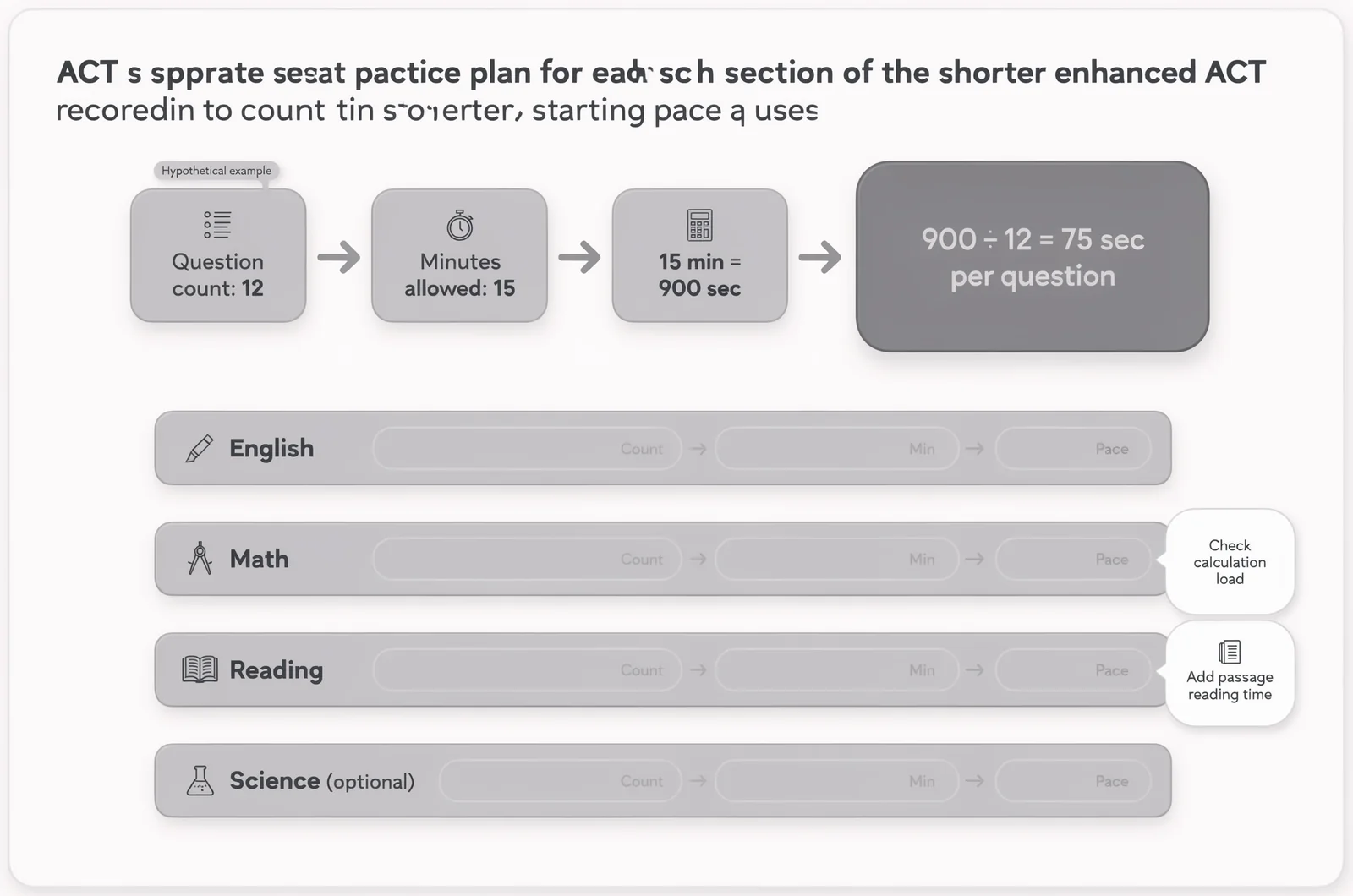
Record counts and minutes together
For each section, keep the question count beside its time limit. Neither number tells you enough alone. A shorter section does not automatically mean you should rush, and fewer questions do not tell you how much reading or calculation each one requires.
Use the specifications for your administration, including any approved timing accommodations. Your preparation should follow those conditions.
Check the practice form itself against those specifications. A recent cover date or an “updated” label cannot establish that its section structure matches. Read the directions and count the questions.
If a resource has useful content but mismatched timing, label it as a drill. Do not quietly substitute its result for a current-format baseline.
Calculate a starting pace
Divide the section’s allowed minutes by its question count, then multiply by 60 to get average seconds per question.
For a hypothetical drill containing 12 questions with a 15-minute limit, the average is 75 seconds per question. That average is a planning aid. Some questions will take less time; others will need more.
A simple pacing calculator could accept your question count and allowed minutes, then display average seconds per question and a halfway checkpoint. Editable inputs would let it reflect your actual instructions and accommodations.
Write your chosen checkpoint on your practice log before starting. Afterward, compare the checkpoint with where you actually were.
Account for passage reading
English and reading practice need passage-level timing as well as question-level timing. Reading the passage consumes part of the same section budget.
During a rehearsal, note where you were at one planned checkpoint without interrupting the test. During review, identify whether delays came from reading, repeated rereading or choosing between answers.
Change one behavior in the next drill. For example, practice finding the supporting sentence before reconsidering every answer choice. Then check whether that change improves both accuracy and completion.
Practice math with four answer choices
Enhanced ACT math practice should prepare you to work with four answer choices. Inspect this directly before trusting a resource’s format label.
An older five-choice problem may still help you practice algebra, geometry or another mathematical skill. Keep it for that purpose. Removing an answer yourself does not turn it into an equivalent current-format question, especially if the removed choice changes the elimination process.
Review how you reached each answer. Did you solve the problem, estimate a reasonable range, substitute the choices or guess? An uncertain correct answer still belongs in your review notes.
Suppose you reach the right choice because two alternatives look unlikely, but you cannot explain the remaining calculation. Treat that as an unresolved skill gap. Redo the problem without the choices, then attempt a fresh problem using the same concept.
Keep calculator habits consistent with your testing instructions. Practice entering expressions accurately, recognizing when mental arithmetic is quicker and checking whether an output makes sense.
Your finished state is specific: you can explain the method, recognize when it applies and complete a fresh problem within your planned pace. Remembering that an earlier answer was “C” does not establish any of those things.
Settle the science choice before a full rehearsal
Your ACT science decision affects the practice session you need to schedule. Settle it before building a full-test routine.
Confirm the arrangement you will actually sit
Science is optional in the enhanced format, but your preparation still needs to reflect your administration and application plans.
Check your registration details. For a school-administered test, confirm the school’s arrangement instead of assuming it matches independent registration. Review the current requirements of colleges or programs you are considering before deciding what to include.
If writing is part of your test, include it in the rehearsal schedule too. Record each section you expect to take on the same page as your timing plan.
Once that arrangement is settled, make the practice sequence match it.
Give science practice its own evidence
If you will take science, preserve study time for it and include it in your full rehearsal. A session that stops before a registered section leaves part of your preparation unmeasured.
During review, distinguish difficulty reading a graph from difficulty following an experiment or comparing explanations. Those problems call for different exercises.
Track science performance separately so you can see what needs work. Use the scoring instructions supplied with the practice form for any reported score.
If you will not take science, remove it from your simulated test schedule and assign that study time to a documented weakness in a section you will take.
Make a full practice run resemble your test day
A full ACT rehearsal should show what you can complete under the conditions you expect to face. Decide those conditions before opening the first question.
Preserve the clock and section sequence
Use an uninterrupted block of time, the correct section order and only the breaks allowed by your instructions. Put your phone away and prepare permitted materials in advance.
For paper testing, include recording answers on the answer sheet. For online testing, practice the navigation tasks your testing interface requires. Familiarity with answering questions in a browser does not establish familiarity with every test interface.
Keep permitted calculator use consistent. Do not pause to look up a formula, check an explanation or finish one last calculation after time expires.
If an interruption happens, record it. You can still review the work, but label the session accordingly. A practice result with ten extra minutes should remain visibly different from one completed within the limit.
Separate timed performance from later understanding
When the timer ends, mark your stopping point and preserve the answers you had at that moment. Make later corrections separately.
Review unfinished questions without the clock. This helps distinguish a skill gap from a pacing problem. A question you solve independently afterward needs different treatment from one you still cannot solve.
Use the conversion information belonging to that practice form. Do not borrow a chart from another booklet or treat a percentage correct as an interchangeable scaled score.
Record whether the questions were new. Repeating a familiar form can show whether you corrected earlier errors, but recognition makes it a weaker readiness check.
Schedule review time alongside the rehearsal itself. Leave enough room to inspect uncertain correct answers as well as misses. For the next comparison, choose fresh material and preserve the same testing conditions.
Use the final month to repair repeated errors
The final month of ACT preparation should connect each practice result to a specific change in your next session. More completed questions alone will not tell you whether a recurring problem has improved.
Start with a baseline and a short error log
Early in the month, complete a format-matched rehearsal. Use it to identify a small set of recurring problems you can address between longer sessions.
Keep the error log brief enough to maintain. Each entry should identify the question, the reason for the mistake, the correct reasoning and the date you will revisit the skill.
Useful distinctions include misunderstood content, missed evidence, calculation errors, misread directions and time pressure. Record the actual cause when you can identify it. “Careless” is too broad to guide another practice session.
For example, repeatedly missing a limiting word in a question calls for a different correction from misunderstanding the underlying concept. Write the missed word beside your correction.
Alternate focused work with fresh checks
Use short sessions between full rehearsals to address the problems in your log. Each session should end with a fresh attempt that requires the same skill.
When using Exam Dumpster’s study mode, attempt the question before opening its explanation. Compare the reasoning with your own work, then close the explanation and reproduce the method independently.
Do not count an immediate repeat as proof of mastery. Return to the skill later and use a different question when available.
For passage questions, identify the evidence that supports the answer. For math, show the calculation or explain the shortcut. For science, describe how the data supports the conclusion.
Keep the review focused enough to finish. One corrected misunderstanding with a successful fresh attempt gives you a clearer result than an unfinished list of topics.
Protect the last week from noisy comparisons
Later in the month, use another fresh timed run to check whether your corrections hold under pressure. Compare accuracy, unfinished work and checkpoint timing under equivalent conditions.
In the final week, revisit persistent errors and rehearse the mechanics of your test arrangement. Confirm your permitted materials, section selections and timing instructions.
Avoid treating a sudden high score on familiar questions as a reason to abandon unresolved work. Equally, inspect a low result before reacting: identify whether it reflects a content gap, an interruption or a mismatched form.
End your final study session with a short list of specific items to review, then prepare the materials required for test day.
Questions about older tests and readiness
Older ACT materials can remain useful when their role is clear. Resolve these questions before including them in your readiness record.
Can I keep using an older practice book?
Yes, for skills that remain relevant to your preparation. Check individual exercises against what you need to study, and separate them from current-format simulations.
Keep the book’s original directions intact. If its counts, timing or answer choices differ, label the work as an older-format drill.
Should I take another full test after every weak result?
First review the weak result. Another full test is most useful after you have addressed a specific problem and want to see whether the correction transfers.
If the cause is a misunderstood concept, complete targeted work first. If it is pacing, rehearse the section with a planned checkpoint. Record the change you intend to test.
When is a practice score useful for judging readiness?
Use a score when you can explain the conditions behind it: the form, format, section selection, time limits and scoring instructions.
Several comparable results provide a more useful basis for planning than one unusually strong attempt. Keep practice scores as estimates, preserve their limitations and check whether your recurring errors are actually decreasing.
ACT preparation and score follow-up
Open a free sample set for their exam code, then create a free account to unlock the rest and save progress Get started |  |