What an ACT Test Sample Questions Video Won't Show You
By ExamDumpster Editorial Team· (updated Sep 29, 2026)

Watching someone else work through ACT test sample questions feels productive. You nod along, the explanations make sense, and you close the tab feeling ready. Then you sit down with a real section and the clock eats you alive. This article walks through what a walkthrough video does well, where it quietly stops short, and how to turn the same question types into scored practice you can actually measure.
Video: Finra Series 7 Exam Sample Questions With Detailed Explanations Practice Smart
The video at the top of this page is a representative example of the format: a host reads a question aloud, talks through the answer choices, and lands on the correct one. That structure is genuinely useful for one specific job, and it is close to useless for another. Knowing which is which saves you weeks.
What a Walkthrough Video Actually Gives You
A good walkthrough does something a static answer key cannot. It shows the reasoning path out loud. When the host eliminates two choices and explains why the remaining two are close, you see the shape of ACT thinking rather than just the destination.
That matters most in three places.
English. The section rewards recognizing sentence boundaries and rhetorical purpose fast. Hearing someone say "this is a comma splice, so it's out" builds pattern recognition quicker than reading the same note in a book.
Reading. The video format lets a host demonstrate how to locate a line reference and read the surrounding two sentences instead of the whole passage. That habit alone saves minutes.
Science. Reasoning about experimental design out loud is genuinely hard to learn from text. Watching someone ask "what is the independent variable here?" teaches a repeatable question to ask yourself.
The format also lowers the cost of starting. If you have twenty minutes after dinner and no energy to build a study plan, pressing play beats doing nothing. That is a real benefit, and it is worth naming.
What it does not do is put you under pressure. And pressure is the thing the ACT actually tests.
Where the Format Stops Short
Here is the honest limitation. A video is paced for explanation, not for exam conditions. The host pauses, rewinds, and takes as long as needed on a single item. You will never get that on test day.
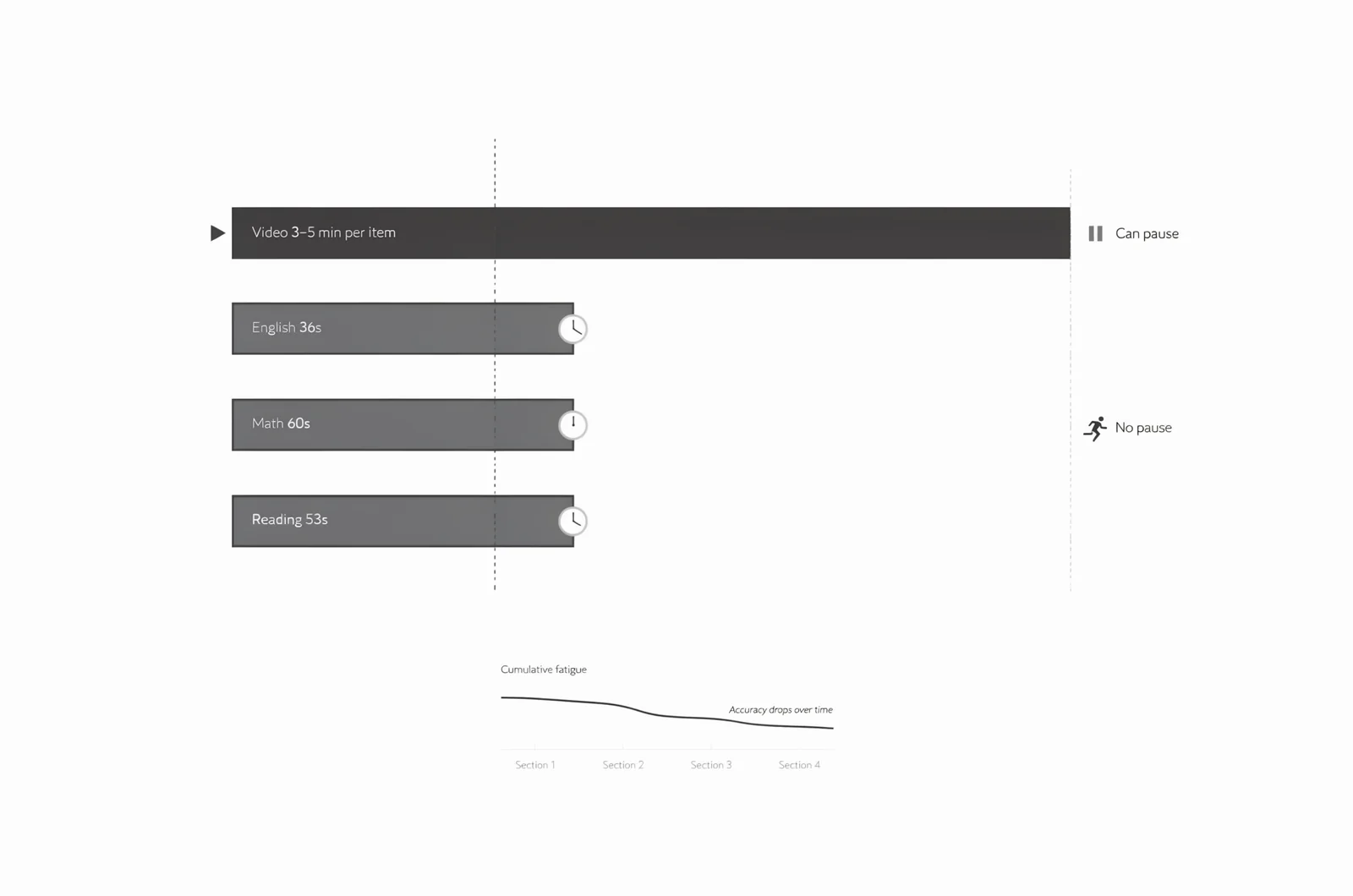
Three gaps show up again and again.
No clock. The ACT gives you roughly 36 seconds per English question, 60 seconds per math question, and about 53 seconds per reading question. A video spends three to five minutes on one item. The ratio is not close.
No cumulative fatigue. Section three of the ACT feels different from section one, and no video reproduces that. Your accuracy drops as the test goes on, and you need to know by how much.
No record. You cannot look back at a video and see that you got 14 of 20 reading questions right under time. Without a score, you cannot tell whether you improved or just got more comfortable.
There is a fourth gap that is subtler. Videos tend to pick interesting questions. Real sections are full of boring ones. If your practice set is curated for entertainment value, your stamina for ordinary questions never gets built.
The Question Types That Keep Showing Up
Across all four sections, a small number of question archetypes account for most of the points. Recognizing them by name is faster than reasoning from scratch every time.
| Section | Recurring type | What it asks you to do |
|---|---|---|
| English | Sentence boundary | Decide whether two clauses need a period, semicolon, or comma-plus-conjunction |
| English | Rhetorical purpose | Choose the option that fits the paragraph's stated goal |
| Math | Word problem setup | Translate a scenario into an equation before solving |
| Math | Geometry with a twist | Apply a formula to a figure that is not drawn to scale |
| Reading | Line-reference detail | Answer using only the cited lines plus immediate context |
| Reading | Main purpose | Identify why the author wrote the passage, not what it says |
| Science | Experimental design | Name the variable being changed and the one being measured |
| Science | Conflicting viewpoints | Track where two scientists disagree and on what evidence |
If you can name the type in the first five seconds, you have already saved time. That naming skill is exactly what a video builds, and exactly what a video cannot test.
Turning Watching Into Scored Practice
The conversion is simple in principle. Take the question types you just watched, and run them under a clock with a recorded score.
Start with a short set, not a full test. Twenty questions in one section, timed at real pace, is enough to expose whether you actually internalized the method. Score it. Write down which types you missed. Then go back to the video only for those types.
A workable weekly loop looks like this:
- Watch one walkthrough segment covering a single question type.
- Immediately run 15 to 20 questions of that type, timed.
- Log the score and the miss reasons in one sentence each.
- Repeat the type at the end of the week to check retention.
- Once three or four types are solid, run a full timed section.
The fourth step is the one people skip, and it is the one that tells you whether the learning stuck. Retention beats exposure.
For the ACT specifically, the ACT sample questions bank lets you drill by section with an explanation attached to every answer, so a miss tells you why rather than just that you were wrong. Half of the sample set opens without an account, which is enough to test whether the format works for you before you commit to anything.
If you are weighing the ACT against other ACT-produced assessments, the same drill-and-explain approach applies to ACT WorkKeys practice questions, which cover workplace-oriented reading, math, and locating information.
Building a Timed Set From a Video
You do not need a formal question bank to start. You need a clock and a rule.
Pick ten questions from the video's topic. Set a timer for the real per-question pace. Do not pause. Mark anything you guessed with a dot, even if you got it right. When the timer ends, score it two ways: raw correct, and correct-minus-guesses. The second number is your honest readiness signal.
Guessed-but-correct answers are the most dangerous kind, because they inflate your confidence without building skill. Tracking them separately is the single highest-value habit in ACT prep.
One caveat on pacing: the per-question averages are just that, averages. Some English items take fifteen seconds and some take ninety. If you hold yourself to a rigid 36 seconds on every single question, you will rush the ones that deserve care and waste time on the ones that do not. Track your total section time instead, and note which question types consistently run long for you. That is the number worth fixing.
What to Do With a Wrong Answer
A wrong answer is only useful if you extract a reason. Three categories cover almost everything:
- Content gap. You did not know the rule or formula. Fix by review.
- Process error. You knew the rule but applied it wrong or ran out of time. Fix by slower repetition, then speed.
- Misread. You answered a different question than the one asked. Fix by underlining the actual ask before reading the choices.
Most students assume every miss is a content gap. In practice, misreads and process errors usually outnumber them, and they are cheaper to fix.
Keep a running tally by category for two weeks. If misreads lead, your fix is a reading habit, not more content review. If process errors lead, your fix is slower untimed reps until the method is automatic. Only if content gaps lead should you go back to the video or a reference sheet. Sorting misses this way turns a vague feeling of "I need to study more" into a specific next action.
Reading the Explanations Like a Coach
An explanation is not a confirmation that you were right or wrong. It is a model of how a strong test taker thinks. Read it that way.
When an explanation says a choice is wrong because it "answers a different question," that is a reusable rule, not a one-off. Collect those rules. After twenty questions you will have a short list of your own recurring traps, and that list is worth more than any single practice set.
Watch for explanations that only justify the correct answer and skip the distractors. Those are weaker study material, because the distractors are where the test maker did the work. A good explanation tells you why each wrong choice was designed to look tempting.
Exam Dumpster attaches an explanation to every answer for this reason. The point is not the score. The point is the pattern you extract from the misses.
The same standard shows up in other exam families, which is why a well-built set in any subject tends to look alike. A Finra Series Exam Sample Questions walkthrough, for instance, follows the identical rhythm: state the scenario, eliminate the near-misses, then explain why the survivor wins. If a set cannot explain why the wrong choices were built to tempt you, it is a quiz, not a study tool.
Building a Study Week Around Evenings
Most people preparing for the ACT are doing it after school, after work, or between other commitments. A plan that assumes two free hours a day will collapse by Wednesday.
A realistic week looks like this:
- Two weeknights, 30 minutes each. One question type per night, timed, scored, logged.
- One weekend block, 60 to 90 minutes. A full timed section, then review of every miss.
- One short session, 15 minutes. Flashcards or a re-run of a type you missed earlier in the week.
That is roughly three hours a week, and it beats a single four-hour cram session because retention depends on spacing. Saved progress matters here. If your practice tool does not remember where you stopped, you lose ten minutes every session rebuilding context.
The failure mode to watch for is the missed week. Life happens, and one skipped week is not a crisis. Two skipped weeks in a row usually means the plan was too ambitious to begin with. If that happens, cut the weekend block to 45 minutes rather than dropping it entirely. A smaller plan you actually run beats an ideal plan you abandon in October.
Judging Whether a Practice Set Is Worth Your Time
Not every free set is built for the current test. A few checks separate useful material from filler.
Does it name the section and question type? Sets organized by type let you target weaknesses. Sets organized randomly are only good for stamina.
Does every answer have an explanation? If wrong answers come with a letter and nothing else, you cannot extract a rule.
Is it timed? Untimed practice builds accuracy without building pace, and pace is where most score is lost.
Does it save your progress? If you cannot see your last five scores, you cannot see improvement.
Is it honest about what is free? A set that blurs every question behind a paywall wastes the ten minutes you spent finding out.
These five checks take about two minutes and save hours. The same standard applies when you compare free sets across providers, which is the approach behind this breakdown of sample question sets ranked by realism.
One more check that rarely gets mentioned: does the set tell you which test version it was written for? Question banks built for retired formats still look fine on the surface, and you only find out when a topic you studied never appears on the real section. If a provider will not say which version its material tracks, treat that as a warning rather than a neutral detail.
Questions People Ask Before They Start Drilling
How many practice questions should I do before test day? There is no magic number, but coverage matters more than volume. Aim to hit every question type at least three times under time before you sit the real thing.
Is watching a video enough on its own? No. Video builds recognition. Only timed, scored practice builds the pace and stamina the test measures.
Should I practice one section at a time or mix them? Both, in that order. Isolate a type until you can name and solve it reliably, then mix sections to rebuild the switching cost the real test imposes.
What score should I be hitting in practice? Track your trend, not a single number. Three consecutive timed sets with a rising correct-minus-guesses score is a better signal than one good day.
How far ahead should I start? Four to eight weeks of consistent short sessions covers most ground. Starting earlier only helps if the sessions stay short enough to actually happen.
Do I need a paid question bank to improve? Not necessarily, but you do need explanations and a clock. Free sets that offer both can carry you a long way. What you cannot do is improve on a set that gives you a letter and nothing else.
After the Practice Set
Once you have a few timed sets logged, the next question is what happens to the score. Understanding ACT score release dates and how to check them removes one more unknown from test day, and it is worth reading before you register rather than after.
The video got you oriented. The clock is what tells you the truth.
Where to Take the Next Timed Set
Open a free sample set for their exam code, then create a free account to unlock the rest and save progress Get started |  |