Renew Cisco Certs With CE Credits: Your Active Recert Checklist
By ExamDumpster Editorial Team· (updated Oct 27, 2026)

Use this Cisco continuing education credits renewal guide to audit an active Associate, Specialist, or Professional credential before its expiration date. The task has several parts: establish your credit target, choose eligible learning, complete the requirements, check that credits are accepted, and verify the renewed certification record. Start with your exact expiration date and Cisco’s current requirements for your credential.
Keep your certification record and the applicable Continuing Education program information open beside this checklist. Copy policy-dependent numbers directly from those records, including the required credits and submission deadlines. That gives your renewal plan a clear starting point.
Run these six checks against your Cisco record
Your Cisco renewal audit should produce a record you can check in one sitting. Use this short checklist first, then work through any unresolved items in the sections below.
- Identify the active credential. Record its full name, level, status, and expiration date. If you hold several certifications, create a separate entry for each one.
- Confirm the renewal route. Find the current requirement for recertification entirely through CE credits. Record any exam-and-credit alternative separately so the requirements stay distinct.
- Count accepted credits. Separate credits already recognized in your account from completed activities awaiting a claim or review. Record planned learning in another column.
- Validate the remaining activities. Confirm each activity’s eligibility, stated credit award, completion requirements, and applicable deadlines before committing time or money.
- Schedule completion and submission. Give each activity a finish date and each claim a submission date. Leave time to correct incomplete evidence or resolve an account discrepancy.
- Check the renewed record. Confirm the certification’s status and updated expiration date in Cisco’s tracking system. Save the confirmation alongside your completion evidence.
A check is finished when you have the corresponding record or confirmation. A course purchase, enrollment email, or personal estimate of study hours leaves work outstanding. Write the unresolved action beside that item.
Match the credit target to each active credential
The credit target belongs to the certification and renewal route you are auditing. Establish that target before choosing a course or calculating your remaining workload.
Copy the requirement for your certification level
For an Associate credential such as CCNA, find the applicable Associate recertification requirement and record the CE-only target. Include the date you checked it so you can revisit the same requirement if your plan changes.
For a Specialist credential, identify the exact certification name. A Specialist certification and a Professional certification are different credentials, even when their names appear within the same broader certification path. Check the rule attached to the credential you actually hold.
For a Professional credential such as CCNP, record the Professional requirement and any conditions attached to your selected route. If you are considering an exam-and-credit combination, give that option its own calculation.
Your finished entry should answer a specific question: “What must I complete to renew this active certification through this route?” If the answer still depends on a remembered number or an old discussion post, resolve that uncertainty before buying training.
Keep several certifications on separate lines
When you hold multiple Cisco credentials, list their expiration dates individually. Check which renewal activity applies to each one and how Cisco treats that activity across your active certifications.
Avoid adding every displayed credit target together without checking the relationship between the credentials. Equally, avoid assuming that reaching one target updates every badge.
If renewal is also prompting an upgrade decision, the CCNA vs CCNP difficulty guide can help you assess the additional study commitment. Keep that career decision separate from the deadline attached to your existing credential.
Choose learning with a documented CE award
A useful Cisco renewal activity needs a verifiable credit award and completion requirements you can meet. Technical relevance alone does not establish eligibility.
Confirm eligibility before paying
Locate the exact activity in Cisco’s applicable CE information. Match its title and identifier, where available, to the course or event you intend to complete.
Record the stated credits and the work required to earn them. Check whether the activity requires assessments, attendance, labs, or another form of completion. Also check any restrictions on repeating an activity you have already completed.
A course description may explain its subject well while leaving the CE details unclear. Resolve those details before enrollment. Keep a copy of the applicable award information with your planning notes.
Treat conference sessions, webinars, employer training, and third-party courses the same way: verify the specific activity. A Cisco-related title or attendance certificate is insufficient evidence of an approved award by itself.
Budget for the remaining work
Compare the total cost of eligible activities with the credits you still need. Include the time required for assessments and labs, access limits, and any travel or scheduling constraints.
For an after-work learner, an affordable course can still be a poor fit if its completion requirements exceed the evenings available. Put the learning sessions on your calendar before purchasing access.
Check whether your employer already provides access to an eligible activity. Confirm the exact offering and completion requirements before counting it toward renewal. Access to a broad training library does not establish the award for an individual course.
Keep course access and certification deadlines on separate lines. If access ends first, that becomes an earlier planning constraint. Save evidence of successful completion while you can still reach the relevant records.
Schedule completion, claims, and confirmation separately
Your Cisco renewal calendar should show when learning ends, when evidence must be submitted, and when you will check the result. Each date answers a different question.
Work backward from the applicable deadlines
Begin with the expiration date displayed for your active certification. Then record the current rules governing activity completion and credit submission.
Check whether an activity has its own claim window. Where more than one deadline applies, plan around the earliest applicable limit. Keep the activity’s completion date and claim deadline together in your notes.
Set a personal finish date ahead of those limits. The gap gives you time to repeat an assessment, retrieve missing evidence, or resolve a discrepancy. Your planning buffer does not extend an official deadline.
For shift work, schedule realistic study blocks against your actual rota. Include the final assessment in the plan. Finishing the videos while leaving the required assessment outstanding leaves the activity incomplete.
Reserve time to correct a problem
Add a calendar reminder to inspect the credit record after submission. Follow any processing guidance supplied for the activity or claim.
If a credit award does not appear as expected, compare the activity identifier, completion date, evidence, and account details. Keep the submission confirmation available when you contact the relevant support channel.
Avoid relying on an alternative exam that you have only considered. An exam route needs its own eligibility check, preparation time, appointment availability, and completion deadline.
If an exam becomes your chosen alternative, Exam Dumpster’s CCNA 200-301 practice tests can support preparation for that exam. Record practice separately from the activities you intend to submit for CE credit.
Keep a credit ledger you can reconcile
Your Cisco credit ledger should make the remaining gap visible without requiring you to reconstruct several months of learning.
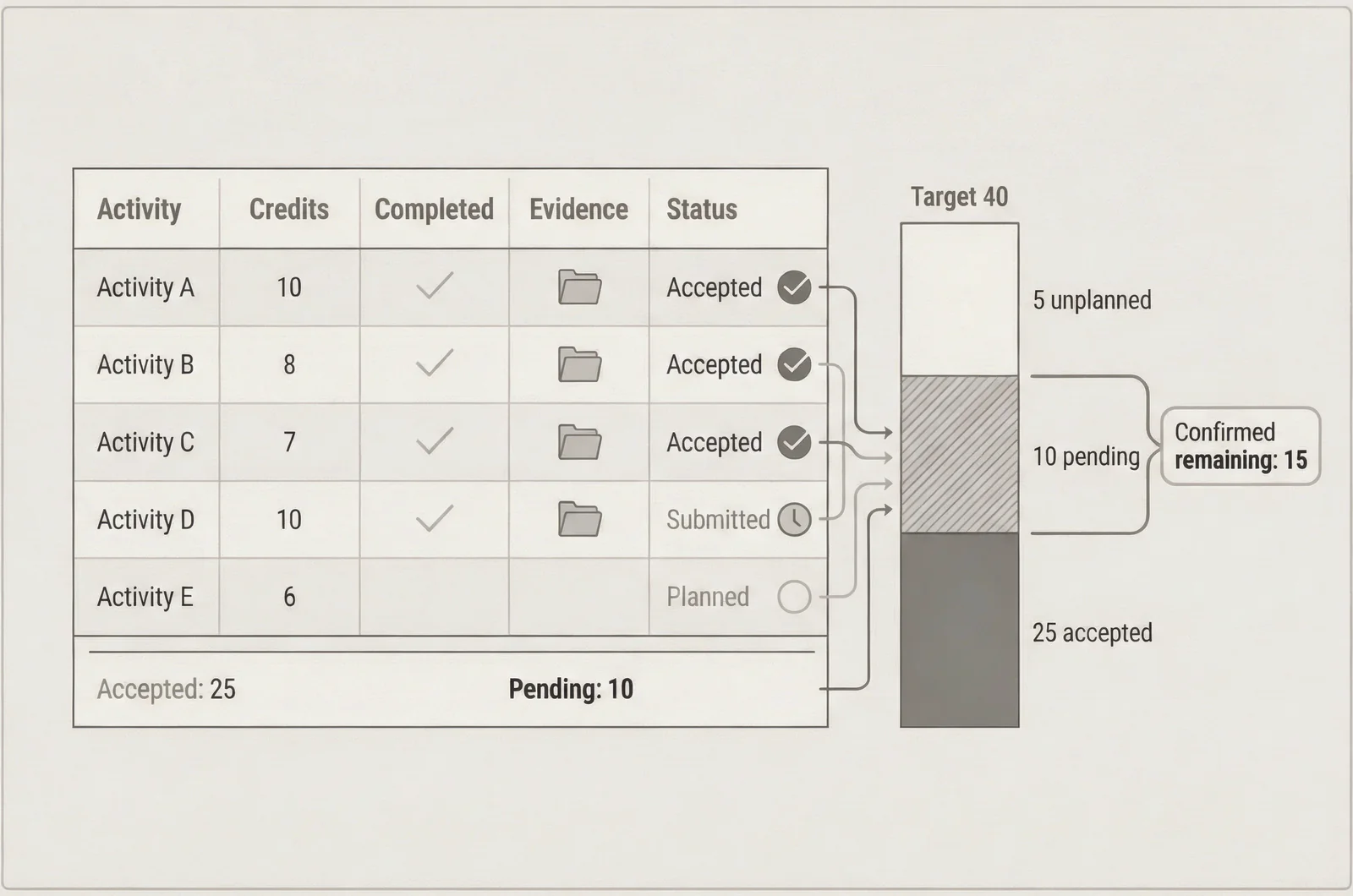
Use one row per activity. Include its exact title, identifier, stated credits, completion date, evidence location, submission date, and current status. Distinguish planned, in progress, completed, submitted, and accepted entries.
Calculate your confirmed remaining requirement from accepted credits. Keep pending claims visible beside that calculation so you can judge how much uncertainty remains.
For a hypothetical example, suppose your verified target is 40 credits. You have 25 accepted credits and another 10 awaiting review. Your confirmed gap is 15 credits. If the pending award is accepted, the remaining gap becomes five.
That distinction matters when deciding whether to schedule another activity. A pending award may change your plan, but its outcome remains unresolved.
Retain the original completion evidence and submission confirmation. Use clear filenames that include the activity and completion date. Keep any correspondence about a correction with the same record.
A small credit-gap calculator would be useful here. It could accept your verified target, accepted credits, and pending credits, then display both the confirmed gap and the gap if pending awards are accepted. It should leave the Cisco requirement for you to enter.
Reconcile the ledger against your account whenever an award changes status. Investigate differences while the activity details are still easy to retrieve.
Resolve questions that can derail a renewal plan
Cisco renewal questions become easier to handle when you identify the exact missing fact. Use these checks when your account, activity evidence, or chosen route leaves uncertainty.
Can practice questions count toward CE renewal?
Check whether the exact activity has an applicable Cisco CE award. A practice score measures performance within that practice session; it does not establish eligibility for continuing education credit.
Exam Dumpster’s CCNA sample questions can help you assess preparation if you are considering an exam route. Keep the resulting scores in your study record. Enter an activity in your CE ledger only after verifying its eligibility and award conditions.
What if a completed activity has missing credits?
Check the activity’s instructions to establish whether you need to submit a claim or follow another process. Confirm that you met every completion requirement.
Compare the expected award with the exact activity identifier. Gather the completion evidence, submission confirmation, and relevant account details before requesting help.
If a claim was returned or rejected, address the stated reason. Preserve the correspondence and record the corrected submission date in your ledger. Keep the item marked unresolved until the account reflects the accepted award.
What if the certification has already expired?
Check the current Cisco rules for the credential’s displayed status before continuing with an active-certification renewal plan. The route available to you needs to match that status.
Do not assume that recent course completion, unused credits, or an open support request changes an expiration date. Ask for clarification where the applicable rule is unclear.
Once you establish the available route, rebuild the plan around its actual requirements. Keep any written clarification with your certification records.
Should you choose CE credits or an exam?
Compare the remaining effort and total expense of the routes available to you. Consider accepted credits, eligible learning you still need, exam preparation, and the time left before expiration.
CE learning may fit your current work goals. An exam may fit an upgrade plan or a subject you are already studying. Neither choice removes the need to verify the applicable renewal requirements.
Write down one primary route and the reason you chose it. Reassess that choice if an activity becomes unavailable or the remaining schedule stops being realistic.
Verify the updated certification record
Your renewal audit ends with the certification record. Once you believe you have completed the requirements, check both the credit history and the credential itself.
Confirm that the expected awards appear with the correct activity details and accepted status. Recalculate your total from the account entries. Investigate any difference between that total and your ledger before marking the credit requirement complete.
Next, open the record for the certification you intended to renew. Verify its status and displayed expiration date. If you hold several credentials, inspect each one affected by the renewal activity.
Save a dated copy of the relevant confirmation. Put it beside your credit ledger, completion evidence, and any support correspondence. Record the expiration date exactly as displayed, rather than calculating a new one yourself.
If accepted credits appear sufficient but the certification record has not changed as expected, follow the current processing guidance. When you need support, provide the credential name, relevant activity identifiers, acceptance details, and the discrepancy you can see.
Keep unresolved items open until the records agree. That prevents a completed course from being mistaken for a completed renewal.
Finally, set reminders for the next displayed expiration date and a personal review date ahead of it. Your immediate task is concrete: reconcile accepted credits, verify the credential’s updated status, and save the evidence.
Prepare for CCNA check-in if you choose an exam
Open a free sample set for their exam code, then create a free account to unlock the rest and save progress Get started |  |