CCNA vs CCNP Difficulty: Where the Gap Actually Shows Up
By ExamDumpster Editorial Team· (updated Oct 12, 2026)
You have a CCNA, or you are close, and the next question is whether CCNP Enterprise is a sensible next exam or a long detour. The CCNA vs CCNP Enterprise difficulty gap is real, but "harder" bundles three different things: more exam time, a different style of question, and a blueprint that assumes you already own the basics. This article pulls them apart using Cisco's published structure, with 200-301 on one side and 350-401 ENCOR plus one concentration exam on the other. You will see which parts of CCNP ask for better design judgment, which parts only add volume, and what that means for a study plan that fits around work.
Cisco publishes no pass rate, so the exam structure is the ruler
Any fair comparison of CCNA and CCNP Enterprise starts with what can be checked. Cisco publishes no pass rate for either certification, so there is no official failure percentage to quote. The structure is public, though, and Certworthit's comparison page sums it up: CCNP Enterprise takes two exams and 210 minutes of exam time, against one 120-minute CCNA exam, and the core exam's topics assume CCNA-level knowledge and go deeper.
The table lays out how the pieces fit.
| CCNA 200-301 | ENCOR 350-401 (core) | Concentration exam | |
|---|---|---|---|
| Exam time | 120 minutes | 120 minutes | 90 minutes |
| Role in the credential | The whole certification | Required core of CCNP Enterprise | Required, and you pick one |
| What it asks | A broad working foundation across networking, security, services and automation | Whether you can apply that foundation to larger, more complex enterprise networks | Deeper skill in one area, such as advanced routing, SD-WAN or design |
Concentrations include ENARSI 300-410 for advanced routing, ENSDWI 300-415 for SD-WAN and ENSLD 300-420 for design. Cisco's list also reaches into areas such as automation, cloud connectivity and network assurance. Check the current menu before you commit, since Cisco revises it.
Lab and simulation load is the part nobody can measure from outside. Cisco does not publish how many items on either exam are simulations, drag-and-drops or plain multiple choice, so treat any precise "lab percentage" as hearsay. The clock is checkable. ExamCert estimates ENCOR at roughly 90 to 110 questions in 120 minutes, which works out to about 65 to 80 seconds per question before a lab-style item takes more than its share. Pacing is a second difficulty that sits on top of the knowledge.
The parts of the gap that are just volume
Some of what makes CCNP Enterprise feel harder than CCNA is simply more of everything. The concentration exam adds 90 minutes, a second blueprint, a second fee and a second chance of needing a retake. ENCOR itself packs enterprise architecture, infrastructure, assurance, security and automation into one 120-minute sitting. The core blueprint is also a moving target, with a 2026 revision covered below, so material written for an earlier version can send you down dead ends.
None of that makes a single question harder. It makes the total job longer and the cost of studying the wrong thing bigger. For someone who studies after work, two exams mean two study blocks, two booking dates and two chances for a rough week to wreck the plan. Volume is a genuine part of the gap, and the easier part to plan for: 210 minutes instead of 120, and two blueprints instead of one.
The parts that demand real design judgment
Judgment is the part of the gap that extra study hours do not fix on their own, because it changes what a question wants from you. ITU Online IT Training puts the shift well:
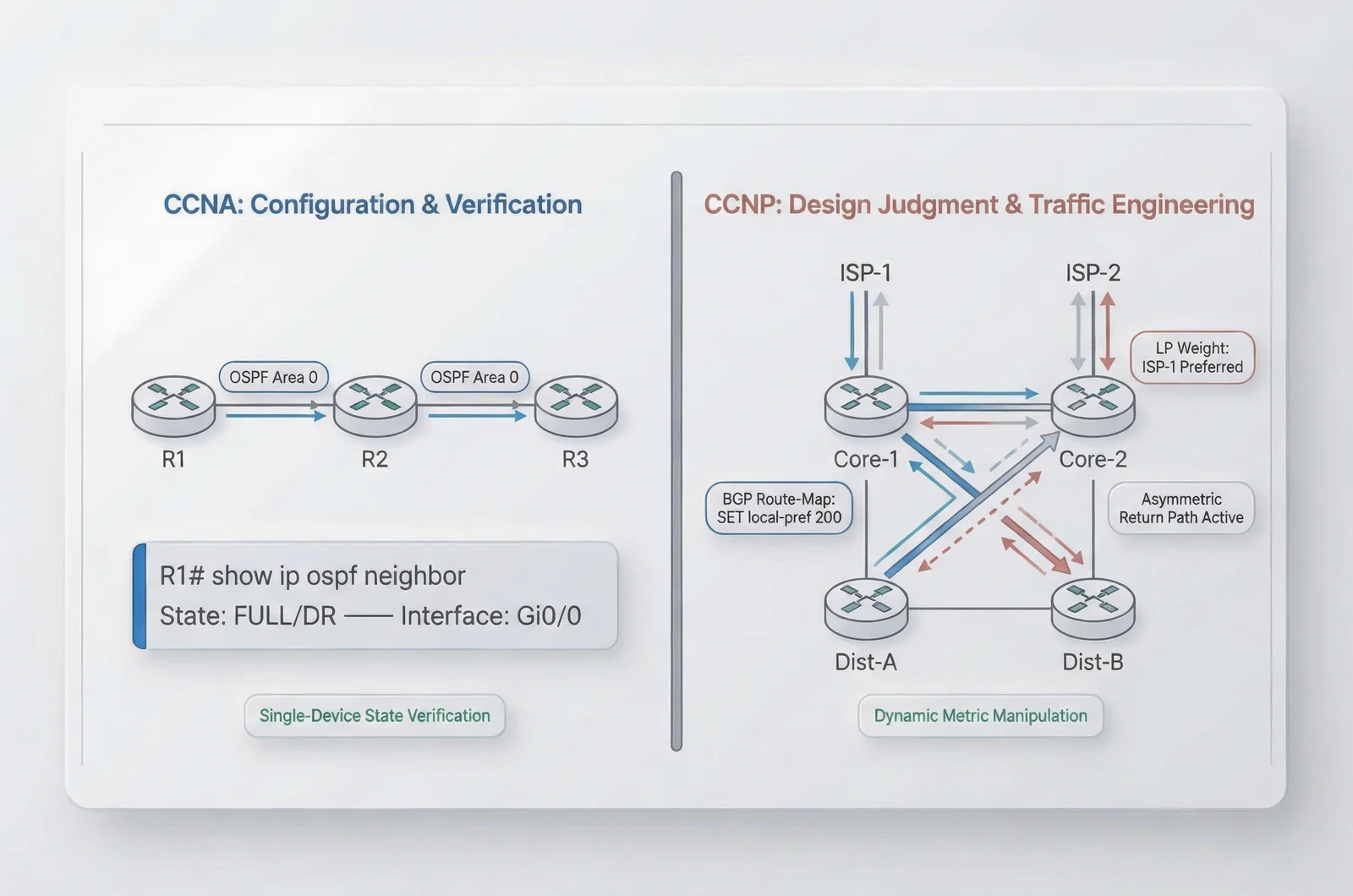
The divergence starts when the questions stop asking, "Can you make this work?" and start asking, "Why is this working this way, and what happens if one variable changes?"
— ITU Online IT Training, "How To Transition From CCNA To CCNP Enterprise Certification"
Routing and WAN: predicting what changes
At CCNA level you configure OSPF and static routes, then read the routing table to confirm they work. At CCNP level, routing and WAN questions lean toward prediction. Which path will traffic take after a cost changes or a BGP policy is applied? What breaks if a redundant link fails? SD-WAN and SD-Access add a design layer: what an overlay buys you, what it costs in complexity, and when the traditional approach is still the right answer. Candidates who memorized commands get exposed here, because a command list does not tell you what a network will do after a change.
Security and automation: reading the evidence
CCNA's Security Fundamentals domain covers basic controls such as AAA, port security and access lists, mostly at the describe-and-configure level. A professional-level question asks which control belongs where and what it disrupts when placed badly. Automation shifts the same way. CCNA gives Automation and Programmability a 10% domain built around concepts such as REST APIs and JSON. Reading a short Python script or an API payload and predicting its result is a different skill from remembering what a REST verb does, which makes it a likely trouble spot for network engineers who have never written code.
Domain weighting shows where the marks come from
The domain split tells you where a CCNA-level weakness will hurt most once you move up to CCNP Enterprise. Cisco's 200-301 topics weight six domains: Network Fundamentals 20%, Network Access 20%, IP Connectivity 25%, IP Services 10%, Security Fundamentals 15% and Automation and Programmability 10%. IP Connectivity is the biggest block, and it matters most when you step up, because ENCOR's topics assume CCNA-level knowledge and go deeper.
ENCOR's blueprint is the moving part. According to CCNPTest's August 2026 breakdown, the exam now runs on version 1.2, effective March 19, 2026. That revision renamed the automation domain to Automation and Artificial Intelligence, put Security at 20% of the blueprint, folded Cisco Catalyst Center AI-powered workflows into Network Assurance and moved wireless topics out to the wireless specialty track. That is one site's summary, so open the exam topics page on Cisco's site and check each percentage before you plan around it.
Two practical effects follow. Practice material written for an earlier version may spend your evenings on wireless content that has left the core exam. And at 20%, Security is too large to skip on a core exam, while CCNA's Security Fundamentals share is 15%. When you plan, write each domain's percentage next to the evenings you give it, then check that the evenings match the marks.
What CCNP assumes you already know, even without a prerequisite
Cisco dropped CCNA as a formal prerequisite for CCNP in 2020, so you can sit ENCOR without it. The assumption is the real prerequisite. ExamCert, summarizing Cisco's guidance, notes a suggested three to five years of enterprise networking experience.
Skipping CCNA moves the difficulty rather than removing it. It leaves the exam and lands in your prep, where you learn the associate layer and the professional layer at once. Say you hold a CCNA and run a small campus network day to day: you arrive with the vocabulary and need to add the prediction habit. Someone with neither has to build both together.
A fair readiness test before booking ENCOR is a timed CCNA-level routing and switching set. If you finish with time left and can explain every miss, the base is solid. Opening the CCNA sample questions and timing yourself costs nothing and shows quickly whether routing or security is the soft spot.
A simple gap tracker helps here. List every topic from the ENCOR exam topics page in a spreadsheet and add three columns: can define it, can configure it, can predict what breaks when it changes. The third column is where the judgment gap lives, and an empty one tells you what to study first.
What three published difficulty guides get right, and where they stop
Several prep sites have tackled this question, and the three below agree on the headline while explaining it differently. Read against the structure above, their views fit together.
NetSecCloud: breadth against depth
NetSecCloud: breadth against depth website screenshot for ccna vs ccnp enterprise difficulty gap
The Difficulty Levels of CCNA vs CCNP Exams describes CCNA as a single comprehensive test of fundamentals, naming IP connectivity, IP services, security fundamentals, and automation and programmability among its domains. CCNP, in its telling, requires a competent understanding of complex network solutions, with each track, ENCOR included, demanding expertise in areas like routing and switching. The breadth-versus-depth framing holds up. One caution: the piece describes the associate exam with two different topic lists, one using current domain names and one using older ones such as LAN switching and WAN technologies. Use it for the framing and take exact topics from Cisco.
CrucialExams: the depth argument
CrucialExams: the depth argument website screenshot for ccna vs ccnp enterprise difficulty gap
Is CCNP much harder than CCNA?, published in September 2025, gives depth of knowledge as the main reason CCNP is harder than CCNA. Its comparison is that CCNA is like knowing how to drive a car and CCNP like knowing how to build one, with CCNP demanding more expert understanding and hands-on skill. That analogy fits the judgment side of the gap well. It says little about the volume side, such as the second exam or the version churn, which is where a candidate with a day job gets caught.
TestKing: design, optimize, manage
CCNA vs CCNP in 2025 says many candidates underestimate the distance between the two, treating the professional credential as a harder version of the associate exam. It describes the difference this way:
TestKing: design, optimize, manage website screenshot for ccna vs ccnp enterprise difficulty gap
The CCNA asks you to understand how networks function and how to perform basic configuration and troubleshooting tasks. The CCNP asks you to design, optimize, and manage complex enterprise-grade networks under conditions that require deep analytical thinking.
— TestKing, "CCNA vs CCNP in 2025"
It names advanced OSPF tuning, BGP policy implementation, SD-WAN architecture and network programmability with Python and REST as the topics where the step up shows. That is the most specific of the three, and it matches the judgment list above. It was written for 2025, so it predates the ENCOR changes reported for 2026.
Which exam to sit next, by where you are now
The right pick depends less on the size of the difficulty gap than on how much of it you have already closed.
If you have not passed 200-301 and have little hands-on time, sit CCNA first. Half of Exam Dumpster's CCNA 200-301 practice test sample bank is open to anyone, and a free account opens the second half and saves your attempt history. That lets you see whether routing or security drags your score before you spend money. We sell practice tests, so of course we think timed practice helps. Test that claim on the free half before paying for anything.
If you have years of enterprise work but no CCNA, you can go straight to ENCOR. Expect the trouble to come from exam style and pace rather than from concepts you have never met, and choose a concentration that matches your daily job so the second exam rewards what you already know. If that job touches SD-WAN, SD-Access or ISE, the Cisco enterprise network practice tests cover those technology families on a separate Cisco exam, 500-470, which makes a quick vocabulary check before you pick.
If you hold CCNA and work with routing every day, you are the natural ENCOR candidate. Your gap is mostly volume plus the prediction habit, and the tracker above shows how big it is. Start with the domain where your third column is emptiest.
Whichever route fits, pick the exam code, open its free sample set, time one run and write down the three topics you missed. Those three topics are your first week of study.
Questions people ask before they commit to CCNP
Is CCNP twice as hard as CCNA?
There is no official ratio, because Cisco publishes no pass rate for either. Exam time is 210 minutes against 120, about 1.75 times as much. Per-question difficulty differs in kind more than in degree, as the judgment section shows.
Can I skip CCNA and go straight to ENCOR?
Yes. Cisco has not required CCNA since 2020. ENCOR's topics assume CCNA-level knowledge, so skipping the associate exam means learning that base inside your CCNP prep.
Which concentration is easiest?
Cisco publishes no difficulty ranking, so any "easiest" claim is opinion. Choose the one closest to your daily work. A topic you already troubleshoot at your job costs fewer evenings than one you have never touched.
How do I know a practice test matches the current ENCOR version?
Check that the provider names the exam code, states which blueprint version its questions map to and marks retired exams. With ENCOR reported on version 1.2 since March 2026, a bank that cannot say which version it follows is a risk.
More Cisco practice to size up your next exam
- SCOR 350-701 sample questions
- CyberOps 200-201 sample questions
- SAA-C03 Sample Questions: Drill Them Timed, Review Every Miss
Open a free sample set for their exam code, then create a free account to unlock the rest and save progress Get started |  |