SAA-C03 Sample Questions: Drill Them Timed, Review Every Miss
By ExamDumpster Editorial Team· (updated Oct 11, 2026)

Use SAA-C03 sample questions to complete a repeatable study task: build a balanced block, answer it against a timer, review every miss, and choose what to practice next. For an IT professional studying after work, that routine gives each session a clear finish line. You should leave with a saved result and a short repair list you can use tomorrow.
Start with unseen questions whenever possible. Keep explanations closed until you submit the block. A strong score on questions you recognize can hide a weak understanding of the architecture decisions behind them.
Set up a drill you can finish after work
Prepare your SAA-C03 practice session before starting the timer. You need a browser, a question set labeled with the exact exam code, and somewhere to record uncertain answers.
Exam Dumpster’s SAA-C03 practice simulator is a starting point for this routine. Half of a sample bank is accessible without an account; a free account makes the remaining half available and saves progress. Check how many unseen items you have before choosing a block size.
For a format reference, AWS publishes ten official sample questions with answers. That PDF carries a 2022 copyright, so use it to study scenario structure and consult the exam guide for scope.
Keep a small record with these fields:
- Attempt date and question count.
- Questions seen before.
- Time allowed and time used.
- Correct answers by domain.
- Uncertain answers, including correct guesses.
- Concepts needing another explanation or practice item.
Reserve time for review. A forty-minute test followed by an abandoned answer screen leaves the repair work unfinished.
For this walkthrough, success means submitting within your chosen time, accounting for every incorrect or uncertain answer, and identifying one topic for the next session. Treat that as the completion check for the exercise.
Build a block around the four SAA-C03 domains
Give your SAA-C03 drill a deliberate topic mix. Selecting only familiar subjects makes the result difficult to use.
Allocate twenty questions
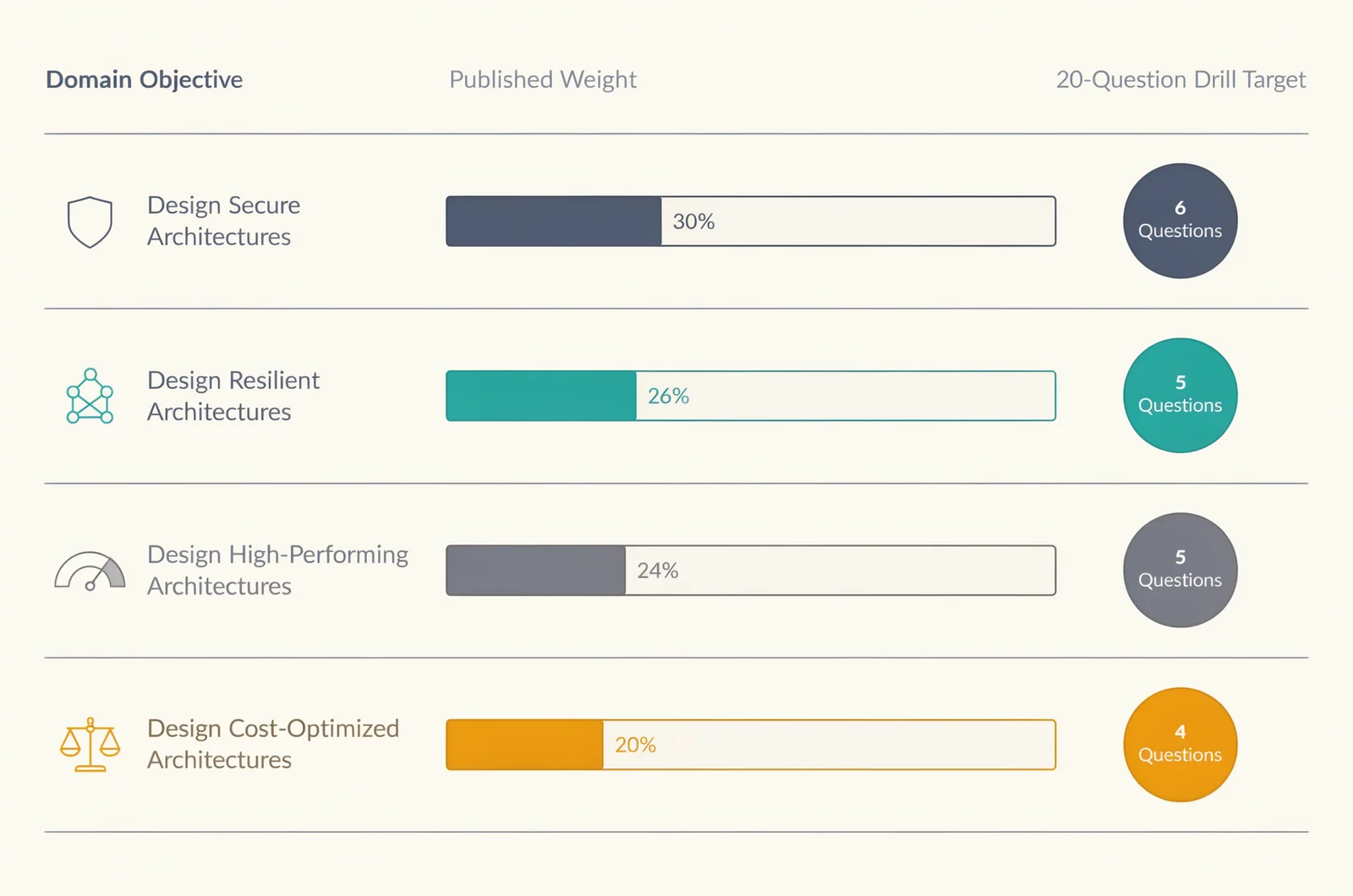
AWS lists four domain weights in its SAA-C03 exam guide. Use them to distribute a twenty-question practice block:
| Domain | Weight of scored content | Suggested questions in a 20-item block |
|---|---|---|
| Design secure architectures | 30% | 6 |
| Design resilient architectures | 26% | 5 |
| Design high-performing architectures | 24% | 5 |
| Design cost-optimized architectures | 20% | 4 |
The question counts are rounded study targets. They do not predict the exact distribution in an individual exam.
If the bank has domain labels or filters, use those to assemble the block. Otherwise, classify items during review. Avoid opening answers just to label questions before testing yourself.
Check that your counts total twenty. If one question crosses domains, assign it to the main decision the prompt asks you to make.
Handle gaps in a small sample
Use a ten-question block when your sample or schedule cannot support twenty. Keep every domain represented across successive sessions, rather than forcing perfect proportions into each small set.
Record missing coverage explicitly. A sample with no cost questions gives you no evidence about your cost-domain readiness.
A useful interactive block planner would accept your available question count and study time, then calculate rounded domain targets. It should flag missing coverage and display the proposed time budget.
Save some unseen items for a later check. Once you have read an explanation, that question becomes a review item.
Run the timer before opening explanations
Make your SAA-C03 timed block a clean attempt. Close notes, documentation, search tabs, and answer explanations before beginning.
Make a first pass without help
For this exercise, allow two minutes per question: twenty minutes for ten items or forty minutes for twenty. This is a chosen training budget. Adjust it for approved accommodations or a different practice goal.
AWS distinguishes single-answer multiple-choice questions from multiple-response questions with two or more correct selections. Read the selection instruction on every item. The exam contains fifty scored and fifteen unidentified unscored questions, so give every item your attention. These details appear in the official exam guide.
Use the same sequence throughout the block:
- Read the requested outcome and selection count.
- Identify the workload requirement that limits the answer.
- Eliminate choices that violate that requirement.
- Select your best-supported answer and flag uncertainty.
For a twenty-item block, check your position at twenty minutes. Aim to have answered about ten questions. If you are behind, choose your best remaining answer on a difficult item and continue.
Save the attempt before reviewing
Submit when the timer ends. Record the score and time before opening explanations, so later corrections cannot blur the original result.
If a call or work interruption breaks the session, mark the attempt as interrupted. Keep it useful for content review, but compare its timing cautiously.
Count uncertain answers separately from wrong answers. A correct guess still needs review. Your completion check is a recorded result with both categories identified.
Turn each miss into a decision you can explain
Review your SAA-C03 answers while you still remember your reasoning. Open the explanation only after recording why you selected the answer.
Separate a knowledge gap from a reading error
Give each miss one primary cause. Useful categories are unfamiliar concepts, confused service behavior, a missed requirement, an incorrect selection count, or rushed reasoning.
Choose the cause that explains the error. If you understood every service but overlooked a deadline, reading discipline needs attention. If you could not explain what a service does, return to the concept.
Then work through four checks:
- Restate the scenario’s required outcome in one sentence.
- Identify the fact that makes the accepted answer fit.
- Explain why your chosen answer fails that requirement.
- Write a short rule to apply to a different scenario.
Read enough of the explanation to account for the distractors. Knowing why one answer works leaves gaps if you cannot explain why a plausible alternative fails.
Keep repair notes specific. Review compute is too broad to guide tomorrow’s session. Check whether the workload can tolerate interruption before choosing capacity gives you a decision to practice.
Verify the repair by closing the explanation and describing the choice aloud. If you need the answer letter to remember the reasoning, spend another minute on the requirement.
Work through a cost constraint
Use question 6 in AWS’s sample question PDF as a worked review. It describes a processing workload that needs temporary extra capacity, must finish within a deadline, and cannot be interrupted.
AWS selects answer A: add On-Demand Instances during high demand. The explanation rejects Spot Instances because interruption conflicts with the workload’s requirements.
If you chose the cheaper-looking option, record the missed constraint. Your repair rule should connect purchasing choice to workload tolerance: temporary capacity must still satisfy the interruption and completion requirements.
Now change one condition mentally. Suppose the hypothetical workload can resume after interruption and has a flexible deadline. Ask whether that change would make the previously rejected choice worth considering.
This checks whether you understand the trade-off. Keep the original answer attached to the original requirements; changing the scenario creates a separate exercise.
Review correct answers that took too long
Inspect correct answers you flagged or spent excessive time on. Write down what delayed the decision.
Sometimes two services seemed interchangeable. Sometimes you reread the prompt because you had not identified its outcome. Those problems need different repairs.
For a confused distinction, write a short comparison focused on the scenario’s requirement. For repeated rereading, practice stating the requested outcome before examining choices.
Finish the review with a list of unresolved decisions. Carry any item you still cannot explain into the next study session.
Use attempt history to choose the next block
Use your SAA-C03 attempt record to direct study time. The total percentage tells you how the block went; the domain and error notes tell you what to do afterward.
Compare first attempts with first attempts
Keep results from unseen questions separate from repeat attempts. Shuffling a familiar set changes its order while preserving its content.
Exam Dumpster’s saved attempt history can keep the timed score available across sessions. Pair that result with your own domain counts and repair notes so the next session starts with a defined task.
Suppose you answer sixteen of twenty questions correctly:
- Security: 3 of 6.
- Resilience: 4 of 5.
- Performance: 5 of 5.
- Cost: 4 of 4.
The overall result is 80%, but three of the four misses sit in security. Review those errors before choosing another block.
The small counts also limit the result. Four correct cost answers provide a narrow sample of that domain. Record the denominator beside every percentage.
Rank repairs by weight and repetition
Prioritize weaknesses using domain importance, repeated errors, and your ability to explain the accepted answers. Avoid inventing a pass prediction from those inputs.
In the hypothetical result above, make security the next repair session. If several misses involve the same decision, study that decision first and answer a few different questions about it.
Then return to a mixed block. You need to check whether the repaired concept holds up when the next question’s topic is unpredictable.
Distinguish a repeated concept error from repeated wording confusion. The first needs technical study. The second needs deliberate prompt reading.
Verify progress on different items after a gap between sessions. Record whether you can identify the deciding requirement and reject a plausible alternative without opening the explanation.
Fit testing and repair into short study sessions
Give SAA-C03 testing and review separate space in your week when one uninterrupted hour is difficult to find. Use a session boundary to preserve focus.
On an evening with thirty minutes available, run ten unseen questions in twenty minutes. Use the remaining ten minutes to record the result and sort wrong or uncertain answers. Save unfinished explanations for the following session.
During the next thirty-minute session, spend twenty minutes repairing the most repeated concept. Use the last ten minutes for a small check with different questions, if available.
On a day with more time, run the twenty-question mixed block. Allow forty minutes for answering and reserve review time afterward. Extend the review when the errors need more work.
Write one specific task before stopping:
Review the missed security decisions, then answer five different items without notes.
That instruction gives the next session a starting point.
If fatigue produces several missed selection instructions or repeated rereading, mark it in the record. Compare with another session before assigning all those errors to technical knowledge.
For a longer simulation, use the exam’s published overall time limit and a sufficiently broad question set. Keep short samples useful for diagnosis; record their size whenever you compare results.
What your SAA-C03 practice score can tell you
Interpret your SAA-C03 results according to the questions you answered and the conditions you used. These decisions matter most when you are considering whether to move from repair sessions to longer simulations.
Does a passing score of 720 mean 72% correct?
AWS reports a scaled score from 100 to 1,000, with 720 as the minimum passing score. It does not establish 72% raw accuracy as an equivalent. See the exam scoring explanation.
Keep your practice percentage as a measure of that practice set. Record timing, prior exposure, and uncertain answers alongside it.
How many sample questions are enough?
Use the available sample to identify weaknesses and assess whether the explanations help you reason through decisions. A short set cannot establish comprehensive readiness.
Continue until you have evidence across all four domains, including different scenarios. If a domain remains absent, seek additional coverage before treating the sample as a readiness check.
Should you repeat a block until every answer is correct?
Repeat missed items to check the repair, then test yourself on different questions. Record both results separately.
A perfect repeat score shows that you can answer that familiar block. Check transfer by explaining a new scenario with changed requirements.
What if an explanation still seems inconsistent?
Record the question identifier, the disputed requirement, and the explanation’s claim. Compare that claim with relevant AWS documentation before turning it into a study rule.
Keep the item marked as unresolved while you check it. Finish the session with a concrete task: repair one recurring decision, then verify it on an unseen question.
SAA-C03 practice and the AWS exam directory
- SAA-C03 timed practice and review
- Amazon certification practice tests
- HSPT Practice Test PDFs: Printable Free Sample Questions To Download
Open a free sample set for their exam code, then create a free account to unlock the rest and save progress Get started |  |