PMP Application Audit Red Flags Ranked by How Often They Trigger PMI
By ExamDumpster Editorial Team· (updated Oct 28, 2026)

If you’re checking PMP application audit process red flags before submitting, start with whether you can substantiate every claim. Your project dates, responsibilities, education, and training should tell a consistent story that another person can verify.
Claims about which errors most frequently trigger PMI audits need verified audit-selection data. There is no established frequency evidence behind this list, so assigning percentages or calling one phrase an automatic trigger would be speculation.
The ranking below reflects editorial judgment about potential consequences: how seriously a problem could undermine your eligibility, followed by how difficult it could make verification. Each entry identifies who should check it, where the concern has limits, and what to correct.
Use PMI’s current application instructions to confirm the requirements for your eligibility route. The discussion of PMP eligibility requirements can help orient that review, but resolve questions against the instructions that apply when you submit.
1. Claiming responsibilities or experience you cannot substantiate
An inaccurate experience claim deserves the highest priority because better wording cannot repair an underlying factual problem. This includes extending participation dates, claiming decisions someone else made, or describing technical delivery as project leadership you never performed.
This check matters most if you are translating a technical job into project-management language. That translation should clarify your work without expanding your authority.
Suppose you coordinated testing for a system migration. You might accurately describe arranging test activities, tracking unresolved issues, and reporting readiness. Claiming that you approved the migration budget would require a different responsibility and supporting evidence.
A formal project-manager title is a separate matter. Someone with another title may have performed relevant responsibilities. The application still needs an accurate account of those responsibilities.
Compare each description with records you can legitimately consult, such as plans, meeting notes, assignments, or status reports. Ask whether someone familiar with the work would recognize your account.
If a sentence sounds stronger than the evidence, narrow it. If the experience itself is unsupported, resolve that gap before submitting. Keep the version your records and verifier can support.
2. Presenting ongoing operations as a defined project
Routine operational work ranks second because it can create a deeper eligibility question than a missing document or unclear sentence.
This deserves attention if your background includes service delivery, infrastructure support, recurring reporting, or continuous administration. Those roles can contain projects, but an employment period does not explain where an individual initiative began or ended.
Consider a hypothetical systems administrator who handles user access throughout the year and also coordinates a one-time access-platform migration. The ongoing account work and the migration need separate descriptions. The migration has an identifiable change, a delivery boundary, and an intended result.
Avoid assuming that any demanding assignment becomes a project because it required coordination. Instead, identify:
- The specific change or outcome the initiative sought.
- The boundaries of your participation.
- The work you led or coordinated.
- The deliverable, transition, or current status.
An unfinished initiative can still have a defined purpose. Do not invent a completion date or successful outcome to make the description look tidy.
This issue ranks above writing quality because the underlying work needs examination first. Separate ongoing duties from distinct initiatives, then assess the initiatives against the applicable experience requirements.
3. Using overlapping dates to inflate elapsed experience
Overlapping assignments become a problem when the calculation implies more elapsed experience than the calendar contains. Working on concurrent projects can be entirely real; the arithmetic still needs a careful check.
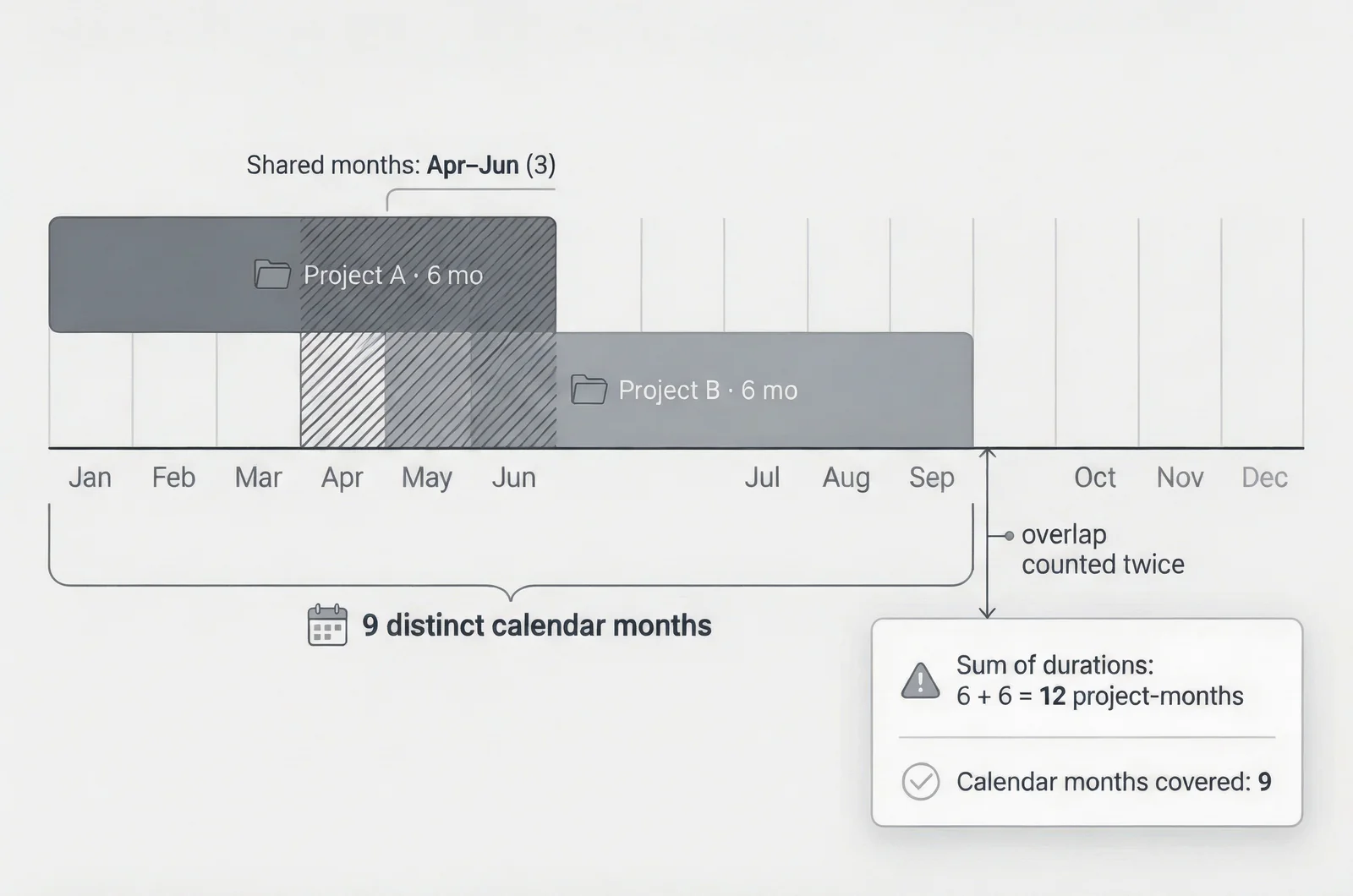
This is especially relevant for consultants, delivery leads, and professionals who divide their time across several initiatives.
For a hypothetical calendar-month illustration, Project A runs from January through June, while Project B runs from April through September. Each spans six months. Together, they cover nine distinct calendar months, although adding their individual durations produces twelve project-months.
That example explains the counting risk. Use PMI’s current instructions to determine how overlapping experience must be reported and counted for your application.
Build a calendar view before relying on a total. Mark your actual participation in each project, including gaps. A project’s full duration may differ from the period when you contributed.
A useful application-checking tool would highlight overlapping months and show the records and verifier associated with each entry. Its output should identify calculation gaps without claiming to predict audit selection.
Keep concurrent projects visible where the application requests them. Reconcile the eligibility total separately according to the applicable counting instructions.
4. Naming a verifier who cannot confirm your account
A verifier mismatch ranks fourth because an otherwise credible description becomes difficult to substantiate when the person named cannot confirm it.
This check is particularly useful for contractors, people who changed employers, and applicants documenting older assignments. A contact may remember the project while knowing little about your responsibilities.
Before submitting, ask the proposed verifier to review the factual account you intend to provide. Confirm dates, your role, and the work they personally knew. Follow the application’s instructions about who can verify experience.
Do not treat agreement to receive an email as confirmation of every statement. Give the person enough context to spot an error before the application moves forward.
There are legitimate limits to anyone’s knowledge. Someone who supervised one phase may be unable to confirm your involvement across the entire initiative. That calls for a more precise account or clarification about acceptable verification.
A changed employer, old email address, or departed manager also creates a practical contact problem. Resolve it early rather than assuming a former workplace will forward a request.
Keep contact details current, document what each person can confirm, and ask PMI for guidance if the required verification arrangement is unclear.
5. Claiming education or training without matching records
Education and training discrepancies rank fifth because these claims depend on specific records. A well-written experience section cannot fill a gap in a separate eligibility requirement.
This review matters if you completed training years ago, changed your name, studied through an employer, or used several providers.
Compare what you plan to enter with the documents you actually hold. Check names, course titles, completion status, and any hours you intend to claim. Use the current instructions to determine what evidence is required and whether the learning activity qualifies.
Enrollment and completion are different facts. Likewise, access to a learning library does not establish that you completed a particular course.
Self-directed study can help you prepare for an exam. Whether it satisfies an application requirement is a separate question that needs confirmation against the applicable rules.
Avoid rewriting a provider’s certificate to match your application. If a record contains an error or leaves something unclear, contact the issuing organization about an accurate replacement or clarification.
Create a small index that pairs every education or training claim with its supporting document. Resolve missing records before treating those claims as ready for submission.
6. Describing activities without explaining your contribution
Vague descriptions rank sixth because the experience may be sound while the explanation leaves too much for the reader to infer.
This often affects applicants who have substantial technical experience and assume their job title explains their contribution. A sentence about attending meetings or supporting implementation gives little detail about what they actually coordinated or decided.
For a hypothetical migration, a useful description could explain that you coordinated the rollout schedule, tracked dependencies between teams, and escalated unresolved readiness issues. Include those responsibilities only if you performed them.
Give each entry a clear sequence:
- Explain the project’s purpose.
- Describe your own responsibilities.
- Identify the deliverable or current status.
- State the result you can support.
This structure is an editing aid. It does not establish that the experience meets every eligibility condition.
Avoid adding a budget, team size, savings figure, or success claim simply because a sample application includes one. Unsupported precision creates another problem.
The limitation here is that writing cannot create missing experience. Improve the description when the underlying work is relevant; reconsider the entry when you cannot explain a genuine contribution. Delete sentences that add terminology without adding facts.
7. Leaving dates and details inconsistent across records
Inconsistent details rank seventh because many can be resolved through a careful reconciliation. They still deserve attention before submission.
Check this closely if you are reconstructing older work from a résumé, calendar, timesheets, and project records. Those documents may describe different periods.
For example, a project might have started in March while your participation began in May. A résumé could summarize the broader initiative, while the application needs a more precise account of your involvement.
A difference does not automatically establish dishonesty. The task is to understand what each date represents and report the period requested.
Build a working sheet with the project name, your participation dates, role, verifier, and supporting record. Flag discrepancies for investigation rather than choosing whichever version produces the largest total.
The same principle applies to names and titles. An internal initiative name may differ from a client’s name for the work. A promotion may also change your title during an assignment.
Use clear wording where clarification is needed. Preserve supporting records as they exist, and follow PMI’s correction instructions if you discover an error after submitting. Keep a copy of the final application for comparison.
8. Borrowing descriptions that erase the facts of your work
Copied descriptions and heavy jargon rank eighth because the immediate problem is often a loss of clarity. The concern becomes more serious when borrowed wording introduces responsibilities or outcomes that are untrue.
This check helps anyone using a sample application, writing service, or AI-assisted draft.
A template can remind you to include purpose, responsibilities, and results. It cannot establish that you managed procurement, approved changes, or led a team.
Compare every sentence with your actual work. Ask whether it identifies something you did, a decision you supported, or an outcome you can explain. Remove passages that could describe almost any applicant.
Technical terminology has a place when it communicates accurately. Repeated process names without project details leave the reader with little evidence of your contribution.
Two projects may involve similar responsibilities, so some repeated language can be reasonable. Their purposes, circumstances, deliverables, and dates should still remain identifiable.
Read each entry aloud. Then ask someone familiar with the assignment to explain what they think you did. If their understanding differs from the facts, revise the wording before using it.
Responding to an audit notice without creating new discrepancies
If an audit notice arrives, let the notice determine the required documents, submission method, and deadline. General advice should help you organize the response without substituting for those instructions.
Begin by saving the application you submitted. Compare each requested item with the claim it supports. That comparison can reveal a missing record or misunderstood date before you send an incomplete response.
Use a simple tracking sheet:
- Record each requested item and its stated deadline.
- Identify the person or organization responsible for supplying it.
- Check the returned material against your submitted details.
- Follow the specified submission procedure and retain confirmation.
If a document is missing or a verifier is unavailable, ask PMI how to address that circumstance. Do not assume that an alternative record will be accepted.
An error discovered during this review needs an accurate explanation. Avoid asking anyone to confirm wording they believe is wrong or altering a supporting record to make it agree.
You can continue ordinary exam preparation while organizing documents, provided you give the response deadline enough attention. Keep application tasks separate from study tasks so neither disappears into an evening revision session.
Retain the submitted package, relevant correspondence, and any receipt or confirmation.
Questions that matter while checking your application
Does an audit notice mean my application contains an error?
The notice alone does not establish that a particular statement is wrong. It also does not tell you which wording, project, or date caused selection.
Read the request and prepare the evidence it asks for. Avoid rewriting an accurate account merely because you believe different terminology would look safer.
Should I change my job title to project manager?
Use an accurate title and explain your responsibilities separately. Renaming the role can create a discrepancy with employment records or the verifier’s account.
If you held a technical title while coordinating project work, describe that work precisely. Check whether it meets the applicable experience criteria before claiming it.
What if the supporting material is confidential?
Ask PMI what verification or alternative documentation is acceptable before sharing restricted material. Your employer or client may also need to clarify what you can disclose.
Do not assume that redaction, an internal screenshot, or a different document will satisfy the request. Obtain guidance for the specific evidence problem and preserve that correspondence.
Can careful wording prevent an audit?
Clear wording helps readers understand your application. There is no verified basis here for promising that a writing style prevents selection.
Focus on the parts you control: accurate claims, consistent dates, appropriate verification, and available records. Correct the highest-ranked unresolved issue before polishing sentences that are already clear.
Prepare for the PMP exam beyond the application
- What the 2026 PMP exam changes mean for your study plan
- What your PMP provisional pass actually means
- PMP Eligibility Requirements
Open a free sample set for their exam code, then create a free account to unlock the rest and save progress Get started |  |