What the 2026 PMP Exam Changes Mean for Your Study Plan
By ExamDumpster Editorial Team· (updated Oct 16, 2026)
The PMP exam now has a July 2026 refresh on record. Candidates who started with older material need to check what they have been studying against PMI's revised exam content outline. For anyone building a PMP study plan for shift workers, that check matters more than it sounds. Study time comes in short pieces between shifts, so one wasted week is hard to win back. This update sets out what is confirmed as of October 15, 2026, which numbers we are leaving out until you can read them in PMI's own document, and how to re-sequence a plan that is already underway.
What is confirmed about the July 2026 PMP refresh
PMI is the issuing body for the PMP credential and the only authority on what the exam covers. Its exam content outline lists the domains, the task statements under each one, and the share of scored questions each domain carries. Any number that touches your study hours should be measured against that document.
Three facts hold up as of today:
- PMI publishes the PMP exam content outline and revises it on its own schedule, so confirm which version applies to your appointment date.
- Exam Dumpster's catalog lists a PMP-2026 question bank labeled as the July refresh and built to match the revised 2026 outline.
- The outline that governed the exam from early 2021 split it into three domains: People at 42%, Process at 50% and Business Environment at 8%. About half the questions drew on predictive approaches and half on agile or hybrid ones.
Use that last item as a baseline for comparison only. The current blueprint is whatever PMI's latest document says.
The figures we are leaving out on purpose
This update does not print PMI's new domain percentages or task counts. They have not been checked here against the published outline, and a wrong figure sends real hours to the wrong place. A five-point error on a 100-hour plan is five hours. For someone who gets five hours of study between shifts, that is a full week.
Before you change anything, find four items on PMI's PMP certification page and in its candidate handbook:
- The effective date of the revised outline, and which version applies to your appointment.
- The percentage for each domain and the number of task statements under it.
- The exam format: question count, time allowed and break rules. The 2021-era exam ran 180 questions in 230 minutes, so confirm whether that still holds before you schedule timed simulations.
- Any task statements that are new or reworded. Those are where older study material is most likely to fall short.
Who needs to rework their plan
The refresh does not land the same way on every candidate. Where you are in your plan decides how much work it creates.
Candidates studying from 2021-era books, courses or question banks carry the most risk. Their material may describe tasks that have since been reworded, merged or dropped, and their practice scores may look better than their readiness. Check each chapter against the new task statements before trusting a high score.
Candidates mid-plan with a booked appointment have a date to protect. They need a gap check this week, not a rebuild. The goal is to find the handful of chapters that no longer match and fix those first.
Candidates who have not started are in the best spot. They can pick material mapped to the revised outline and set the schedule around the current weights from day one.
Our read: how to re-sequence a plan when the weights move
Everything in this section is analysis, not PMI guidance. It treats domain weights as the budget for your study hours and your practice scores as the adjustment.
Turn the new weights into hours
Build one sheet with four columns: domain, old weight, new weight from PMI, and your latest practice score. Multiply your remaining study hours by each new weight. Say you have 60 hours left (a made-up figure). A domain weighted at 30% earns 18 of them, and one weighted at 8% earns about five.
Then adjust. Move roughly a tenth of the hours from domains where you score comfortably, say 80% or better, to domains where you score under 70%. Those thresholds are our rule of thumb, not PMI's.
Sort old notes into three piles
Old notes are not wasted. Mark each chapter green if its task statements carry over unchanged, amber if they were reworded, and red if they no longer appear. Study amber chapters first, because they feel familiar while being wrong in the details. Drop red chapters, even if the notes took you a month to write.
A small tool worth building
If you build one thing, make it an hours-per-domain calculator. Paste in PMI's weights, add your last score for each domain and the number of shifts you work per week, and let it return hours per domain and sessions per week. A spreadsheet does the job in ten minutes. It also turns a mid-plan change into a two-minute update instead of an evening of arithmetic.
Rebuilding the weeks around rotating shifts
A solid PMP study plan for shift workers starts from the clock, not the calendar. A plan written for a 9-to-5 candidate assumes a fresh evening. For you, the evening might be the middle of the night, so the hours have to be placed where your head is actually working.
Match the study block to the shift
| Shift pattern | On shift days | Off days |
|---|---|---|
| Fixed nights | One 45-minute question set after you wake, before you head in | Two 90-minute blocks, with timed work in your first waking hours |
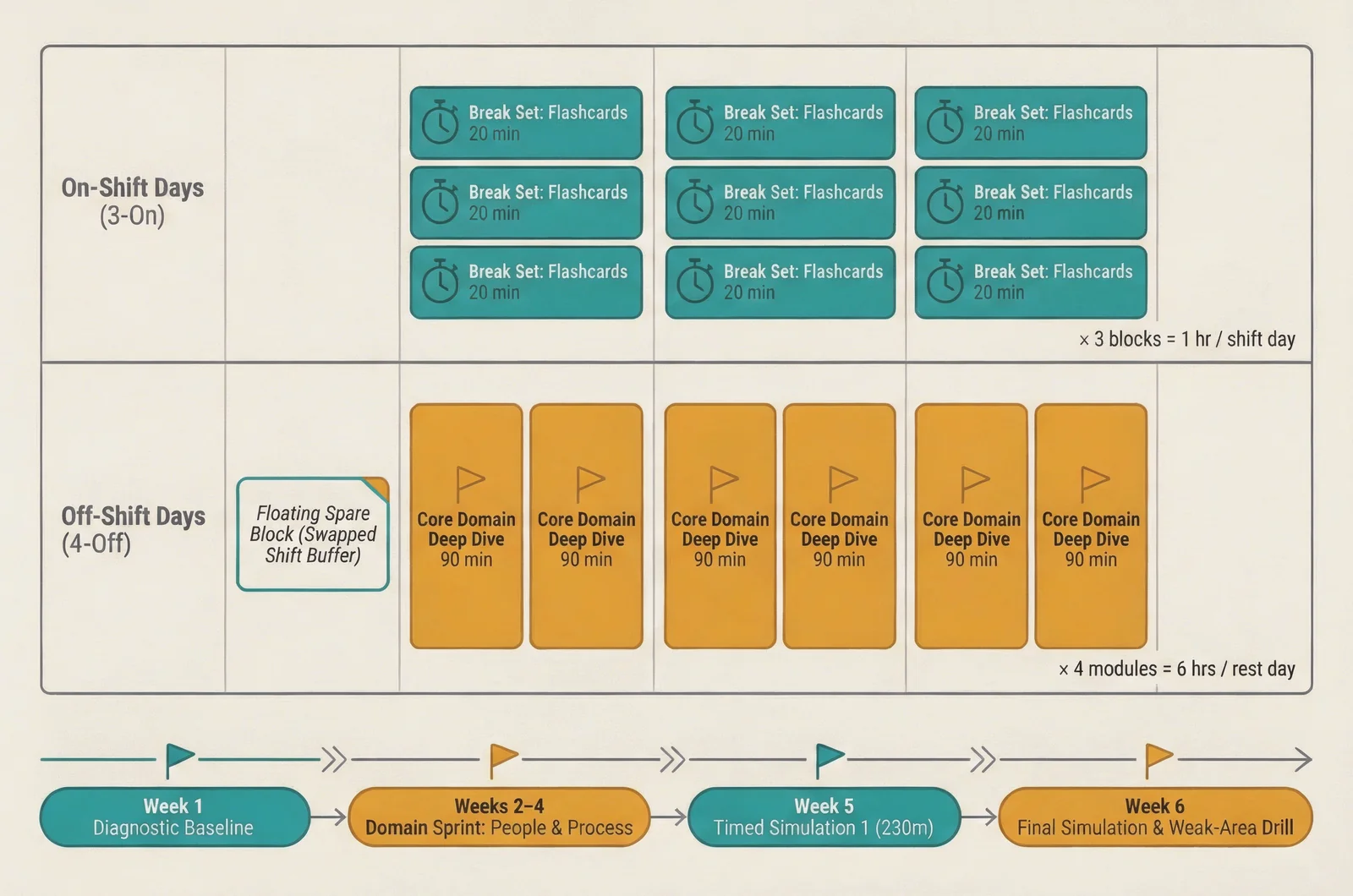
| Rotating 12-hour blocks (say 3 on, 4 off) | Flashcards or a 20-question set on a break | Blocks for new material, practice and review |
| Irregular or on-call | Two 25-minute sets whenever the phone stays quiet | One two-hour anchor block, booked like a shift |
Do the arithmetic for the 3-on, 4-off pattern. Three 20-minute break sets add up to one hour. Four 90-minute off-day blocks add six more. That is about seven hours a week, or 42 hours over six weeks. It is thin for a cold start, so either stretch to eight weeks or add a fifth block.
Whichever pattern you work, use a tool that saves progress and resumes on any device. A 20-question set started on a break should pick up on the laptop at home without losing the score.
A six-week order that survives a swapped shift
Week one is for orientation. Read PMI's outline, sort your notes into green, amber and red, and take a 30-to-40-question diagnostic set. Log the score for each domain.
Weeks two and three go to the heaviest-weight domain, then the second heaviest. Use study mode with explanations open, and write one line on why each wrong answer was wrong.
Week four covers the remaining domains and starts mixed sets. Week five brings the first full-length timed simulation. Review every miss, and every guess that landed by luck.
Week six holds a second simulation, flashcards on your weakest task statements, and then light days. Add no new material in the last 48 hours.
On a four-week schedule, fold weeks two to four into two weeks and run one simulation. On eight weeks, add a week of mixed sets before the first simulation and a third simulation at the end. Either way, keep one floating block per week. Shifts get swapped, and a spare evening absorbs the loss.
Pick the exam slot like you pick a shift
Run your timed simulations at the same clock time as your appointment, so your body has practiced being sharp then. Night workers should avoid a morning slot straight after a shift. Swap a shift if you need to, so you sleep a full night before test day. Of the delivery options PMI gives you, choose the one that avoids a long drive on little sleep.
Checking your practice questions against the new outline
The costliest mistake in this refresh is practicing against the wrong version. A question bank tied to a retired outline can return a score that looks healthy and means little. Before paying for any bank, ask three things. Which outline version does it name? When was it last updated? Does every answer explain why the other options fail?
Exam Dumpster's 2026 PMP practice questions are listed as the July refresh set. Half the sample is open to anyone, and a free account opens the second half, so you can judge the explanations before you spend anything. From there, run a shuffled timed simulation to gauge readiness and save the score to your attempt history. Flashcards fit the final week. Full access is either a single exam purchase kept for good or a monthly membership with two or four active exam slots, swappable at renewal. That structure suits a budget stretched across exam fees and a possible retake.
Your wrong answers also point somewhere. If they cluster around basics such as work breakdown structures or earned value, the CAPM exam sample questions are a lower-stakes way to firm up the vocabulary before you return to longer PMP sets. If they cluster around requirements and stakeholder needs, the PMI-PBA practice questions cover the business analysis side. That is a separate credential, not a PMP requirement.
What to watch between now and test day
Two things can still move under you. PMI can update its outline page, candidate handbook or exam policies. Publishers also release refreshed books and courses at different speeds.
Set a calendar reminder to reread PMI's PMP page two weeks before your appointment and again two days before. Treat any prep product that names the 2021 outline without mentioning a 2026 update as pre-refresh until it says otherwise.
If a course provider has published an update note, read what changed in the course, not just the marketing line. Ask for a task-statement mapping. A provider that cannot point to the outline version its material was built on is a coin flip for your next few weeks.
Quick answers for night-shift and rotating-shift candidates
Do I need to restart because of the refresh?
No. Restart only the chapters that map to reworded or removed task statements. Notes on unchanged tasks keep their value. For a fast gap check, run the open half of a refreshed sample bank and see which task areas you miss.
How many weeks does a shift worker need?
Four to eight weeks works if you already have project experience and can find about 7 to 12 hours a week. Starting cold, plan for the longer end. A diagnostic set in week one tells you more than any rule of thumb.
When should I sit the first full-length simulation?
Around two-thirds of the way through your plan, which is week five of six. Earlier than that, the score mostly tells you what you have not read yet.
Should I push my exam date?
Push it if your last two timed simulations land well below where you want to be and your main material predates the refresh. Check PMI's rescheduling rules and deadlines first, since late changes may carry a fee or limits. If you are close, keep the date and spend the extra days on amber chapters.
More PMI practice sets to sit beside your PMP weeks
- July 2026 PMP refresh sample questions
- PMI-CPMAI sample questions
- How Much Does An AWS Certification Exam Cost In 2026?
Open a free sample set for their exam code, then create a free account to unlock the rest and save progress Get started |  |