CAPM vs PMP Requirements: What PMI Changed for 2026
By ExamDumpster Editorial Team· (updated Oct 24, 2026)

If you are choosing between the CAPM and the PMP this fall, the CAPM vs PMP eligibility criteria difference comes down to one question you can answer tonight: can you document years of leading projects, or only a diploma and a short course? The CAPM asks for the second. The PMP asks for the first. The one dated 2026 event on the PMP side is the exam's July refresh, which changes what you study. No change to the eligibility thresholds themselves is documented in this report. It labels each claim as confirmed or as analysis, so you know what to check with the Project Management Institute (PMI) before you spend money.
Confirmed rules, open questions, and one dated change
This update was written on October 23, 2026. PMI, which owns both credentials, publishes the eligibility rules in its CAPM and PMP handbooks. No PMI notice is quoted here, and none is paraphrased. Handbook wording matters, and a secondhand summary can drift from the original.
Three statements sort cleanly.
- PMI's long-standing published rules put the CAPM at a secondary degree plus 23 hours of project management education. They put the PMP at a degree, documented experience leading projects, and 35 hours of education or a CAPM certification.
- The PMP exam moved to a refreshed version in July 2026. That is a change to exam content.
- Whether PMI altered any degree level, month count, hour count, or audit rate this year is not documented here.
Now the analysis, kept apart from the facts above. A PMP applicant should treat the audit as a real possibility, because preparing for one costs an afternoon and being unprepared can cost the application. Also, if you read somewhere that PMI tightened a threshold, ask the author for the handbook page and its revision date. A claim that can name neither is a rumor, however confidently it is posted.
Plan around the standing thresholds in the next section, and check each against the current handbook before you pay for anything. Both handbooks are free to download, and the check takes about ten minutes.
CAPM and PMP eligibility side by side
The CAPM is the education-only route, and the PMP is the documented-experience route. That single split drives the whole CAPM vs PMP eligibility criteria difference. The table shows all three paths as PMI has published them.
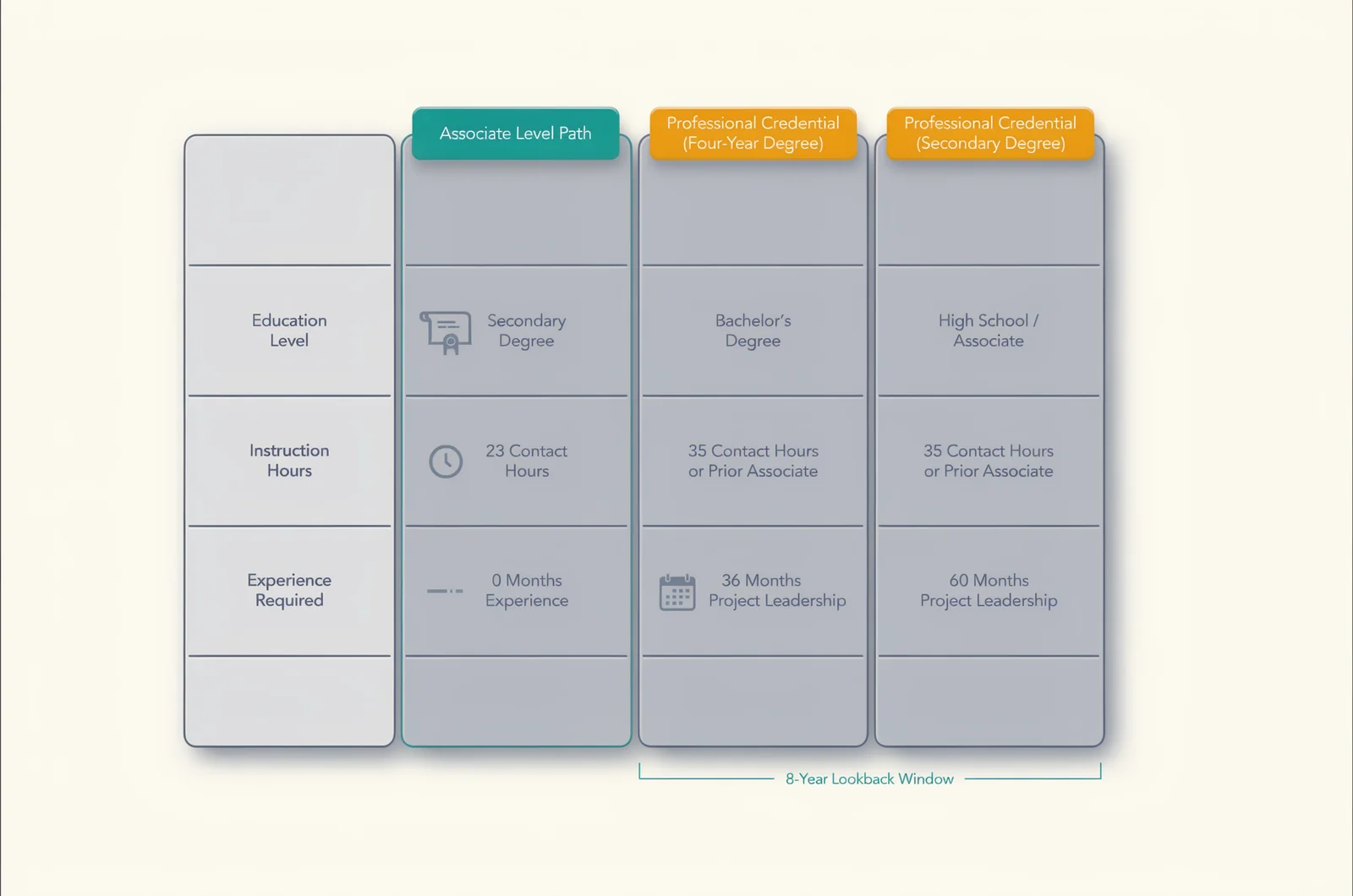
| Requirement | CAPM | PMP with a four-year degree | PMP with a secondary degree |
|---|---|---|---|
| Degree | High school diploma, associate degree, or global equivalent | Bachelor's degree or global equivalent | High school diploma, associate degree, or global equivalent |
| Experience leading projects | None | 36 months, non-overlapping | 60 months, non-overlapping |
| Experience window | Not applicable | Within the last 8 years | Within the last 8 years |
| Project management education | 23 hours | 35 hours, or a CAPM | 35 hours, or a CAPM |
Read the table by row. The degree row decides which PMP column applies to you, and no course or certificate moves you between them. A bachelor's degree puts you on the 36-month path, which is three years of leading projects. A diploma or associate degree puts you on the 60-month path, which is five years.
The education row looks heavier for the PMP, at 35 hours against 23. In practice it is the lightest hurdle, because holding the CAPM satisfies it. A CAPM holder does not need to show a separate 35-hour course.
Why experience is the real divider
Months must be non-overlapping and must fall inside the last eight years, so a project history from a decade ago does not help. The CAPM has no experience requirement at all, which is why it suits students, career changers, and people who support projects without leading them.
Before you read on, find your own column. Start with your degree, then write down an honest count of your leading-projects months.
What the July 2026 PMP refresh does and does not touch
The refresh is the only dated 2026 event in this story, and it applies to the exam rather than the application. A refresh changes the content outline a candidate studies. It does not by itself change who may apply, and nothing in this update ties the two together.
The practical impact depends on where you are. If PMI has already approved your application and you hold an exam date, check the exam version on your scheduling confirmation and match your study material to it. If you are still studying, drop any practice bank written for the retired outline. Exam Dumpster's 2026 PMP practice test follows the July refresh and marks retired versions instead of hiding them, which helps when you are unsure which version a coworker's old notes were written for. If you are not yet eligible, which describes most CAPM-stage readers, you can ignore the refresh until your months and hours are in order.
Timing needs more room than it looks like. Once PMI approves a PMP application, the candidate has one year to sit the exam, with up to three attempts. PMI's review has historically taken about five to ten business days, and an audit adds more time on top of that. An exam date set two weeks after you submit leaves no slack if your application is selected. Submit first, then schedule.
How PMI counts PMP experience
PMP experience is counted in calendar months, not project by project. That detail matters for IT professionals, whose project work often overlaps. The arithmetic is dull, which is the reason to do it before PMI does.
Counting months on the calendar
Say you led a network migration from January through June 2024 and a firewall refresh from April through September 2024. Added up project by project, that looks like twelve months. On the calendar, the two projects cover January through September, which is nine months. Nine is the number that counts. The example is hypothetical, but it shows how the non-overlapping rule works.
The lookback is eight years. For an application submitted in late 2026, the window reaches back to roughly late 2018. Months before that do not count, even if they came from your best projects.
What counts as leading a project
PMI's published guidance describes the experience as leading and directing project work, and a project manager title is not required. Picture a systems administrator who ran the cutover workstream for a data center move while the title stayed the same. That work can count if the person can describe the responsibilities clearly and someone can vouch for the dates. This is analysis, not a promise. PMI decides, and a vague description invites questions.
A simple eligibility checker would save time here. A useful one asks for your degree level, takes the start and end month of each project, merges the overlaps, and returns CAPM-ready, PMP-ready, or the exact gap in months or hours. A spreadsheet with a start column, an end column, and a merged-months total does the same job today.
Where the audit enters the picture
PMI audits a share of applications at random. The PMP gives an auditor the most to check, because it asks you to prove a degree, education hours, and months of project leadership. If your application is selected, it pauses until you send the requested documents. The notice states the deadline, which PMI has historically set at 90 days. Read your own notice for the exact date.
What a PMP audit asks you to produce
Expect requests along these lines:
- A copy of your diploma or degree.
- A certificate or letter from each training provider for your contact hours, or your CAPM certificate in place of them.
- For every project you listed, a signature from someone who can vouch for your role and dates, such as a manager or supervisor.
The CAPM has less to prove. An education-only candidate has a diploma and a certificate of completion for the 23 hours. If an education-only application is selected, the paper trail is shorter. That is analysis based on how little the application contains. It says nothing about audit rates, which this report cannot confirm.
Paperwork to collect before you submit
The signatures take the longest. Managers change jobs, and a request sent after an audit notice competes with your deadline. Gather the evidence while the application is still a draft.
- Build a one-page project log with the project name, start month, end month, your role, and a contact for each entry.
- Ask each signer to confirm the dates against your log, so the application and the signature agree.
- Save the training certificate as a PDF with your name and the hour count visible.
- Round months down, never up.
Choosing CAPM first or applying straight for the PMP
The right first credential depends on how many documented months you hold today. The three readers below are hypothetical, but the arithmetic is real.
Three readers, three routes
Start with a reader who holds a bachelor's degree and eighteen months of leading projects. That person is not PMP-eligible yet. The CAPM is the credential available now, and the remaining eighteen months have to pass either way.
A second reader has a bachelor's degree and thirty months of documented project leadership, which is six months short of the 36-month threshold. A CAPM would add a second exam fee and weeks of study for a credential held briefly. Taking a 35-hour course now and applying for the PMP once month 36 is documented skips that extra exam.
A third reader holds a high school diploma and four years of leading projects. That puts them on the 60-month path, twelve months short. The CAPM gives them something to show in the meantime, and it covers the 35-hour requirement for the day they do qualify.
How the fees stack up
Money settles the close calls. PMI sets exam fees, and they differ for members and non-members, so pull current numbers from PMI rather than trusting a blog post. The structure matters more than the figures. The CAPM-first route means a 23-hour course, a CAPM fee, and then a PMP fee. The direct route means a 35-hour course and a PMP fee. If you have no use for the extra credential, the direct route costs less. If an employer wants to see a certificate this year, the CAPM may earn back its cost.
Budget-minded readers can test the water before paying for anything. Exam Dumpster's CAPM sample questions are half open without an account, and a free account opens the second half and saves your progress. That lets you judge the difficulty and the explanations first.
Eligibility edge cases that trip up applicants
Can I skip the CAPM and apply for the PMP directly?
Yes. The CAPM is optional. If you meet the experience months for your degree level and have 35 hours of project management education, the PMP application does not ask for it.
Do practice tests count as contact hours?
No. Contact hours come from structured instruction that ends in a completion certificate. Practice questions measure readiness and do not replace the course. Confirm what qualifies in the handbook before you buy any course.
Does holding the CAPM reduce the months of experience I need?
No. The CAPM replaces the 35-hour education requirement and nothing else. The 36 or 60 months stay the same.
What should I do this week?
Download both handbooks and note their revision dates. Find your column in the table above and count your merged months. If you are on the CAPM path, open the free sample set, finish the first half, and create a free account to reach the second half. If you are on the PMP path, drill PMP practice exam questions in study mode until the explanations stop surprising you. Then run one shuffled, timed simulation and save the score.
More on the 2026 PMP changes and post-exam checks
- What the 2026 PMP Exam Changes Mean for Your Study Plan
- What Your PMP Provisional Pass at the Test Center Actually Means
- How Are Red Hat Certification Exams Scored And Structured?
Open a free sample set for their exam code, then create a free account to unlock the rest and save progress Get started |  |