How Are Red Hat Certification Exams Scored and Structured?
By ExamDumpster Editorial Team· (updated Oct 23, 2026)

Red Hat certification exams assess your ability to complete practical technical tasks in a working environment. That changes how you should interpret the passing score, prepare after work, and judge whether you are ready. The standard passing benchmark is 210 out of 300 points, or 70%, but a percentage alone tells you little about which tasks to prioritize. These answers explain the performance-based format, what automated grading means, and which exam-specific details to confirm before committing your study time and exam budget.
What does a performance-based Red Hat exam involve?
A performance-based exam asks you to carry out technical work and produce the required results. Your preparation therefore needs to include operating the relevant systems, diagnosing problems, and checking your changes.
Depending on the exam, that work can involve Linux administration, automation, OpenShift administration, or a specialist subject. The published objectives define the skills you need for your selected exam. A familiar product name does not establish that two exams cover the same tasks.
Read an objective as something you must demonstrate. Knowing what a command does is one level of preparation. Choosing it, supplying the correct options, and confirming the result requires further practice.
Suppose a practice task asks you to make a service available after a restart. You would need to understand the service configuration, apply the change, and verify the requested behavior. Recognizing the correct command in a question bank would cover only part of that work.
For each objective, write a practical completion test. Replace “understand service management” with an observable result, such as configuring a service and checking its behavior under the conditions specified in your lab.
How does automated grading assess your work?
Automated grading checks your completed work against the results required by the exam tasks. The useful preparation principle is to make the requested configuration work and then verify it independently.
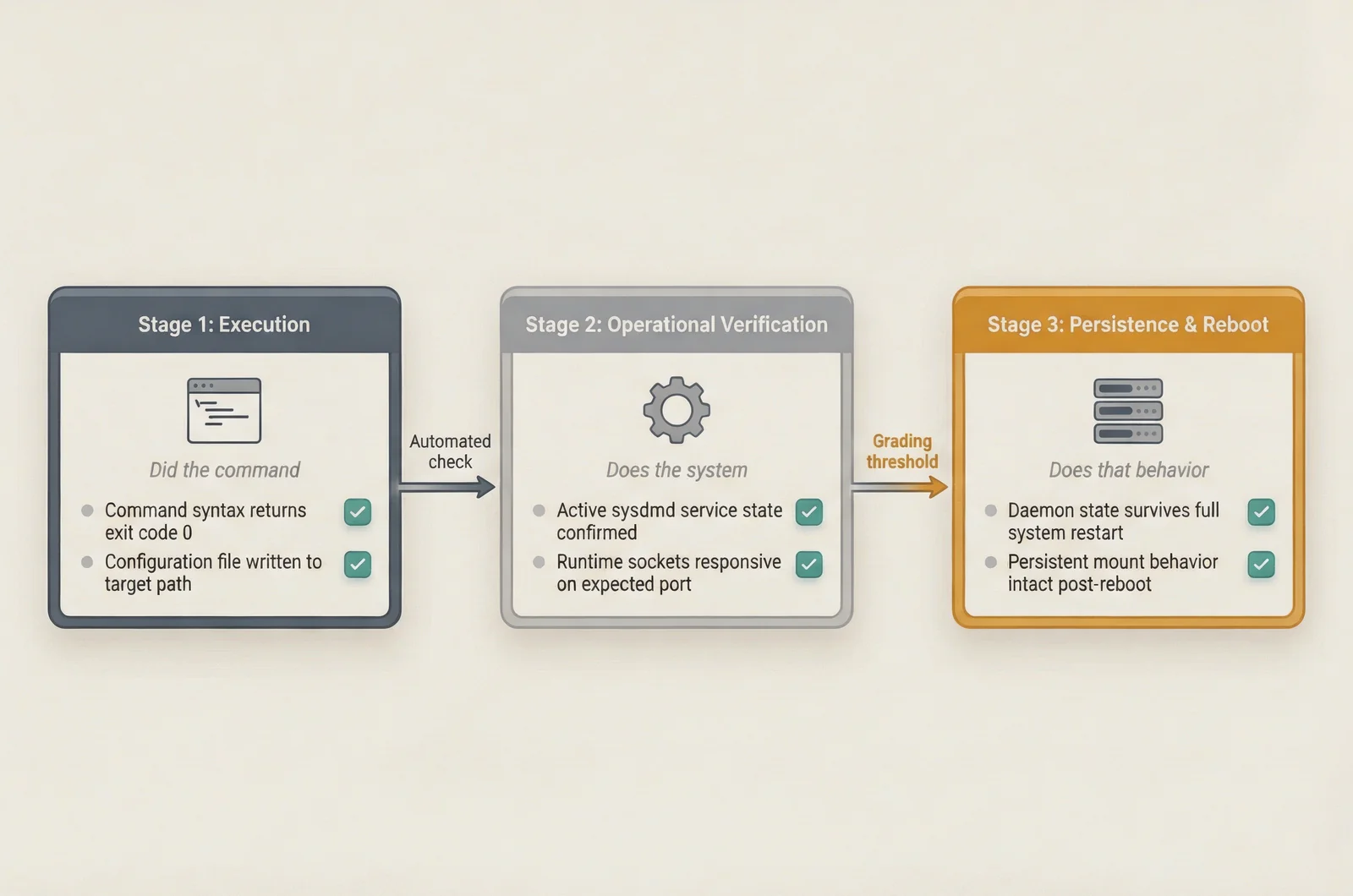
A successful command does not prove that the whole task is complete. It may change one setting while leaving another requirement unresolved. Likewise, creating a configuration file does not establish that the relevant service can use it.
During practice, separate three questions:
- Did the command or configuration change complete successfully?
- Does the system now behave as the task requires?
- Does that behavior remain correct under any additional conditions in the instructions?
Those questions help you distinguish activity from completion. They also make troubleshooting more focused because you can identify which part of your verification failed.
Avoid building a strategy around guesses about the grader’s internal scripts. Assumptions about exact checks, execution order, or hidden point allocations can distract you from the stated requirements.
Instead, keep a short verification note for each practice objective. Record the command, output, or behavior that demonstrates success. If you cannot explain how you checked your work, repeat the task and add that verification step.
What does a passing score of 210 out of 300 mean?
A score of 210 out of 300 equals 70% of the available points under that scoring scale. Confirm the passing requirement in the information for your particular exam.
The distinction is between points and tasks. A 70% passing benchmark does not establish that completing seven out of ten tasks will produce a pass. That calculation would require equal task weights and clear knowledge of how each task earns credit.
You should also avoid translating a practice-question percentage directly into an expected practical exam score. The two assessments can measure different abilities.
For example, a question may ask you to identify the correct configuration option. A practical task requires you to apply a configuration correctly within the working environment. That adds execution and verification to the knowledge requirement.
Use the passing benchmark to understand the scoring scale. Use your practice record to identify readiness.
A more useful readiness question is: can you complete the published objectives from a clean starting point, without a walkthrough, and demonstrate the requested results? Record unresolved objectives separately from tasks you have completed successfully. Repeating familiar questions can raise a practice percentage while leaving those practical gaps untouched.
Can you rely on partial credit or estimate task weights?
You should not rely on a particular amount of partial credit unless the exam information explicitly explains it. A task that is partly complete does not give you a dependable point estimate.
One requirement may be satisfied while another remains unresolved. Without the applicable grading rules, you cannot determine how that translates into a score. Counting completed commands is especially unreliable because commands are steps toward a result.
During preparation, classify work by its actual state:
- Complete and verified against every stated requirement.
- Partly complete, with a specific unresolved requirement.
- Unattempted or unsuccessful.
This creates a practical record without inventing scoring weights.
During the exam, use the instructions and any disclosed weighting to guide decisions. When weights are unavailable, consider task dependencies, your confidence, and the time needed to make further progress.
Set a stopping point for troubleshooting during timed practice. Record what remains broken, move to another task, and return later. Practice that decision before exam day so one difficult configuration does not consume the session.
Does every configuration need to survive a reboot?
A configuration needs to persist when persistence is part of the stated requirement. Read the task carefully to identify whether it requires behavior after a service restart, system reboot, or another change in state.
These conditions are different. A setting can work in the current session yet disappear later. A configuration file can also contain the intended value while the running service still uses an earlier configuration.
Practice checking both the active behavior and the saved configuration whenever the objective requires them.
Use disruptive checks carefully. A reboot or restart can affect other work, so understand the dependency before performing it. Do not assume that restarting everything is an appropriate verification method for every task.
In your own lab, rehearse recovery as well as successful configuration. If a restart exposes a problem, inspect the relevant status information and configuration rather than immediately rebuilding the environment.
Keep the distinction visible in your notes: “works now” and “works after the required restart” are separate observations. Mark the objective complete only after checking the conditions the task actually specifies.
What should you confirm about the exam environment and time limit?
Confirm the duration, software version, delivery arrangements, and permitted resources for the exact exam you intend to take. Those details determine whether your practice environment and timed sessions are suitable.
Use the exam-specific information and your booking instructions. A study guide for another version or a different specialist exam may create the wrong expectations.
Before scheduling, check:
- The exact exam code and product version associated with your attempt.
- The published duration and any instructions affecting the session.
- The delivery format and applicable technical requirements.
- Which documentation or other resources the exam permits.
- Identification, check-in, and appointment requirements.
Treat resource access as an exam rule. Do not assume you can use personal notes, an unrestricted browser, or the same documentation arrangement you use at work.
For timed practice, match the confirmed exam duration when you are ready for a full rehearsal. Earlier sessions can be shorter and focused on individual objectives.
If your delivery arrangement requires equipment checks, complete the prescribed checks early enough to resolve problems. Technical preparation belongs in your schedule alongside lab work; leaving it until the final evening creates another avoidable source of pressure.
Which prerequisites apply to different Red Hat certification tracks?
Prerequisites depend on the exam and credential you choose, so check formal requirements separately from recommended experience. A suggested training course, an expected skill level, and a required certification have different meanings.
Start with the technical work you want to validate. Linux administration, OpenShift administration, diagnostics, and services automation represent different preparation needs. Experience in one area can help without covering the objectives of another.
For any track, establish three things:
- Whether the exam has formal registration prerequisites.
- Whether earning the credential requires another qualification.
- Which technical skills or training Red Hat recommends before attempting it.
Do not assume that permission to book an exam proves you have the necessary background. Equally, do not treat every recommended course as a mandatory purchase.
An intermediate IT professional may already have useful operational experience but still need structured practice in unfamiliar objectives. Compare your actual work against the objective list rather than relying on your job title.
For a limited budget, this check should happen before buying preparation materials. Write the exam code, version, formal requirements, and largest skill gaps at the top of your study plan. If a resource cannot be matched to that plan, pause before paying for it.
How should you prepare when your study time is limited?
Use short sessions built around completing and verifying one published objective. This gives each evening a defined purpose and makes it easier to resume after a shift or a missed day.
A practical study cycle is:
- Read the objective and identify the result you must produce.
- Attempt a matching lab task without following a walkthrough.
- Check the result and investigate any failed requirement.
- Repeat from a clean starting point after correcting the gap.
Keep your notes brief. Record the error, why it occurred, and the check that confirmed the correction. A long command transcript is harder to review than a clear explanation of one failure.
Exam Dumpster’s EX342 troubleshooting questions can support a focused review of troubleshooting concepts. Follow that review with practical work in your own environment, using the objectives for your selected exam version.
Keep troubleshooting practice controlled: introduce a known fault in a disposable lab, diagnose it, correct it, and verify the recovery. Record which evidence led you to the cause.
Reserve some sessions for connected tasks. Individual exercises help you learn a skill; a combined lab shows whether an earlier change disrupts work completed later. Include verification time in every timed session.
Can practice-question scores predict your practical exam result?
Practice-question scores can reveal conceptual gaps, but they cannot establish that you can complete practical tasks under exam conditions. Treat them as one part of your preparation record.
A correct answer can show that you recognize a command, configuration choice, or likely cause of a fault. Practical execution adds other demands: entering the details accurately, interpreting output, recovering from mistakes, and checking the result.
Exam Dumpster’s EX358 services management questions can help you review explanations before a related lab session. Match any preparation material to the objectives and version you plan to sit.
After reviewing an explanation, close it and attempt the corresponding task. If you need to reopen the answer repeatedly, record that objective as needing further practice.
An objective-based readiness checklist would be useful here: enter the exam code and version, then track whether each task was completed unaided, verified, and repeated from a clean environment.
Keep question accuracy and lab completion as separate measures. Repeatedly recognizing an answer should not overwrite a failed practical attempt in your study notes.
How should you manage tasks during the exam?
Read the full instructions before changing the environment, then work through tasks with attention to dependencies and verification. A few minutes spent understanding requirements can prevent changes that conflict with later work.
Identify tasks that establish something other work needs. Also note shared systems, files, or services so you can consider the effect of each change.
When you complete a task, perform the checks available within the exam rules. Avoid postponing all verification until the end, when a problem may be harder to trace.
If you become stuck, describe the remaining issue to yourself precisely. “The service fails to start” is more useful than “this task is broken.” That narrower description helps you choose the next diagnostic check.
Use the pacing decisions you rehearsed in timed labs. Move on when further troubleshooting has stopped producing useful evidence, and return if time permits.
Before finishing, review the requirements for work you consider complete. Check for omitted conditions, unsaved changes, and effects on dependent tasks. Use the final review to verify requested behavior rather than making broad, unfamiliar changes.
How should you use feedback after an unsuccessful attempt?
Use the feedback provided to choose what to rebuild and verify before another attempt. Repeating the same study routine without identifying a practical gap gives you little basis for expecting a different result.
If the feedback identifies weaker areas, map them back to the published objectives. For each area, distinguish among missing knowledge, execution errors, incomplete verification, and time pressure.
Then create a focused lab for the weakness. Practice from a clean environment so the starting conditions do not hide an unfinished step.
Avoid trying to reconstruct confidential exam content. Published objectives give you an appropriate basis for fresh exercises and a wider range of practice scenarios.
Before booking again, check the terms that apply to your purchase, including retake eligibility, scheduling, and any additional cost. Do not build your budget around an assumed retake arrangement.
Record a concrete readiness condition for the next attempt: complete the previously weak objectives unaided, verify their results, and repeat them successfully within your practice schedule.
Where can you explore cloud-native integration practice?
Open a free sample set for their exam code, then create a free account to unlock the rest and save progress Get started |  |