IBM Credly Badge Verification and What Employers See When They Check
By ExamDumpster Editorial Team· (updated Nov 20, 2026)

IBM certification Credly badge verification should connect an applicant’s credential claim to an individual award record. For employers, the useful questions concern the recipient, issuer, credential title, dates and any supporting information displayed. A badge image leaves several of those questions unanswered.
As of November 19, 2026, this report does not confirm a newly announced IBM or Credly verification change or a universal layout for IBM badge pages. Its scope is how applicants and employers should assess the record available to them. The hiring recommendations below are editorial analysis, not statements of either company’s hiring policy.
The practical consequence is straightforward: describe what the individual record establishes, and leave missing information unresolved until it can be confirmed.
What the individual badge link needs to establish
For an IBM credential presented through Credly, the individual award record should be the starting point for an employer’s check. The reviewer needs enough information to connect the applicant with the exact qualification claimed.
Connect the recipient, issuer and credential title
Begin with the destination of the shared link. Determine whether it identifies an individual recipient or describes a credential that multiple people could earn. A page explaining an award’s requirements cannot, by itself, establish that a particular applicant received it.
Then compare the visible record with the application:
- Does the recipient information reasonably match the applicant?
- Does the issuer information support the claimed IBM award?
- Does the credential title match the qualification listed?
- Are a product version, level or specialization part of that title?
- Is there any visible status information that needs clarification?
These are checks to perform, not a promise that every badge page contains every field. If information is absent, record the gap instead of supplying an answer from memory.
A name difference deserves a question. An applicant might use initials, a shortened first name or a different professional surname. The reviewer should resolve the connection through the organization’s normal identity-checking process. A matching display name alone should not carry that entire responsibility.
Read the award description before interpreting its significance
An IBM-branded badge should not automatically be treated as proof of a particular professional certification. Read the exact title and any description or earning criteria available.
Look for what the award explicitly recognizes. If the description establishes course completion, keep that wording. If it identifies an assessment requirement, describe that requirement accurately. Avoid upgrading a broad learning achievement into a more specific qualification.
Applicants should also check the shared destination outside their own signed-in session. Open the intended link in a private browser window and review what appears. This is a practical accessibility check, not proof of the award’s validity.
If the page cannot be reached, the employer has an access problem to resolve. If the page opens but does not identify the claimed recipient or award, the verification question remains open. Save the exact link that was reviewed.
Dates and evidence need separate readings
Dates on an IBM credential record can help establish its history, but each date needs its own meaning. Employers should avoid treating an issue date, exam date and expiry date as interchangeable.
An issue date does not answer every timing question
When an issue date appears, report it as the issue date. Do not relabel it as the exam date unless the relevant record or issuer explicitly supports that interpretation.
That distinction matters when an applicant describes when they passed an assessment, received an award or added it to an application. Those are separate events, even when they happen close together.
Consider a hypothetical application that says a credential was earned in March while the shared badge displays an April issue date. The difference needs clarification. It does not, by itself, establish that the application is inaccurate.
Expiry needs equally careful treatment. If an expiry date is displayed, compare it with the date of the employer’s check and inspect any accompanying status explanation. Preserve the wording used by the issuer.
An absent expiry date does not establish lifetime validity. It also does not establish that renewal is overdue. The narrower observation is that the reviewer did not find an expiry date in the record examined. Confirm any continuing-validity requirement through the relevant credential policy.
Exam retirement is another question. A statement about an exam’s availability should not be substituted for a statement about an individual award’s status. Identify which event a notice actually addresses.
Earning criteria and individual evidence support different claims
Earning criteria describe the requirements associated with an award. Individual evidence, when present, may provide information connected with the recipient’s achievement. Read each item according to its stated purpose.
For example, a description of required activities should not be rewritten as a detailed account of an applicant’s performance. Likewise, a linked project should be assessed for what it actually demonstrates. Its presence does not justify inventing an assessment score or level of workplace proficiency.
Keep preparation records separate. An Exam Dumpster practice-test score belongs in a learner’s study history. Use the issuer’s award record to support a claim that a credential was earned.
A reviewer who needs an exact exam score should request appropriate documentation through an agreed channel. Avoid filling that gap with a badge description, a practice result or an assumption about passing requirements.
Record the visible dates and evidence exactly as labeled.
Why a badge can be missing from a check
A missing IBM badge leaves the employer without the requested verification evidence. It does not establish a single explanation for the gap.
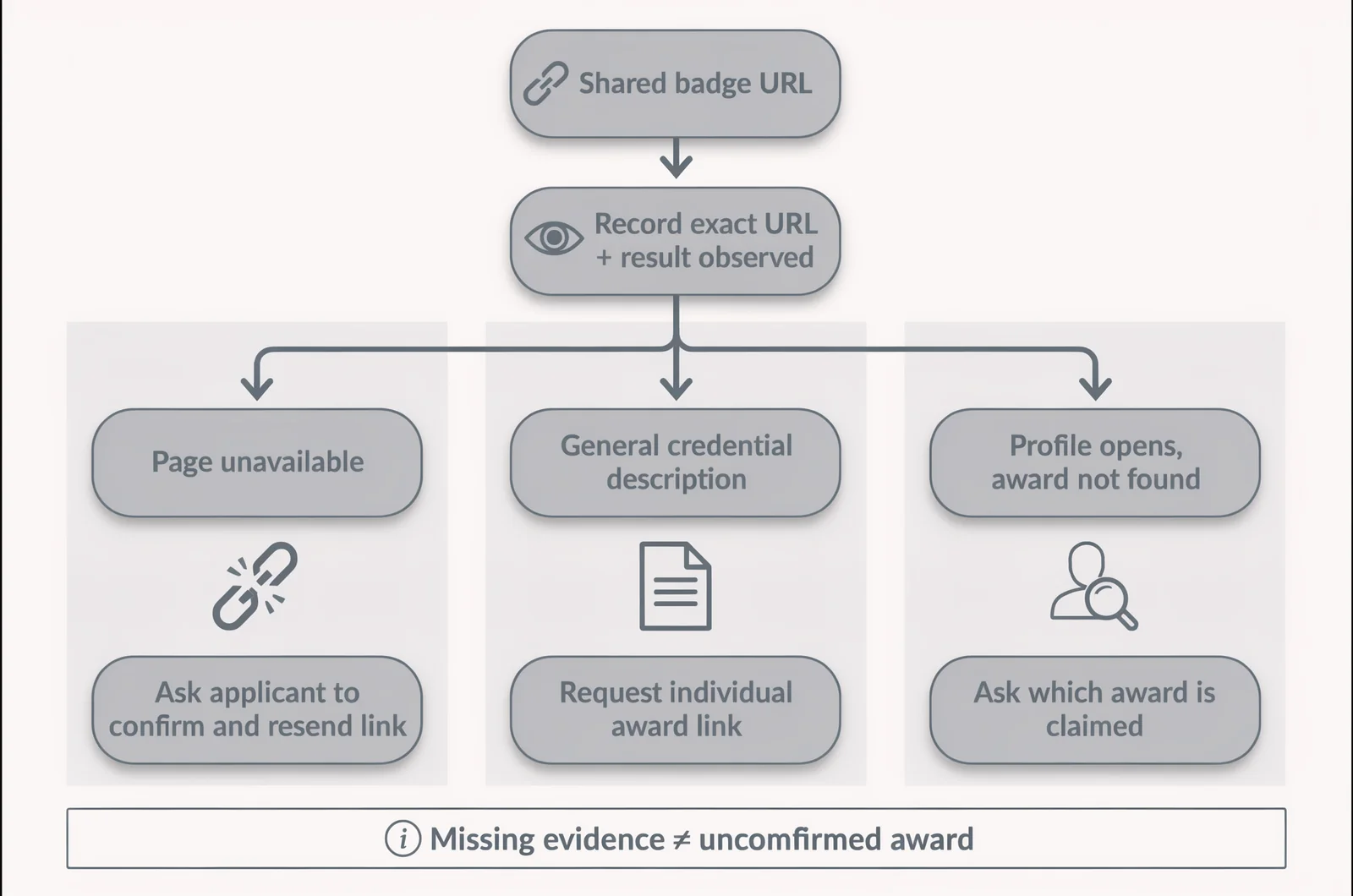
Separate an inaccessible link from an unconfirmed award
The first question is what failed. Did the link lead to an unavailable page? Did it open a general credential description? Did the applicant share a profile where the relevant award could not be found?
Those situations require different follow-up questions. Start with the exact URL and the result the employer observed. The applicant can then check whether they shared the intended award record.
If the award itself is missing, possible explanations should remain possibilities. Do not announce that IBM has a processing delay, that Credly lost the record or that a privacy setting caused the problem without evidence.
The same restraint applies to troubleshooting instructions. Follow the instructions associated with the particular award and use the relevant official support channel. Avoid relying on an old screenshot or an assumed menu sequence.
A useful support request identifies the credential involved and describes the problem precisely. Include the information the support process requests, while keeping passwords and other account secrets private.
Until the issue is resolved, an employer can record the status as awaiting verification. An applicant can explain the gap without claiming that a missing page confirms the award.
Preserve the wording of a test result
A result notification and an issued credential should each retain their original wording. If a document says provisional, pending or subject to review, an application should preserve that qualification.
The distinction between a test-day result and a confirmed credential is also the subject of the PMP provisional pass explanation. IBM award timing and requirements need their own confirmation.
For applicants, the immediate task is to identify what documentation is available today. State what it says, explain what remains pending and provide the individual award link when it becomes available.
For employers, set a reasonable follow-up point and identify the evidence needed to close the check. Avoid turning an unexplained access failure into a conclusion about the applicant’s honesty.
What verification can change in hiring
An IBM badge check can help an employer assess a credential claim. Its influence on a hiring decision should stay within the information the record supports.
The following recommendations are editorial analysis. They describe a practical way to use credential evidence without assigning it conclusions that have not been established.
Record the observation as well as the link
A useful verification note includes the credential title, recipient information, issuer, URL and date of review. Add any visible issue date, expiry date or status wording relevant to the role.
Keep observations separate from interpretations. “No expiry date was visible” records what the reviewer saw. “The credential never expires” requires further support.
The same principle applies to a missing score. Record that the reviewed page did not establish a score. Avoid translating that absence into a claim about the applicant’s performance.
This approach also helps when an application moves between recruiters and hiring managers. A precise note explains what was checked and what still needs attention. A copied badge image may leave that context behind.
If supporting documents arrive later, connect them with the original question. Update the verification note with the new evidence and review date.
Use the credential to focus the interview
After confirming the award, a hiring manager can ask how the applicant applies the relevant knowledge. The credential title and earning criteria can help frame that conversation.
For a role involving a particular IBM technology, questions should address the work the employee would perform. Ask about a relevant task, the decisions involved and how the applicant would investigate a problem. Keep the scenario aligned with the job.
A credential record should not be stretched into proof of experience it does not describe. If the position requires production troubleshooting, assess that ability directly through the organization’s interview process.
Applicants can prepare for that discussion by connecting the qualification with their own work, labs or projects. Label each example accurately and explain their personal contribution. Keep claims about the award separate from claims about practical experience.
Questions about sharing an IBM credential
Applicants and employers can encounter different questions when they open the same credential link. Answers should follow the information actually available in the shared record.
Will an employer see my exam score?
Do not assume that a badge link establishes an exam score. Inspect the public record and identify whether it contains any score information and what that information represents.
If an employer requests a score report, clarify which document is needed and how it should be provided. A credential link and a score report answer different questions.
Applicants should avoid adding a numerical result to an award description unless they have documentation for it. Employers should leave a score field unresolved when the available record does not support an entry.
Can I share one award without exposing more information?
Review the destination outside your account before sending it. Check whether the link opens the individual award, a broader profile or another page.
Look at the information visible to someone who is not signed in as you. Confirm that the intended recipient and credential can be identified, then review any additional personal information displayed.
Use the sharing controls and instructions available for the account and award involved. This report does not establish a universal privacy-setting sequence.
An employer should receive an appropriate verification link or document. They should not need the applicant’s password to complete the check.
Is a screenshot enough for an application?
A screenshot can help communicate what an applicant is referring to. By itself, it leaves the reviewer unable to inspect the underlying destination.
Where a working individual award link is available, provide it alongside any requested image or document. Check that the destination matches the credential described in the application.
If an employer’s form accepts only an attachment, follow its instructions and ask how to supply verification details. Preserve the full credential title and relevant dates in the permitted fields.
A screenshot that omits the recipient or credential title leaves those parts of the claim unanswered.
What if the badge title differs from my resume?
Compare the wording carefully. A shortened resume entry may omit a level, specialization or version that matters to the employer.
Use the official award title where space permits. If you add an explanation of its relevance, make that explanation distinct from the credential’s name.
For example, describe the qualification accurately, then explain its relationship to the role in the surrounding sentence. Avoid rewriting a course achievement into a certification title or adding a higher level than the record supports.
Correct any mismatch before submitting the application, and use the same title in follow-up correspondence.
Keep the application wording tied to the award
For an IBM credential holder, the most useful immediate action is to compare the application with the record an employer can actually inspect. Check the title, recipient information, dates and any status qualification.
Keep a small record of the shared URL and the date you checked it. If a field is missing, write down the question it leaves open. This can save another round of correspondence when a recruiter asks for clarification.
Someone preparing for a future credential should maintain the same distinction in their study records. When using Exam Dumpster’s practice tests, label saved results as practice attempts. Match preparation materials to the intended exam code and version before spending additional study time or money.
Once an award is available, update the application from its exact wording. If verification remains pending, say what is pending and identify the documentation already available.
For employers, the corresponding action is to record the evidence reviewed and request clarification only where the claim remains unresolved. A usable verification note should identify the award, the link, the review date and any outstanding question.
Other credentials with separate status rules
Open a free sample set for their exam code, then create a free account to unlock the rest and save progress Get started |  |