How Is an ISACA Exam Scored Across the 200 to 800 Scale?
By ExamDumpster Editorial Team· (updated Oct 31, 2026)

For candidates who want the ISACA scaled scoring system explained, start with two numbers: results on this scale range from 200 to 800, and 450 is the passing mark. Your reported score is a converted result rather than a percentage of questions answered correctly. That distinction matters when you interpret practice tests, plan your remaining study time, or read an exam report. The questions below explain what those numbers reveal and where their usefulness ends.
What does an ISACA score between 200 and 800 mean?
An ISACA scaled score expresses your exam performance on a standardized reporting scale, with 450 as the passing threshold. The scale allows results from different exam forms to be reported against a consistent passing standard.
Three terms help separate the scoring process:
- A raw score records correct answers to scored questions.
- A scaled score expresses that performance on the exam’s reporting scale.
- A passing standard identifies the performance required to pass.
These terms describe different parts of the same result. A scaled score of 600 does not tell you that you answered 600 questions correctly, nor does it mean 75% simply because 600 divided by 800 equals 0.75.
The 200-point starting position also matters. This is a bounded reporting scale, so treating it like a school percentage introduces assumptions the numbers cannot support.
For the 200–800 model, the immediate decision is straightforward: a reported total of 450 or higher meets the passing threshold. A result below 450 falls short. Use the score report’s total and stated outcome when interpreting your result.
Does a passing score of 450 mean 56.25% correct?
No. Dividing 450 by 800 gives 56.25%, but that calculation does not reveal the percentage of questions needed to pass an ISACA exam.
The calculation assumes that scaled points behave like marks earned out of a possible total. They do not. The score has already been converted from exam performance into a reporting scale.
Subtracting the lower endpoint does not solve the problem either. Calculating where 450 sits between 200 and 800 describes its position within that numerical range. It still does not reveal the raw passing percentage.
A conversion requires more information than the minimum score, maximum score, and passing mark. You would need the applicable relationship between raw performance and scaled results.
This distinction also applies to higher scores. A result of 640 cannot safely be read as 80% correct. Likewise, a 50-point improvement does not identify a particular number of additional correct answers.
Keep percentages for practice accuracy and scaled points for official results. When a study resource claims that a certain percentage equals 450, check whether it provides an authorized conversion for that exam.
How does ISACA convert correct answers into a scaled score?
ISACA converts performance on scored questions into the reporting scale, with adjustments intended to account for differences in difficulty between exam forms. This process supports a consistent passing standard across different sets of questions.
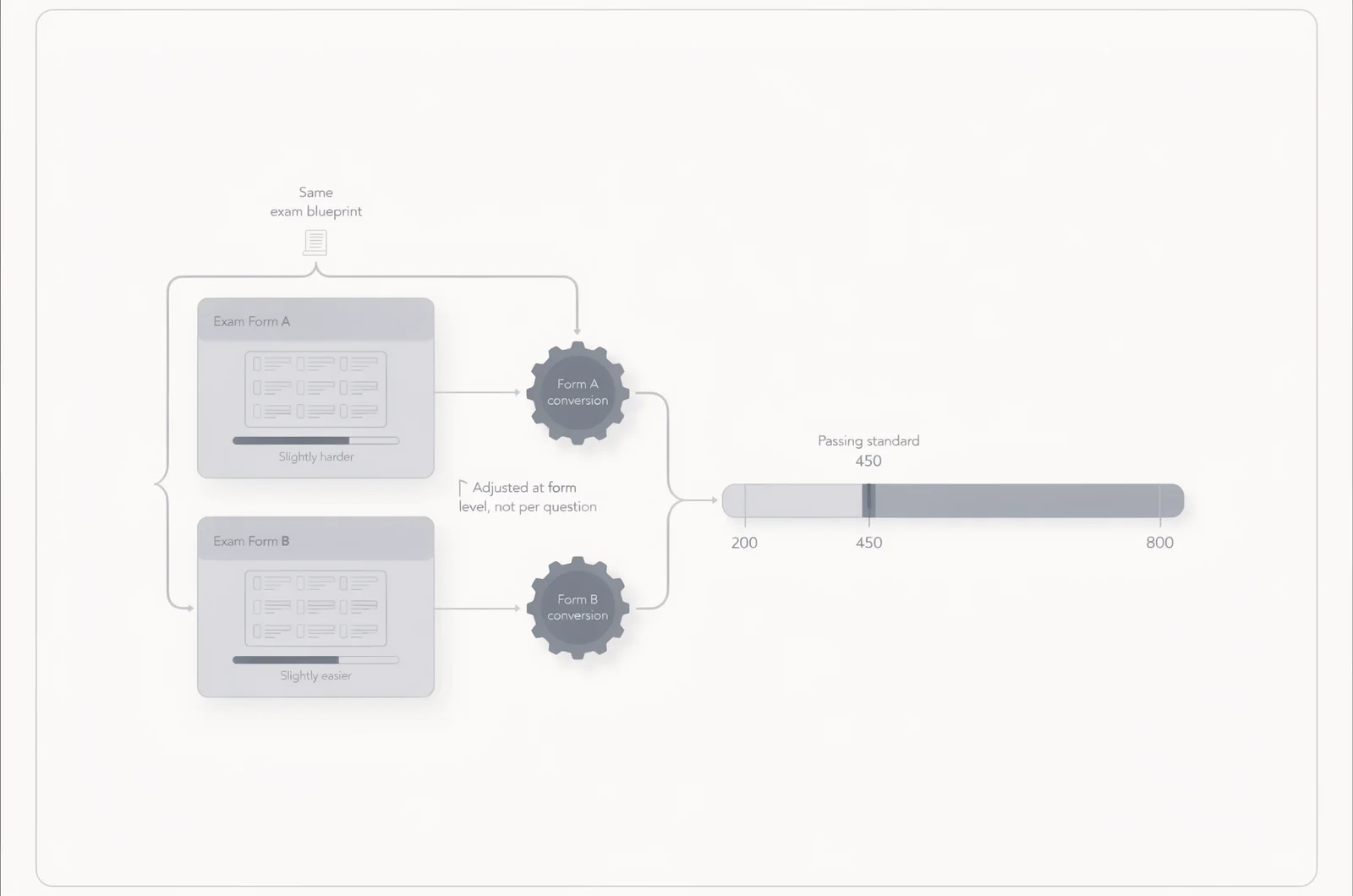
An exam form is a particular selection of questions. Two candidates can receive different selections covering the same exam blueprint. Those selections may differ somewhat in difficulty.
The scoring process addresses that difference at the exam-form level. Candidates should avoid assuming that a question they found difficult automatically earns extra points. Personal difficulty and statistical difficulty are separate concepts.
This also explains why scaled scoring differs from a classroom curve. A curve can depend on how students perform relative to one another. A certification passing standard measures performance against the required level of competence.
There is no useful reason to spend exam time estimating whether your particular question set feels harder than someone else’s. Familiarity, fatigue, and work experience all affect that impression.
For preparation, concentrate on choosing the best answer and understanding its reasoning. A difficult practice question deserves review because it exposes a knowledge or judgment gap; its appearance does not establish a scaled-point value.
How many correct answers do you need to pass?
The published 200–800 range and 450 passing threshold do not provide enough information to calculate an exact required number of correct answers.
To obtain a defensible raw count, you would need the scoring conversion applicable to the exam form. Multiplying the number of questions by 56.25% cannot supply it.
Be equally careful with claims about how many questions you can miss. A statement such as “you can miss a certain number and still pass” needs more support than the exam length and passing score.
Your own recollection after the exam is also an unreliable calculator. You may remember difficult questions more clearly, misjudge uncertain answers, or overlook errors in questions that felt easy.
A score just below 450 does not reveal how many additional correct responses would have changed the outcome. One scaled point cannot be treated as one question.
For study planning, replace the search for an exact miss allowance with two checks: whether you can answer unfamiliar questions consistently and whether you can explain your decisions without relying on remembered wording.
How do exam domain weights affect your score?
Domain weights describe how the exam blueprint distributes coverage, so larger domains generally represent more opportunities to affect your overall performance.
A domain’s percentage should guide preparation. It does not mean you can simply multiply a reported domain score by that percentage to reconstruct the official total.
Consider a hypothetical practice exam with 100 scored questions. Domain A represents 30% of the blueprint, while Domain B represents 10%. That produces 30 questions from A and 10 from B.
If your accuracy improves by 20 percentage points in each domain, the expected improvement is:
- Six additional correct answers from Domain A.
- Two additional correct answers from Domain B.
This illustration explains why the same improvement in accuracy can have different effects depending on domain size. It does not predict an official scaled score.
Weight alone should not determine every study session. A large domain where you are already strong may need less immediate attention than a smaller domain you barely understand.
Exam Dumpster’s study mode includes answer explanations. Use them to identify the concept behind an error, then connect that concept to your exam’s domain outline.
A useful interactive study-priority calculator could combine published domain weights with practice accuracy to flag review priorities. Its output should recommend a study order without claiming to predict an official scaled result.
Do you need a passing score in every domain?
For the core ISACA certifications using this scoring model, the overall scaled score determines whether you pass; individual domain results provide diagnostic feedback.
That means uneven performance across domains does not automatically establish a failed attempt. The total result is the deciding measure.
However, treating a weak domain as expendable is a poor preparation strategy. Missing foundational concepts can affect several topics, especially when questions combine governance, risk, controls, and professional judgment.
The distinction between a reporting rule and a study decision matters. A separate domain passing requirement would be a formal exam condition. Choosing to strengthen your weakest domain is a preparation decision.
Also avoid calculating a simple average of domain scores and comparing it with 450. Domain coverage can differ, and reported domain results are not interchangeable components of an ordinary average.
Use the overall score to interpret the outcome. Use domain feedback to choose the material for your next review session.
Can a practice-test percentage predict your official score?
A practice-test percentage can show your accuracy on that question set, but it cannot reliably predict an official ISACA scaled score without a validated conversion.
Question quality, topic coverage, difficulty, and familiarity all affect the result. A high percentage on repeated questions measures something different from strong performance on unfamiliar scenarios.
For example, remembering which answer occupies a particular position can raise your practice score without improving your reasoning. Changing the answer order may expose that gap immediately.
A more useful readiness check considers several signals together:
- Accuracy remains reasonably consistent across fresh, mixed question sets.
- Your practice coverage matches the exam outline you will sit.
- You can explain why competing answers are less suitable.
- You can finish timed attempts without rushing the final portion.
On Exam Dumpster, timed mode and saved attempt history can help you compare practice sessions. Keep the comparison honest by noting whether an attempt contains familiar questions.
If you are studying for AAIA, assess your work on AAIA sample questions against that credential’s own outline and scoring guidance. Shared vendor branding does not establish identical scoring rules.
Record your practice percentage as a practice percentage. Beside it, record the errors that still need explanation and whether time pressure affected your choices.
Does every ISACA credential use the 200–800 scale?
No. You should verify the scoring rules for the exact ISACA certification or certificate you are taking rather than applying one model across the entire catalog.
The 200–800 scale and 450 passing mark are associated with core certifications such as CISA, CISM, CRISC, and CGEIT. That shared reporting format does not make their content or difficulty identical.
If you are choosing between audit and risk pathways, CISA versus CRISC sequencing addresses a separate decision: which certification best fits your preparation and direction.
Certificate exams require their own checks. Someone using COBIT 2019 Foundation questions should follow the Foundation exam’s requirements. The same applies to COBIT design and implementation practice and that exam’s rules.
Before comparing two credentials, identify the reporting scale, passing requirement, exam outline, and result terminology for each one.
A passing score from one credential cannot establish an equivalent performance level in another. Keep the credential name beside every scoring rule in your study notes.
What can your score report tell you after the exam?
Your score report tells you the reported outcome and provides the available performance feedback; it does not necessarily reveal your exact raw accuracy.
Start with the total scaled score and the stated pass or fail result. Then review any domain-level information to decide what deserves attention.
If your total is below 450, avoid turning the gap into a guessed question count. Being ten scaled points short does not establish that you needed ten additional correct answers.
Domain feedback is more useful when combined with your preparation records. A weaker reported area that also caused repeated practice errors gives you a clear place to investigate.
Different signals need different responses. Conceptual errors call for review of the underlying material. Misreading a qualifier calls for more careful question analysis. Repeated time pressure calls for pacing practice.
If a result is described as preliminary, distinguish it from the official result and follow the instructions supplied with the exam. Do not assume another vendor’s reporting timetable applies.
For an unsuccessful attempt, build the next study plan from the report and your error log. For a passing attempt, follow the credential’s remaining certification requirements rather than assuming the exam result completes every step.
How should you use scoring information in your last study week?
Use the scoring model to prioritize broad, reliable performance across the exam outline, while using practice results to identify specific weaknesses.
The final week is a poor time to chase a supposed secret conversion formula. Your available hours are better spent correcting errors you can still influence.
Begin with one fresh mixed practice session under realistic time limits. Review every incorrect answer and any correct answer you selected with weak reasoning.
Sort the problems into practical categories: missing knowledge, confusion between plausible options, misread wording, and pacing. Each category needs a different response.
For missing knowledge, revisit the relevant objective and write a short explanation in your own words. For competing options, identify the condition that makes one answer preferable. For wording errors, practice noticing qualifiers such as first, best, and most appropriate.
Then use the domain weights to allocate your remaining sessions. Give substantial weaknesses in heavily represented areas enough attention, while keeping smaller domains in your mixed practice.
Keep a brief record of what changed between attempts. An improving percentage means more when you can connect it to better reasoning on unfamiliar questions.
Choose one specific objective for your next session, complete a focused set, and explain each missed answer before moving to another topic.
Where can you compare other exam scoring systems?
Open a free sample set for their exam code, then create a free account to unlock the rest and save progress Get started |  |