Ranking CISA and CRISC by Which ISACA Certification Comes First
By ExamDumpster Editorial Team· (updated Oct 13, 2026)

If you are weighing CRISC vs CISA and deciding which certification comes first, start with the work you want to do. CISA takes the first slot for an audit career. CRISC moves ahead when your next role centers on assessing technology risk, choosing responses, and tracking treatment plans. For an IT professional studying after work, that distinction matters more than which credential sounds harder or more senior.
Both paths deserve consideration, but they solve different career problems. This guide ranks them against role fit, qualifying experience, employer requirements, and reusable knowledge. The aim is to choose one useful first exam without buying two sets of materials and hoping the direction becomes clear later.
Rank the paths against your next job
The strongest first certification is the one that connects your current experience to a specific next role. A general ambition to work in governance, risk, and compliance, often shortened to GRC, leaves too much room for an expensive detour.
CISA, Certified Information Systems Auditor, belongs on this shortlist because it addresses the audit and assurance direction. CRISC, Certified in Risk and Information Systems Control, belongs because it addresses the technology risk direction. Narrower governance or specialist certificates answer different questions, so they do not receive competing rankings here.
Give career fit the largest share of the score
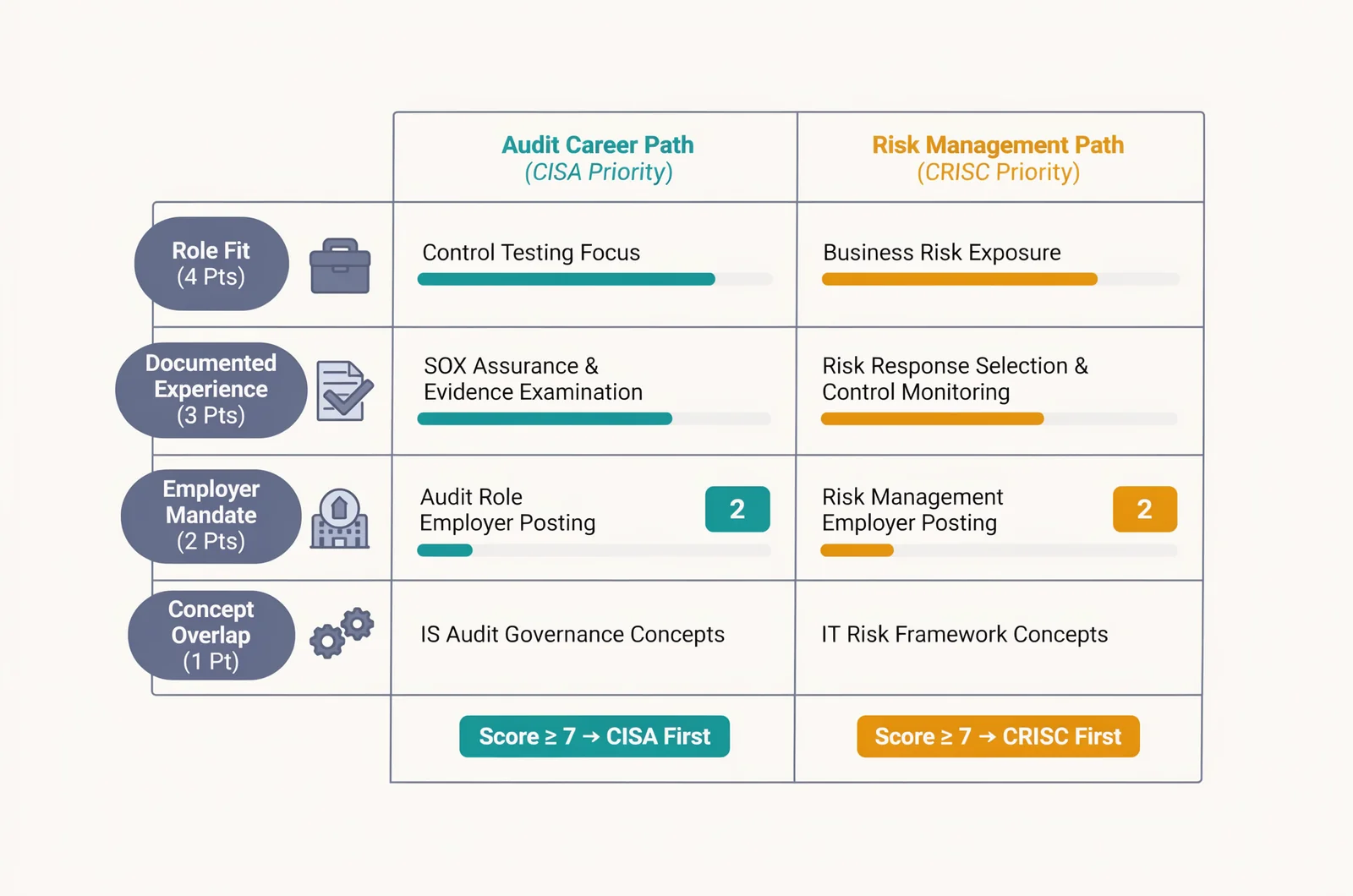
Use this ten-point editorial score for each path. It is a decision aid, not an employer survey or a prediction of hiring success.
- Award up to four points for alignment with the responsibilities of your next role.
- Award up to three points for relevant experience you can document against the certification requirements.
- Award up to two points when an actual target job or your employer explicitly names the credential.
- Award one point for substantial overlap with concepts you already use confidently.
A hypothetical audit vacancy that names CISA, matches your experience, and involves familiar work could give CISA nine or ten points. A role centered on risk assessment and treatment could reverse the result.
When scores are close, let the next job’s responsibilities break the tie. Familiar study material should carry less weight than career direction.
Read employer wording before assigning points
Separate a required credential from a preferred one. Also distinguish a list of acceptable certifications from a specific request for CISA or CRISC.
A job advertisement that accepts either credential does not establish which should come first. Its responsibilities provide the better clue. Record the wording from roles you would actually apply for, then assign the employer points.
An interactive version of this scorecard could show a recommended exam order and flag experience gaps separately.
CISA comes first for an audit career
CISA earns the first slot when your destination involves examining controls, gathering evidence, and reporting whether systems and processes meet defined expectations.
FlashGenius’s April 2026 audit career guidance recommends CISA first for IT auditors working with internal audit and Sarbanes-Oxley compliance. That supports an audit-specific recommendation rather than a universal ranking.
The strongest fit is work built around assurance
Choose this path when you want to assess how reliably an organization’s controls operate. Assurance means giving stakeholders a supported assessment of those controls and the processes behind them.
In a hypothetical access review, an auditor might examine approval records, test whether permissions match responsibilities, and document exceptions. The work depends on sufficient evidence and a defensible conclusion.
That is the career direction that gives CISA its place ahead of CRISC. If your target role involves reviewing control effectiveness and communicating findings, its study perspective has a clear purpose.
Your existing technical knowledge still matters. It helps you understand the system under review. The additional challenge is deciding what evidence supports an audit conclusion.
Its limitation is the distance from risk ownership
CISA may be less direct when your main goal is to run risk assessments or coordinate treatment decisions. Those responsibilities can sit beside audit work, but they change the purpose of the decision.
The cost signal is therefore about relevance. Estimate the exam expense, preparation materials, any applicable certification charges, and a possible retake. Then ask how much of that spending supports the role you want.
CISA remains the first recommendation for an audit-bound candidate, including someone who later plans to add risk responsibilities. Before selecting it, write down the audit tasks in your target role and match them to the applicable exam outline.
CRISC comes first for a risk career
CRISC moves into the first slot when you already work with technology risk or want your next role to involve managing it.
CyberCertPrep’s August 2026 risk career comparison describes CRISC as the more direct path for security professionals moving toward risk leadership. Its examples include risk identification, response selection, control monitoring, and reporting to people responsible for budgets.
The strongest fit is responsibility for risk decisions
Consider CRISC first when you want to assess a business exposure, recommend a response, and follow the resulting treatment plan.
In a hypothetical vendor review, that could mean assessing the consequences of an outage, comparing possible responses, and identifying who should accept the remaining risk. The decision needs business context as well as technical understanding.
A security practitioner may recognize many of the underlying threats and controls. The useful shift is toward explaining their effect on business objectives and presenting a reasoned response.
This gives CRISC a stronger first-place case for a risk analyst or security professional whose next role includes risk assessment and reporting. Match the recommendation to the work, rather than assuming every security role follows the same path.
Its limitation is specialization around risk
CRISC can be a detour if the vacancies you want concentrate on audit testing, evidence review, and assurance reporting. A risk credential may support that work, but CISA addresses the audit direction more directly.
Use the same cost categories you considered for CISA. Include the time required to learn unfamiliar business concepts, because evening study hours are part of the investment.
A higher salary figure in a comparison article should not decide the order. Different roles, experience levels, and locations can affect those figures.
Choose CRISC first when you can name the risk responsibilities you want and explain why they belong in your next role.
Qualifying experience can change the order
The best study order and the earliest certification date can differ. Relevant work experience deserves a separate check before you spend money.
Destination Certification’s April 2026 CRISC experience comparison describes a requirement of three years of experience across two or more CRISC domains. Three years somewhere in IT does not automatically demonstrate that match.
For CISA, compare your history with the applicable certification application requirements rather than estimating eligibility from your job title. Check any experience substitutions directly in the rules that apply to your application.
Map responsibilities instead of counting job titles
Write down the work you actually performed. Useful entries describe tasks, dates, scope, and someone who can verify them.
A description such as “reviewed access permissions and documented control exceptions” gives you more to assess than “security analyst.” Likewise, “assessed supplier risk and tracked agreed treatment actions” describes responsibilities that a broad title may hide.
You could have relevant work in a role whose title never mentioned audit or risk. You could also hold an impressive title without enough matching responsibilities.
Keep exam readiness and certification eligibility separate in your notes. Studying successfully does not establish that your work history satisfies an application requirement.
Use an experience gap to guide your work
If one path fits your next role but your experience is incomplete, identify the missing responsibilities. Then consider whether your current position can provide them.
An audit-bound candidate might seek participation in evidence collection or control reviews. A risk-bound candidate might seek involvement in assessments, treatment tracking, or reporting.
These are examples of work to discuss with your manager, not promises that particular tasks will qualify. Match any proposed responsibilities to the certification rules.
Before paying, record the relevant requirement, the experience you can support, and the gap that remains.
Reuse the concepts, change the question
CISA and CRISC share useful concepts around controls, governance, and risk. That overlap can reduce repeated learning, but it does not make their decision perspectives interchangeable.
The main study challenge is recognizing what the question asks you to accomplish. Auditing a decision and making a risk decision can involve the same system while requiring different reasoning.
One supplier access request shows the distinction
Say an organization wants to give a supplier remote access to a business system.
From an audit perspective, you might examine whether the approval process was followed, whether permissions were appropriate, and whether records support the review. Your reasoning centers on evidence and control effectiveness.
From a risk perspective, you might assess the exposure, compare treatment choices, establish responsibility, and decide how to monitor the remaining risk. Your reasoning centers on the organization’s response.
This is a simplified illustration, not an exam question. It shows why knowing a control’s purpose may help with both paths while leaving additional study work for the second.
When reviewing an explanation, identify the decision-maker and the objective before comparing answer choices.
Governance knowledge is useful without becoming a detour
Governance is how an organization directs responsibilities and decisions. Weak governance vocabulary can slow progress on either certification path.
If that is a specific weakness, COBIT Foundation sample questions can provide an optional way to explore governance concepts.
Keep that work limited to the gap you identified. Another certificate should enter the plan only when it has a purpose of its own.
For the second ISACA exam, retain notes on shared concepts and rebuild your question practice around its applicable objectives.
Commit to one study budget and one exam target
Once CISA or CRISC wins on role fit and experience, concentrate your preparation spending on that path. Preparing both simultaneously makes it harder to identify which material deserves your next evening.
The career comparisons cited here were published between April and August 2026. They provide context for choosing a direction. Confirm current fees, application conditions, and exam content before purchasing.
Use samples to examine your reasoning
A short sample set is useful for identifying unfamiliar decisions. It cannot prove readiness across an entire exam.
After each question, explain why your selected answer fits the scenario. Then check whether the explanation changes your understanding. A correct answer reached through a guess still deserves review.
Exam Dumpster’s ISACA practice exam catalog is a later option for finding relevant preparation resources. Its sample banks have answer explanations, with half available without an account and the remaining sample portion accessible through a free account.
When comparing CISA and CRISC samples, use similar study conditions and record the concepts that cause difficulty. Compare the reasoning demands rather than treating two small percentages as a reliable difficulty ranking.
Make the calendar reflect available evenings
For a hypothetical candidate with six dependable study hours per week, eight weeks provides 48 hours. That arithmetic describes capacity; it does not establish that eight weeks is enough.
Allocate the available time after identifying your gaps. Someone familiar with controls may need more work on audit reasoning. Someone comfortable with technical threats may need more work on business risk decisions.
ISACA’s 2025 exam candidate guide provides an administration reference. Confirm the guidance applicable to your booking rather than assuming an older document settles current arrangements.
Before scheduling, record your weekly hours, weak areas, preparation budget, and the rules that apply to the exam you intend to sit.
Questions that can change your first exam
A few uncertainties can overturn the initial CISA-first or CRISC-first recommendation. Resolve them against your intended work before adding another purchase.
Which path should I choose if I am undecided about GRC?
Start by examining responsibilities in roles you would realistically pursue. Broad interest in GRC is not enough to support a useful ranking.
If audit testing and assurance work appeal to you, CISA has the stronger first-place case. If assessing exposure and coordinating responses appeal to you, CRISC moves ahead.
When neither direction is clear, delay the purchase and compare the work itself.
Which exam will be easier for me?
Use your background to identify likely study gaps. Audit experience may make CISA’s perspective more familiar, while risk assessment experience may make CRISC’s decisions more familiar.
That does not establish a universal difficulty ranking. Sample questions can help you distinguish unfamiliar terminology from unfamiliar reasoning.
Choose the path with the stronger career fit, then budget time for its weak areas.
Should I plan to earn both?
Plan the second credential when it supports additional responsibilities. An auditor moving into risk work has a clearer reason to add CRISC. A risk practitioner taking on assurance work has a clearer reason to consider CISA.
You do not need to decide on both purchases today. Finish the first preparation cycle, reassess your role, and check the second certification’s requirements separately.
What if my employer accepts either credential?
Remove the employer preference from the tie-breaker and return to responsibilities, qualifying experience, and study overlap.
If reimbursement is available, check which expenses it covers and any conditions attached to it. A payment arrangement can affect your budget, but the work you intend to do should still determine the order.
Before committing, complete this sentence: “I am choosing this certification first because my next role requires me to ______.”
Governance and cloud audit practice
- COBIT design and implementation questions
- CCAK cloud auditing practice
- CCNA Vs CCNP Difficulty: Where The Gap Actually Shows Up
Open a free sample set for their exam code, then create a free account to unlock the rest and save progress Get started |  |