CLF-C02 Sample Questions Answered, With the Reasoning Behind Each
By ExamDumpster Editorial Team· (updated Nov 15, 2026)

These CLF-C02 sample questions help AWS Certified Cloud Practitioner candidates practice choosing services, assigning security responsibilities, and understanding cloud costs. The 16 original study exercises cover Cloud Concepts, Security and Compliance, Cloud Technology and Services, and Billing, Pricing and Support.
Choose your answers before reading the explanations. For each multiple-response item, select exactly two options. Then check whether your reasoning survives the distractors: recognizing a service name is easier than explaining why it fits the scenario.
How do Cloud Concepts questions connect business needs to cloud benefits?
Choose the benefit or design principle that directly addresses the business requirement in the question.
1. Which cloud benefit handles a short traffic spike?
An online store needs additional compute capacity during a sale and less capacity afterward. Which concept best describes this adjustment?
- A. High availability
- B. Elasticity
- C. Economies of scale
- D. Fault tolerance
Answer: B. Elasticity.
Elasticity means adjusting resources as demand changes. The drop after the sale matters as much as the initial increase.
High availability concerns keeping a service accessible. Fault tolerance concerns continued operation through failures. Economies of scale concern cost advantages from operating at scale. Each is a cloud concept, but the scenario asks about matching capacity to changing demand. Look for words such as temporary, fluctuating, and release unused capacity.
2. Which approach replaces an upfront hardware purchase with variable spending?
A company wants to launch an application without buying servers sized for its highest possible demand. Which approach fits?
- A. Purchase physical servers before launch
- B. Pay for cloud resources as they are consumed
- C. Build a second company-owned data center
- D. Buy additional hardware and leave it idle
Answer: B. Pay for resources as they are consumed.
Usage-based consumption can replace a large initial infrastructure purchase with spending tied to resource use. It also reduces the need to predict every future capacity requirement before launch.
The other choices require purchasing or maintaining physical infrastructure. Idle hardware still represents money already spent. Variable spending needs monitoring, too: leaving unnecessary cloud resources running can increase the bill. Identify the change in spending model rather than assuming cloud use automatically costs less.
3. Which two Well-Architected pillars match recovery and waste reduction?
A team wants its application to recover from failures and wants to remove unnecessary resource spending. Which two pillars fit? Choose two.
- A. Reliability
- B. Performance efficiency
- C. Cost optimization
- D. Sustainability
- E. Operational excellence
Answer: A and C. Reliability and cost optimization.
Reliability addresses dependable operation and recovery from failures. Cost optimization addresses the financial efficiency of the workload.
Performance efficiency concerns using computing resources effectively to meet requirements. Sustainability focuses on environmental impact. Operational excellence concerns operating and improving workloads. Those pillars can overlap in practice, but the question gives two direct signals: recovery and unnecessary spending. Match each signal to its strongest answer before considering broader benefits.
How do Security and Compliance questions divide responsibility?
Identify the infrastructure AWS manages, the configuration the customer controls, and the security task the scenario describes.
4. Who patches the guest operating system on an EC2 instance?
A company runs an application on Amazon EC2. Under the shared responsibility model, who is responsible for patching the instance’s guest operating system?
- A. AWS alone
- B. The customer
- C. The company’s internet provider
- D. The domain registrar
Answer: B. The customer.
For EC2, the customer manages the guest operating system, including its patches. AWS manages the underlying infrastructure that supports the service.
The internet provider and domain registrar have no role in maintaining that operating system. The tempting error is treating every cloud service as fully managed. Responsibilities depend on the service selected. When answering, identify the layer named in the question: physical infrastructure, guest operating system, application, or customer data.
5. Which permissions approach follows least privilege?
An application needs to read objects from one specific Amazon S3 prefix. Which permissions approach is appropriate?
- A. Grant administrator access
- B. Allow only the required reads on that prefix
- C. Make the entire bucket public
- D. Give the application root credentials
Answer: B. Restrict access to the required actions and resources.
Least privilege means granting the permissions needed for the task. A prefix is a shared beginning in object names; permissions can target the relevant objects.
Administrator access and root credentials provide far more authority than this application requires. Public access exposes data beyond the application’s identity. In Exam Dumpster’s study mode, note the required action and resource before checking the explanation. Here, those details are reading objects and one specified prefix.
6. Which two practices protect an AWS account’s root user?
A small team is organizing account access. Which two practices should it adopt? Choose two.
- A. Enable multifactor authentication for the root user
- B. Use the root user for daily administration
- C. Use individual identities for routine work
- D. Share the root password across the team
- E. Store root access keys in application code
Answer: A and C.
Multifactor authentication adds protection to root access. Individual identities support controlled permissions and accountability for routine actions.
Daily root use exposes powerful credentials more often than necessary. Sharing the password makes individual actions harder to attribute. Putting root access keys in application code exposes credentials that could grant extensive account access. The question asks for two protective practices, so evaluate every option independently rather than stopping after finding MFA.
7. Which service supplies AWS compliance reports?
A company’s auditor requests AWS compliance reports and related agreements. Which service best fits?
- A. Amazon GuardDuty
- B. Amazon Inspector
- C. AWS Artifact
- D. AWS CloudTrail
Answer: C. AWS Artifact.
AWS Artifact provides access to AWS compliance reports and agreements. The requirement is documentation for an audit.
GuardDuty detects potential threats. Inspector assesses supported workloads for vulnerabilities. CloudTrail records account activity, including API events. Their security roles make them plausible distractors, but they answer different questions. Distinguish evidence about AWS compliance from evidence about activity or vulnerabilities within a customer’s environment. Reports and agreements point toward Artifact.
Which AWS services fit common Cloud Technology and Services scenarios?
Match the workload to the service’s main job, then check the storage, operational, or availability requirement.
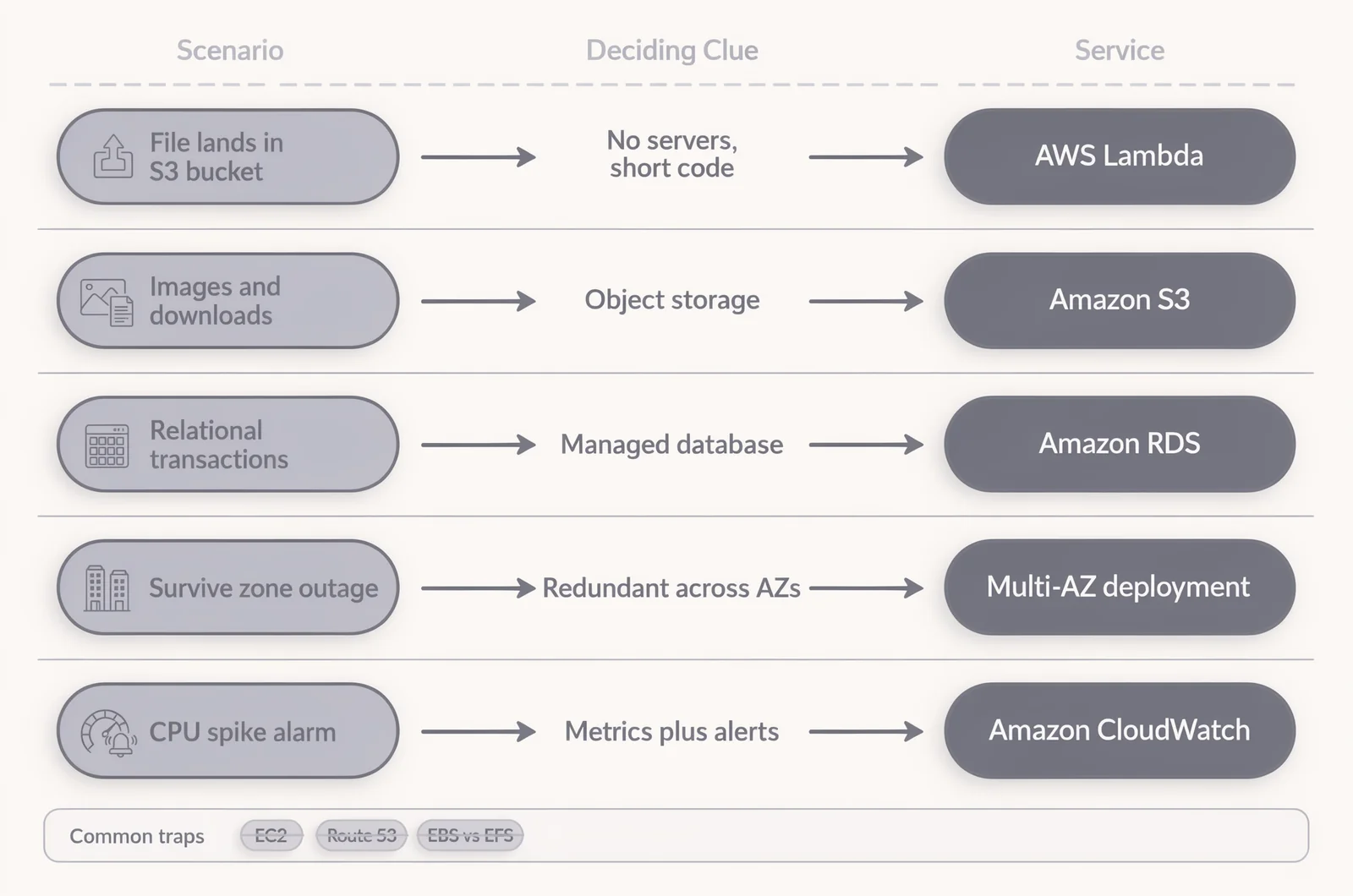
8. Which service runs short code after a file arrives?
A team wants a short function to run when an object is uploaded to S3, without provisioning or managing servers. Which service fits?
- A. Amazon EC2
- B. AWS Lambda
- C. Amazon RDS
- D. Amazon Route 53
Answer: B. AWS Lambda.
Lambda runs code in response to events and manages the underlying compute environment. An object upload can trigger a function.
EC2 provides virtual servers and gives customers more responsibility for managing them. RDS manages relational databases. Route 53 handles DNS and related traffic-routing functions. The decisive clues are event-triggered code and avoiding server management. The team still needs to write, configure, and secure its function.
9. Which storage service fits images and downloadable documents?
An application needs to store product images and PDF files as objects that it can retrieve by name. Which service fits?
- A. Amazon EBS
- B. Amazon EFS
- C. Amazon S3
- D. Amazon RDS
Answer: C. Amazon S3.
S3 is object storage. Images and documents stored as individually addressed objects fit that model.
EBS provides block storage associated with compute workloads. EFS provides a shared file system. RDS stores relational database data. All four can involve storing information, which makes the broad word storage insufficient. Identify how the application accesses its data: objects, blocks, files, or database records. In this question, named objects are the deciding detail.
10. Which service fits a managed relational database?
A business application uses SQL, related tables, and transactions. The team wants AWS to handle more database infrastructure administration. Which service fits?
- A. Amazon DynamoDB
- B. Amazon RDS
- C. Amazon Redshift
- D. Amazon ElastiCache
Answer: B. Amazon RDS.
RDS manages relational databases for application workloads. The combination of related tables, SQL, and transactions points toward this category.
DynamoDB is a NoSQL database service. Redshift targets data warehousing and analytics. ElastiCache provides in-memory caching. SQL alone can tempt readers toward Redshift, so consider the workload as a whole. This scenario describes an application’s transactional database. Customers still manage responsibilities such as their data, access permissions, and database configuration choices.
11. Which deployment layout supports surviving an Availability Zone failure?
A web application should remain accessible if one Availability Zone becomes unavailable. Which layout supports that requirement?
- A. All resources in one Availability Zone
- B. Redundant resources across two Availability Zones
- C. Two subnets within the same Availability Zone
- D. A larger instance in the original Availability Zone
Answer: B. Redundant resources across two Availability Zones.
Distributing redundant application resources across Availability Zones provides separation from a failure affecting one zone.
Two subnets in the same zone retain that shared failure exposure. A larger instance adds capacity but does not change its location. Keeping everything in one zone creates the same weakness. The application also needs suitable traffic distribution and data replication. Count the failure boundaries in the answers rather than counting instances or subnets.
12. Which service monitors CPU utilization and raises an alarm?
An operations team needs to track EC2 CPU utilization and receive a notification when a threshold is exceeded. Which service should it use?
- A. AWS CloudTrail
- B. Amazon CloudWatch
- C. Amazon Route 53
- D. AWS Budgets
Answer: B. Amazon CloudWatch.
CloudWatch collects monitoring data and supports alarms based on metrics. CPU utilization is a performance metric.
CloudTrail records account activity, such as API calls. Route 53 handles DNS and related routing functions. Budgets tracks cost or usage against configured thresholds. The word threshold appears in several monitoring contexts, so identify what is being measured. CPU points to operational monitoring; spending points toward billing tools; account actions point toward an activity record.
How do Billing, Pricing and Support questions distinguish estimates, alerts, and assistance?
Identify whether the scenario needs a forecast, a spending notification, a purchasing option, or help with an account issue.
13. Which tool estimates a workload’s cost before deployment?
A team wants to estimate monthly costs for a proposed AWS architecture before creating its resources. Which tool fits?
- A. AWS Cost Explorer
- B. AWS Pricing Calculator
- C. AWS CloudTrail
- D. Amazon Inspector
Answer: B. AWS Pricing Calculator.
Pricing Calculator estimates costs from proposed services and usage assumptions. It suits planning before deployment.
Cost Explorer helps analyze cost and usage data. CloudTrail records activity, while Inspector assesses vulnerabilities. An estimate depends on the inputs, so unrealistic usage assumptions can produce an unrealistic forecast.
Keep this workload estimate separate from your study budget. AWS certification exam costs concern booking a credential, which is a different expense from operating cloud resources.
14. Which tool alerts a team when spending approaches its budget?
A team wants notifications when actual or forecast spending approaches a chosen monthly amount. Which tool fits?
- A. AWS Budgets
- B. AWS Pricing Calculator
- C. Amazon Route 53
- D. AWS Artifact
Answer: A. AWS Budgets.
Budgets lets a team track spending against configured amounts and set notifications. The requirement concerns monitoring an account’s spending.
Pricing Calculator estimates a proposed workload. Route 53 handles DNS, and Artifact supplies compliance documentation. A budget notification alone does not impose a hard spending cap. If an answer claims that setting an alert automatically stops every charge, it adds behavior that the question has not established. Separate notification from enforcement.
15. Which EC2 purchasing option suits interruption-tolerant batch work?
A batch job can pause, save progress, and resume later. It has a flexible completion deadline and prioritizes lower compute cost. Which option fits?
- A. On-Demand Instances
- B. Spot Instances
- C. Dedicated Hosts
- D. Savings Plans
Answer: B. Spot Instances.
Spot Instances use spare EC2 capacity and can be interrupted. A job designed to resume can accommodate that tradeoff.
On-Demand suits workloads that need capacity without a usage commitment. Dedicated Hosts address requirements involving dedicated physical servers. Savings Plans involve usage commitments and fit a different purchasing decision. The scenario explicitly permits interruption, which makes Spot the strongest match. Saving progress matters because restarting the entire job could waste completed work.
16. Where should a company request help with an AWS invoice?
A company needs assistance understanding an unexpected charge on its AWS bill. Where should it raise the account or billing issue?
- A. AWS Support Center
- B. Amazon Inspector
- C. AWS Artifact
- D. Amazon VPC
Answer: A. AWS Support Center.
Support Center is the appropriate route for an account or billing support case. The company needs assistance with its bill.
Inspector examines supported workloads for vulnerabilities. Artifact supplies compliance reports and agreements. VPC provides networking resources. A security service cannot resolve an invoice question merely because both involve an AWS account. Read whether the prompt describes a charge, an account-access issue, or a technical workload failure before choosing the support route.
How should you review these answers before a timed practice test?
Record your answer and reasoning, then review every guess as carefully as an incorrect response.
A correct letter can hide a weak concept. For each uncertain item, write one sentence explaining the deciding clue. Add another explaining why the closest distractor fails. For example: “The workload can tolerate interruption, so Spot fits; a usage commitment is not the requirement.”
Turn recurring service mix-ups into short recall prompts. A guide to Leitner flashcard apps can help organize repeated review without rereading the entire answer bank.
A useful interactive review selector would accept missed or guessed question numbers and display the domain and concept to revisit.
Exam Dumpster’s timed mode and saved attempt history can help compare performance across separate sessions. Keep the question set unfamiliar where possible; remembering an answer’s position says little about understanding.
Use AWS practice exam scores alongside your ability to explain answers. Revisit any question where changing one requirement, such as allowing interruptions or requiring relational transactions, would change your choice.
Which language-accommodation rules should you check before booking?
Open a free sample set for their exam code, then create a free account to unlock the rest and save progress Get started |  |