What AWS Practice Exam Score Do You Need to Pass the Real Test?
By ExamDumpster Editorial Team· (updated Nov 7, 2026)

AWS practice exam score vs real readiness comes down to how you earned the percentage. A cautious personal target is 80–85% across three fresh, timed practice sets, with enough understanding to explain your choices. That is a suggested study rule, not an AWS requirement or a validated prediction of passing. For an after-work learner deciding whether to spend money on an exam, the useful evidence is consistent performance on unfamiliar questions, manageable timing, and fewer recurring knowledge gaps.
What practice percentage should you aim for before booking?
Use 80–85% on fresh, representative practice sets as a working target, then check whether your reasoning and timing support that result.
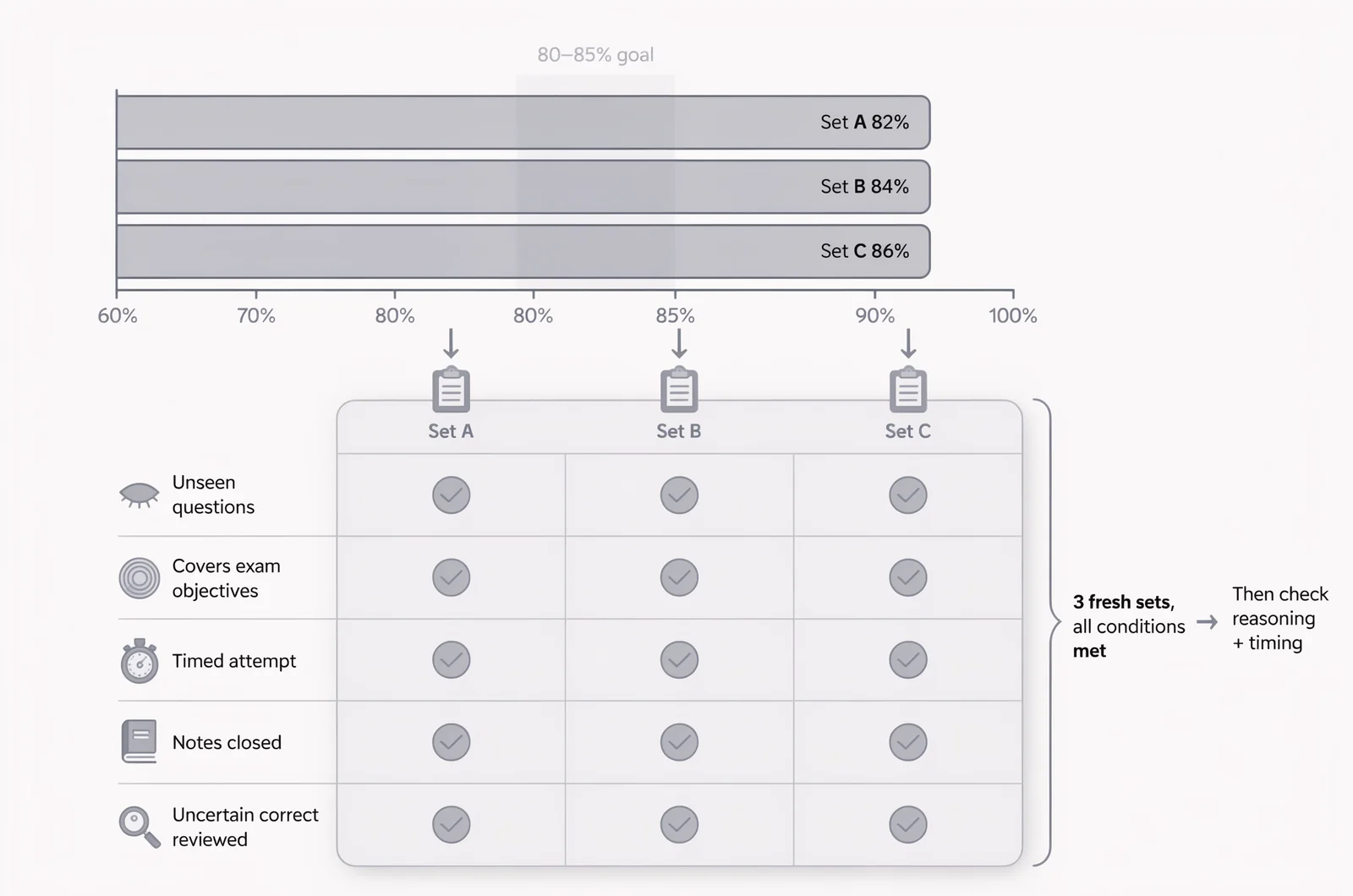
This range gives you a concrete study goal. It does not establish a universal boundary between ready and unready. Question quality, coverage, difficulty, and previous exposure all affect what a practice percentage means.
For this suggested rule, count three attempts that meet these conditions:
- The questions were unfamiliar before the attempt.
- The sets covered the objectives for your intended exam code.
- You completed them under an appropriate time limit.
- You kept explanations and notes closed until submission.
- You reviewed uncertain correct answers alongside incorrect ones.
Say you score 82%, 84%, and 86% on three separate sets. Those hypothetical results support a booking decision more convincingly if your errors are scattered and you can explain the answers afterward.
Now suppose those results all come from one narrow topic. They provide much less evidence about the rest of the exam.
Avoid treating 80% as a finish line you cross once. Write down the conditions beside each result, then judge the series.
Does an AWS passing score of 720 mean 72% correct?
No. A scaled passing score of 720 does not mean that answering 72% of a practice bank correctly will produce a passing result.
A raw practice percentage is the share of questions marked correct in that set. A scaled score expresses performance through a separate scoring system. The numbers look easy to compare, but dividing a scaled score by ten does not produce a reliable practice target.
If the guide for your chosen certification lists 700, 720, or 750 as its passing threshold, read that number as a scaled threshold. It is not a direct statement that you need 70%, 72%, or 75% on a third-party practice test.
Likewise, an 80% practice result cannot simply be relabeled as an official score of 800. Without a validated conversion for that particular practice assessment, the conversion is unsupported.
Readers preparing for several credentials should keep each scoring model separate. The explanation of ISACA scaled scoring concerns another certification system; its scale should not determine your AWS target.
Confirm the passing threshold in the exam guide for your exact AWS exam code.
Should you count first attempts or retakes?
Give first attempts on unfamiliar questions the greatest weight when judging readiness, and use retakes to check learning.
After reviewing an explanation, you may remember the answer, the scenario, or a distinctive phrase. A later correct response can reflect useful learning, answer recognition, or both. The percentage alone cannot separate them.
Shuffling previously seen questions changes their order. It does not make them unseen.
Suppose your first attempt is 68%, followed by 94% on the same questions two days later. That hypothetical improvement shows that something changed after review. It does not establish how you would perform on fresh scenarios.
Keep separate records for:
- First attempts on unseen questions.
- Repeat attempts after review.
- Focused drills on a weak objective.
All three serve a purpose. Fresh attempts help assess transfer to unfamiliar problems. Repeats help check whether you retained an explanation. Focused drills help repair a specific gap.
When revisiting a question, explain the reasoning before checking the answer. Then change one condition in the scenario: a tighter budget, a different recovery requirement, or less available administration time.
If that change alters your choice, explain why. Reserve your next unseen set for checking whether the lesson transfers.
What makes a timed practice score meaningful?
A timed score is useful when the attempt reasonably matches the demands you intend to assess: coverage, concentration, pacing, and independent decision-making.
First, match the practice material to the exam code you plan to sit. A familiar certification name is insufficient if the questions address different objectives.
Next, use mixed questions. A session devoted to one service can help you learn that service, but it provides limited evidence about switching between topics.
Set the timer according to the format described for your chosen exam. Keep notes and explanations closed, and record interruptions. An attempt paused repeatedly around work messages is difficult to compare with an uninterrupted session.
Exam Dumpster separates study mode from timed mode, so use each for a distinct purpose and keep the results identifiable in attempt history.
A realistic attempt also needs enough questions to test sustained attention. Eight correct answers out of ten produce 80%, as do forty correct answers out of fifty. The percentages match, but the longer set samples more decisions.
Treat a short sample as an initial check. For a booking decision, use broader coverage and record how much time remained.
Can a strong overall score hide a weak domain?
Yes. A strong total can coexist with a repeated weakness in one part of the exam objectives.
An overall percentage combines your stronger and weaker areas. It cannot tell you whether the same misunderstanding caused several errors.
Tag mistakes against the objectives for your exam code. Use the published objective structure rather than inventing a domain breakdown from memory. Then look for repeated problems.
A useful error note is specific: “Chose a service before checking the recovery requirement.” “Need to study storage” gives you much less direction.
Review correct answers too. If you guessed between two choices, mark that uncertainty separately. Keep the reported score unchanged, but preserve the uncertainty in your notes.
Avoid creating a firm domain percentage from only a handful of questions. One miss in a small group can change the number sharply.
For example, suppose a hypothetical candidate gets four of five security questions correct. The resulting 80% says little about security objectives that never appeared.
Use the domain notes to choose your next study task, then test that topic through different scenarios.
How should you review wrong answers and lucky guesses?
Review the decision behind each answer, then check whether you can apply the same reasoning to a changed scenario.
Reading an explanation once can feel productive without revealing what you misunderstood. Make the review active by answering four questions:
- What requirement in the scenario controlled the choice?
- Why did the selected answer meet that requirement?
- Why did the closest alternative fall short?
- What change would make that alternative appropriate?
For architecture questions, compare the requested outcome with constraints such as cost, availability, operational effort, and recovery needs. For concept questions, state the distinction in plain language.
A hypothetical mistake might involve choosing an approach with more administration when the scenario prioritizes low operational effort. The repair is understanding that tradeoff, rather than memorizing an answer position.
On Exam Dumpster, use study mode explanations for this review, then record a short note about the distinction you missed.
Candidates preparing for AI Practitioner can use the AIF-C01 sample questions as additional scenario material where relevant to their objectives.
Once you have studied those questions, label them as seen. Keep future readiness attempts separate.
What if two question banks give you very different scores?
Treat the difference as something to investigate before averaging the results or choosing the more reassuring number.
Two practice sets may differ in topic coverage, wording, difficulty, length, or scoring rules. Prior exposure can create another difference.
Compare the conditions first. Were both attempts timed? Did both cover the intended objectives? Had you already studied either bank? Were explanations available during one attempt?
Then inspect the disagreements. A lower result may expose a real gap, but it can also reflect ambiguous wording or material outside your intended scope.
When an explanation seems questionable, check the relevant AWS documentation or exam objective. Write down the unresolved point instead of treating either the provider or your first instinct as automatically correct.
Avoid combining 76% from one provider and 88% from another into a supposedly predictive 82%. The arithmetic is valid; the readiness interpretation may not be.
Choose the material you can justify through objective coverage and clear explanations. Compare later attempts under similar conditions, while keeping questions unfamiliar where possible.
Record the provider and set name beside every result.
How can you check readiness without buying several courses?
Start with the material you have, identify the evidence that is missing, and pay only when another resource fills a specific gap.
A free sample can reveal unfamiliar terminology, weak explanations, or a mismatch with your intended exam code. Its limited size makes it a starting point rather than a complete readiness assessment.
Exam Dumpster makes half of each sample bank available without an account; a free account provides access to the remaining sample questions and saved progress. Keep track of which questions you have already studied.
Before buying another resource, state the reason in one sentence. Perhaps you need unseen mixed questions, clearer explanations, or practical work on a recurring weakness.
“Another bank might make me feel ready” is harder to evaluate than “I need fresh scenarios covering these two objectives.”
Include the examination attempt in your budget. The guide to AWS certification exam costs can help you plan that spending without assuming a fee here.
If your available bank is exhausted, use documentation and practical exercises to repair gaps. Save any remaining unseen questions for a later assessment.
What should you record besides the percentage?
Record question familiarity, timing, coverage, and recurring uncertainty so the percentage has enough context to guide a decision.
A useful attempt log can stay brief:
- Date, exam code, provider, and set name.
- First attempt or repeat attempt.
- Number of questions and final percentage.
- Time used and any interruptions.
- Objectives behind wrong answers and uncertain correct answers.
Keep the original score intact. If you guessed five answers correctly, note five uncertain correct answers rather than creating an unofficial adjusted score.
After reviewing the attempt, choose one specific repair task. That could be explaining a service distinction, completing a small practical exercise, or revisiting an objective you could not describe.
For an after-work schedule, a hypothetical week might contain one assessment evening, one review evening, and one targeted study evening. Schedule the next fresh assessment after you have addressed the recorded gaps.
A useful interactive readiness tracker would flag repeated questions and missing timing data beside each result. It should show the evidence collected without inventing a probability of passing.
Keep your latest three fresh attempts visible together.
When is it reasonable to book the real AWS exam?
Booking becomes reasonable when several fresh results support the decision and your remaining weaknesses are specific enough to manage.
Use the suggested 80–85% target alongside these checks:
- You can complete representative sets within the intended time.
- Your results remain reasonably consistent across separate sessions.
- You can explain why plausible alternatives fail.
- Repeated errors have decreased after targeted review.
- Your material matches the objectives for your intended exam code.
You do not need to recognize every possible scenario. You do need a repeatable way to interpret requirements and choose among plausible answers.
Consider the pattern in your last few attempts. Similar percentages with better reasoning and fewer rushed decisions provide different evidence from similar percentages earned through recognition.
Also consider the conditions you can control. If your latest attempt followed a difficult shift, record that context. Arrange another comparable session before treating fatigue as either the whole explanation or an irrelevant detail.
Before booking, write a short readiness note with your recent fresh scores, timing, and two remaining weaknesses. If you cannot name the weaknesses clearly, review the attempt records first.
Should you postpone if your exam is booked and scores are borderline?
Consider postponement when fresh attempts still show repeated gaps, persistent timing problems, or heavy dependence on familiar questions.
One disappointing session should prompt a review of the conditions. Several comparable attempts with the same problems deserve more attention.
Use a short sequence to decide:
- Check the current rules attached to your appointment.
- Identify the recurring problem in your recent attempts.
- Complete a focused review session.
- Assess the repair with unfamiliar questions if available.
Make the review match the problem. Repeated rushing calls for a pacing exercise. A service-selection gap calls for comparing requirements and tradeoffs. Misread qualifiers call for slower scenario reading.
Avoid using a repeat score from the same bank as your only evidence that the problem is resolved.
If you have exhausted your questions, say so in your records. Repeated exposure limits what another percentage can establish. Practical exercises and explanation checks can still help, but they answer different readiness questions.
Base the appointment decision on the evidence you can describe. Record the unresolved issue and the study task required to address it.
Which AWS appointment rules should you check before changing your date?
Open a free sample set for their exam code, then create a free account to unlock the rest and save progress Get started |  |