CISM Work Experience Requirements: Full 5 Years vs Waiver Paths
By ExamDumpster Editorial Team· (updated Nov 6, 2026)

This CISM work experience waiver requirements guide compares three routes: five qualifying years, four years plus an accepted one-year substitution, or three years plus an accepted two-year substitution. The deciding factor is your background. A waiver can reduce the overall experience requirement, but you still need at least three years of information security management experience across three of the four CISM domains. Start there before spending money on another credential.
Passing the exam and qualifying for certification are separate milestones. Your planning needs to account for both, along with the evidence someone else can verify.
How the five-year and waiver paths compare
The CISM experience comparison starts with two checks: how much qualifying work you can document and whether an accepted substitution covers any shortfall.
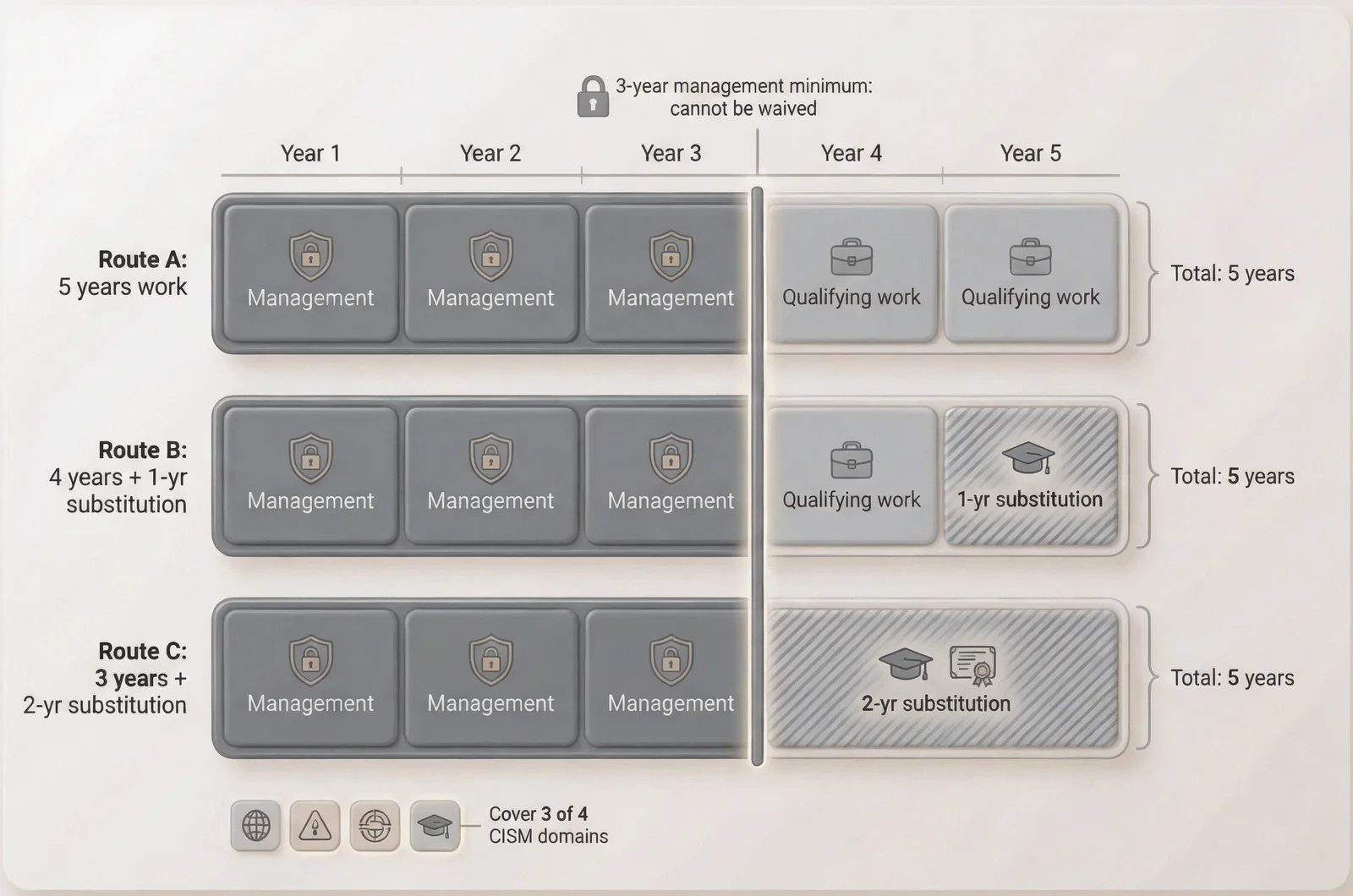
ISACA states a five-year experience standard and requires coverage across at least three CISM domains. Its application framework allows eligible substitutions while preserving the three-year management minimum. The reduced employment totals below assume an accepted degree or certification substitution.
| Experience route | Qualifying employment needed | Management experience that remains | Additional evidence |
|---|---|---|---|
| Full five-year route | Five years | At least three years across three domains | Verified employment and responsibilities |
| One-year substitution | Four years | At least three years across three domains | Proof of an accepted one-year substitution |
| Two-year substitution | Three years | At least three years across three domains | Proof of an accepted two-year substitution |
A work-based waiver has different arithmetic. If your claim uses other employment, that employment still happened and needs documentation. It does not reduce your actual working history in the same way as a degree or certification substitution.
The full route suits someone who already has enough qualifying experience. A substitution matters when it closes a genuine gap.
There is little practical value in pursuing another qualification solely to waive a year you will complete before earning it. Compare the remaining months, likely study effort, and documentation burden before choosing that route.
What can support a one-year or two-year waiver
CISM waiver eligibility depends on the particular qualification or experience claimed. The length of a degree program or difficulty of another exam does not determine its substitution value.
ISACA’s June 2022-and-later application distinguishes general security employment from credential and education substitutions. Use that framework for planning, then confirm the selections in your current application before relying on a waiver.
Qualifications associated with one year
The application lists a bachelor’s degree in information security or a related field, an accepted skill-based or general security certification, and one full year of information systems management experience among its one-year options.
A related degree needs a defensible connection to the stated field. If your degree title leaves that connection unclear, gather the transcript and course information before asking ISACA to assess it.
For a certification claim, confirm that the particular credential qualifies. A course completion certificate and a professional certification establish different things.
The practical fit is someone with four qualifying years who already holds an accepted qualification. Someone with three years should first calculate whether another year of work remains necessary.
Qualifications associated with two years
The application lists CISA or CISSP in good standing, and an eligible MBA or master’s degree in information security or a related field, among its two-year options.
These substitutions matter most to candidates who already have three years of suitable management experience. Having the qualification alone leaves the management requirement unresolved.
Check the exact degree wording if your field is adjacent to security. For CISA or CISSP, distinguish a passed exam from an awarded credential in good standing. Keep evidence that matches the claim you intend to submit.
Combining claims without counting the same evidence twice
The application limits applicants to one substitution in Section C. Its separate general security experience section excludes employment dates already claimed in the management section. These distinctions appear in the CISM application form.
Two one-year credentials therefore should not be treated as an automatic two-year substitution. Likewise, holding both CISA and CISSP does not create four years of credit.
Keep separate totals for management work, other eligible employment, and the selected substitution. Preserve the three-year management minimum when calculating the total.
The three years that still need management evidence
The CISM management requirement determines whether a waiver can help you now. Five years in an IT department may include relevant experience, but the calendar alone cannot establish your responsibilities.
Match responsibilities to the domain tasks
Use the task statements attached to your applicable CISM application to map your work. Start with what you actually did, then identify the domain it supports.
Possible responsibilities to examine include:
- Developing security policies and presenting decisions to business stakeholders.
- Assessing information security risks and tracking agreed treatment.
- Planning security program activities, resources, or performance reporting.
- Coordinating incident response plans, exercises, and follow-up work.
These are prompts for reviewing your history, rather than automatic eligibility findings. Each claim still needs accurate dates, task alignment, and verification.
For example, maintaining a vulnerability scanner establishes a technical responsibility. Deciding remediation priorities, reporting unresolved exposure, and coordinating treatment may provide additional management evidence. Describe each responsibility precisely.
One position may involve several domains. Record the actual employment period once, then show the domains supported by that work. Three years covering multiple domains should remain three years in your calendar calculation.
Explain the work behind the job title
A manager title gives the reviewer limited information about security responsibilities. An analyst or consultant title can also leave substantial responsibilities unexplained.
For each role, draft a short account of the security activity, your responsibility, and the resulting decision or deliverable. A useful description might explain how you maintained a risk register and coordinated treatment reviews.
Avoid expanding participation into ownership. If you prepared reports for someone else’s decision, say that.
If your documented work used COBIT 5, COBIT 5 sample questions can refresh that framework’s terminology. Your experience description must still reflect the responsibilities you performed.
Three backgrounds, three different eligibility decisions
The appropriate CISM route becomes clearer when you apply the requirements to a specific work history. The following examples are hypothetical planning illustrations; ISACA decides whether an application qualifies.
Five qualifying years and no substitution
Suppose you can document five years of suitable work, including the required management experience and domain coverage. You have verifiers who know those responsibilities.
The full experience route is the direct choice. Another degree or certification adds little to this application calculation.
Your remaining work is administrative: reconcile dates, select the applicable tasks, and arrange verification. Check that each claimed period fits the experience window before submitting.
Four qualifying years and a relevant bachelor’s degree
Suppose you have four qualifying years, sufficient management experience, and a bachelor’s degree that appears to match the one-year category.
The one-year substitution may close the experience gap. The unresolved question is whether the degree qualifies under the applicable wording.
Gather the degree evidence and clarify any field-of-study ambiguity. If you will complete five qualifying years soon, compare the effort of resolving that question with waiting until the full experience route becomes available.
Three qualifying years and CISSP in good standing
Suppose you hold CISSP in good standing and have three years of management work across the required domains.
The two-year substitution is worth assessing because it could bridge the entire remaining gap. Check the management evidence as carefully as the credential.
If only two years support management responsibilities, the substitution cannot fill that missing management year. Identify the remaining work requirement and set a date to review your eligibility again.
Build the evidence file for your chosen path
Every CISM route needs a work history that another person can verify. A substitution changes part of the evidence file; it leaves the underlying management claim in place.
Reconcile dates and responsibilities first
Create a working record with employer names, employment dates, qualifying responsibilities, domain mappings, and potential verifiers.
Use this record to identify overlapping periods and gaps before completing the application. If your responsibilities changed during one job, distinguish the relevant periods in your notes.
Then prepare concise examples for each claimed domain. Internal project names may mean little to a reviewer. Explain the security purpose and your contribution in ordinary language.
Useful preparation records may include role descriptions, performance reviews, project summaries, and approved responsibility statements. Keep confidential employer material within its permitted boundaries. Ask what evidence is required before sharing supporting documents.
Match each document to a claim
A degree supports an education substitution. Certification evidence supports a credential substitution. Employment verification supports the work performed.
Ask your verifier to review the dates and responsibilities you plan to claim. Resolve disagreements before submission.
ISACA’s current certification guidance directs candidates to obtain verification from a supervisor or manager. Follow the verifier instructions in the application you are using. See its certification application requirements.
A short eligibility checker could help organize this preparation: enter employment periods, domain coverage, and one proposed substitution. It should flag missing evidence and remaining months, while reserving the eligibility decision for ISACA.
Plan for experience, verification, and review separately
CISM timing involves your work history, your exam result, and the application process. A waiver can affect the first of these without making verification or review faster.
Keep both application windows visible
ISACA allows candidates to take the exam before meeting the experience requirement. Its guidance gives candidates five years after passing to apply and places qualifying work within the ten years preceding application.
Put both boundaries on your planning calendar. If you expect to apply later, check whether older employment will still fall inside the relevant window.
Taking the exam early can suit someone with a realistic path to the remaining experience. Someone whose next role is uncertain should consider that uncertainty before starting the application clock.
Compare the documentation burden of each route
A five-year applicant might need several former employers to verify different periods. A three-year applicant using a substitution could still need several verifiers.
Employment continuity matters more than the route’s label. A waiver claim also adds qualification evidence that may need clarification.
There is no sound basis here for promising that either route receives faster approval. Obtain the current processing estimate from ISACA and allow time for questions. Avoid tying an employment commitment to an assumed approval date.
Choose study work that fits the remaining gap
Once your eligibility plan is clear, CISM practice tests can support a separate exam preparation plan. Exam Dumpster is one practice resource; practice scores provide no evidence of professional experience.
If certification remains distant, focused study around ISACA IT Risk Fundamentals may fit an immediate learning need. Check that credential’s own requirements and objectives.
Choose study materials for the exam version you intend to take, then schedule an eligibility review alongside your study checkpoints.
Questions that change your CISM application plan
These CISM questions affect which route you can reasonably plan around and what evidence you need to collect.
Does passing CISM mean I am certified?
Passing completes the examination requirement. Certification still depends on meeting the applicable requirements and receiving approval.
Keep those milestones separate on your résumé and professional profiles. Record the exam result accurately while the certification application remains incomplete.
Can a waiver replace missing management experience?
The three-year management requirement remains in place. A two-year substitution can reduce the overall experience burden to three qualifying years when all other requirements are satisfied.
If your management history is shorter, calculate the remaining months and identify responsibilities that could address the gap.
Does any bachelor’s degree qualify for one year?
The application wording specifies information security or a related field. Treat an unrelated degree as an unresolved eligibility question.
Prepare the degree title and transcript information, then ask ISACA about the particular qualification before relying on it.
Should I earn another certification just for the waiver?
Compare its cost and preparation time with the qualifying experience you still need. Also consider whether that credential supports your career independently.
An accepted qualification you already hold may simplify your route. A new qualification requires its own investment. Write down your qualifying months, management coverage, and available substitution evidence before committing to another exam.
ISACA exam scores and certification sequencing
- Understand the ISACA exam scoring scale
- Compare CISA and CRISC sequencing
- The Contact Hours Vs PDUs Difference: How To Report Each To PMI
Open a free sample set for their exam code, then create a free account to unlock the rest and save progress Get started |  |