CISA vs CISM Career Path: Which Roles Each One Actually Opens
By ExamDumpster Editorial Team· (updated Nov 21, 2026)

A useful CISA vs CISM career path comparison starts with the work you want to own. CISA, the Certified Information Systems Auditor credential, aligns with IT audit and assurance. CISM, the Certified Information Security Manager credential, aligns with managing information security. Both involve risk, controls, and business priorities, but they approach those subjects from different responsibilities.
For an IT professional studying after work, that distinction matters. Choose the credential that supports your next realistic role before committing your evenings and exam budget. Neither credential guarantees a job, and neither replaces the experience behind the title.
CISA and CISM point toward different responsibilities
CISA is the closer fit when you want to assess whether technology controls work and support a defensible audit conclusion. CISM is the closer fit when you want responsibility for a security program and its business results.
An auditor might examine whether access reviews are complete, test the supporting evidence, and report weaknesses. A security manager might decide how those reviews should operate, assign responsibility, and secure resources to fix persistent gaps.
The subject overlaps. The accountability differs.
That gives you a practical starting point:
- Choose CISA when your next role centers on independent assessment, audit evidence, control testing, and findings.
- Choose CISM when your next role centers on security priorities, risk decisions, program delivery, and incident management.
- Consider a sequence when your career genuinely crosses both areas, such as moving from IT audit into security governance.
Neither credential defines a rigid career boundary. An audit manager needs leadership skills, and a security manager needs enough technical understanding to challenge weak assumptions. Read the responsibilities in a target job description before relying on its title.
The roles on each path and the work behind them
The strongest reason to choose CISA or CISM is a clear connection between its subject matter and the responsibilities you want next.
CISA and the IT audit route
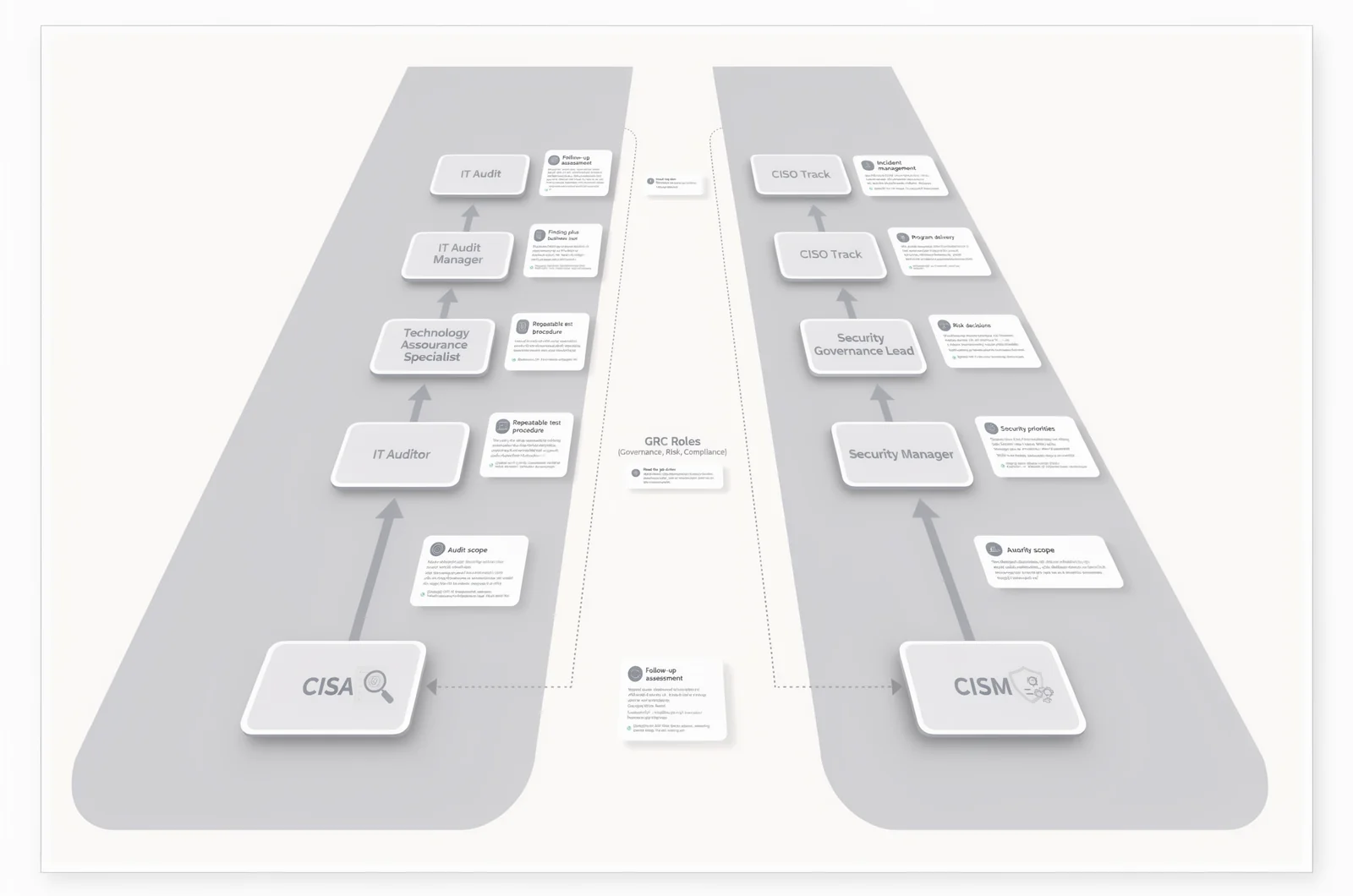
CISA aligns with roles such as IT auditor, technology assurance specialist, and IT audit manager. These positions examine systems, processes, and controls to determine whether an organization manages technology risk appropriately.
The audit emphasis connects directly to planning an assessment, gathering evidence, testing controls, and communicating findings. Broader coverage of technology governance, system changes, operations, and information protection gives context for that assessment.
For example, understanding change management helps an auditor assess whether production changes receive appropriate approval and testing. The career value comes from applying that knowledge to evidence.
Useful work products include:
- An audit scope tied to business risks.
- A test procedure that another auditor could repeat.
- A finding that connects a control weakness to its business consequence.
- A follow-up assessment that checks whether corrective action addressed the problem.
Progression toward audit management adds responsibility for engagement planning, review quality, stakeholder discussions, and staff development. CISA supports the subject knowledge; a promotion also requires evidence that you can direct reliable audit work.
CISM and the security management route
CISM aligns with security manager and security governance responsibilities. It also fits professionals building toward broader security leadership, including a potential CISO path.
Its management emphasis connects governance, information risk, security programs, and incident management. Those areas concern how security supports business objectives and how management chooses between competing demands.
Relevant work might include translating a risk assessment into a funded improvement plan, assigning control responsibilities, or explaining security priorities to business leaders.
Useful work products include a security roadmap, a business case for an improvement, and a report that explains whether the program is reducing meaningful risk.
The limitation is seniority. Passing a management-focused exam does not demonstrate that someone can manage budgets, resolve competing priorities, or lead an incident response. Those responsibilities need workplace evidence. For a CISO-track role, broader organizational leadership remains part of the development plan.
GRC roles need a closer reading
Governance, risk, and compliance work can sit between these paths. A GRC title alone does not settle the choice.
If the position emphasizes control assessments, evidence review, and assurance reporting, CISA may fit better. If it emphasizes security policy, program coordination, and decisions about risk treatment, CISM may fit better.
Look at the verbs in the job description. Test, assess, validate, and report suggest an assurance emphasis. Direct, prioritize, implement, and manage suggest responsibility for delivery.
Match the credential to the responsibilities that occupy most of the role.
Choose the first credential from your current role
Your starting point changes which credential creates the clearest career story. Compare several possible routes rather than treating either certification as a universal first choice.
| Current role | Target responsibility | Likely first choice | Experience to build alongside study |
|---|---|---|---|
| Internal auditor | Assess technology controls | CISA | IT audit scoping, evidence review, and control testing |
| IT compliance analyst | Perform technology assurance | CISA | Documented assessments and clear findings |
| Systems administrator | Move toward security program management | CISM | Risk-based improvement planning and stakeholder coordination |
| Security analyst | Lead a security function | CISM | Program ownership, prioritization, and management reporting |
| IT auditor | Become an audit manager | CISA | Engagement leadership and review of other auditors’ work |
| GRC analyst | Manage security governance | CISM | Policy ownership, risk treatment tracking, and program metrics |
These routes are career guidance, not eligibility decisions. A systems administrator might prefer audit, while a compliance analyst might already own a security program. Actual responsibilities take priority over the first column.
When your current work supports both
Use your next job as the tie-breaker. If you want to stay in assurance for the next move, CISA creates a direct connection. If you want to take responsibility for implementing security improvements, CISM may support that transition.
Then identify the experience gap. Someone who tests controls may need opportunities to own remediation before moving into management. Someone who operates controls may need experience assessing evidence independently before moving into audit.
A useful career selector could ask for your current responsibilities, preferred work, and target role, then show the better-fitting credential and the experience gaps to address.
Write down the target role before choosing a study package.
Experience requirements and hiring evidence shape the sequence
Both CISA and CISM have a five-year experience baseline, but their qualifying experience rules are different. Treat exam preparation and certification eligibility as separate planning questions.
Check which work qualifies
A job title cannot establish whether your background meets a credential’s requirements. What you did, when you did it, and how it maps to the relevant experience categories matter.
For CISM, use the detailed guide to CISM work experience requirements to examine that issue separately. Confirm the applicable requirements before treating a possible substitution or waiver as part of your plan.
This comparison does not resolve individual eligibility. Keep a record of relevant responsibilities and identify who can verify that work.
If certification remains some distance away, consider which assignments would build useful experience while you study. An access-control review, risk assessment, or security improvement project may support career development, depending on your responsibilities.
Build evidence for the role you want
Hiring evidence should match the path.
For audit, prepare examples of how you selected evidence, evaluated a control, handled an incomplete response, and explained a finding. Describe the reasoning without sharing confidential material.
For security management, prepare examples of how you prioritized work, coordinated stakeholders, tracked remediation, or explained a risk decision. Show where you held responsibility.
A strong example states the problem, your decision, and the result you can substantiate. If you cannot explain your contribution clearly, seek a more defined responsibility on the next project.
Test career fit with one access-control problem
The difference between CISA and CISM becomes easier to understand when both paths examine the same situation.
Consider a hypothetical organization where former contractors retain access after their assignments end. This is a shared security problem, but the two career paths contribute different work.
The auditor’s assignment
An auditor would define the assessment scope and determine what evidence could establish whether access removal works.
That might involve comparing contractor departure records with account status, examining approval records, and checking whether the control operated throughout the period under review.
The auditor would also distinguish a documented procedure from evidence that people followed it. A policy requiring prompt removal does not establish that accounts were actually disabled.
The resulting finding should explain the condition, the expected control, and the risk. The auditor can later assess whether remediation addressed the weakness.
The security manager’s assignment
A security manager would coordinate the response and establish responsibility for fixing the process.
That could involve agreeing on a reliable departure notification, assigning account-removal ownership, and resolving exceptions. The manager would also need a way to monitor whether the revised process works.
If departments disagree about responsibility or resources, management must address that conflict. A technically sound recommendation still needs someone to put it into operation.
Ask which assignment you would rather repeat: determining whether the control works, or organizing the people and resources needed to make it work. Use that preference alongside the experience your next role requires.
Spend study time on the career path you can use
Once you choose between CISA and CISM, connect preparation to the responsibilities behind that choice. This helps keep study time focused.
Check the reasoning behind your answers
For CISA-oriented practice, explain what evidence supports an assessment and why a proposed audit response fits the situation.
For CISM-oriented practice, explain how a decision relates to business priorities, risk ownership, or program responsibilities.
Getting a question right through recognition gives you less information than explaining why the alternatives are weaker. After a practice set, record whether an error came from missing knowledge, misreading the scenario, or applying the wrong perspective.
Exam Dumpster’s study mode, timed mode, and answer explanations can support these different checks. Study mode gives space to examine reasoning; timed practice helps you assess how you make decisions under a time limit.
Keep practice results separate from career fit
A stronger practice score in one subject does not automatically make it the better career choice. Familiar work may simply make its scenarios easier to interpret.
The guide to the ISACA exam scoring scale explains scoring separately. Use practice results to identify study gaps rather than estimate hiring prospects.
For a limited budget, choose one primary exam first. Set a study schedule that fits your working week, and review the second credential only when it supports a defined role change.
Finish each study session by explaining one decision in your own words.
Questions about moving between audit and security management
CISA and CISM can support different stages of a career, but switching paths requires more than adding another credential.
Can CISA lead to a management role?
Yes. Audit management involves leadership, planning, quality review, and communication with senior stakeholders. CISA aligns with the audit subject matter behind those responsibilities.
Moving from audit management into security program management is a further change. Build evidence of delivery, prioritization, and ownership of improvements.
Is CISM the better choice for a future CISO?
It is the closer fit between these two credentials because its emphasis is security management. A CISO path also requires broader leadership experience and the ability to explain security decisions in business terms.
Identify a management responsibility you can own before treating the credential as a direct route to an executive title.
Should you earn both?
Both can make sense when your work crosses assurance and security management. There is no need to assume that sequence at the start.
Complete the first credential for a specific purpose. Reassess the second after your responsibilities change or a target role creates a clear reason to pursue it.
Which certification pays more?
A useful salary comparison needs matching roles, seniority, location, and responsibilities. Comparing an early-career auditor with a security manager mixes different career stages.
Compare compensation ranges for the jobs you would realistically pursue after each credential. Choose the path whose responsibilities you want and whose experience requirements you can work toward.
Audit and risk certification sequencing
Open a free sample set for their exam code, then create a free account to unlock the rest and save progress Get started |  |