Certified Coding Specialist Salary: Entry Level to Experienced
By ExamDumpster Editorial Team· (updated Sep 29, 2026)

If you are weighing the CCS credential, the first question is usually the money one: what does a certified coding specialist salary actually look like, and does it hold up once you factor in experience, state, and whether the job is remote? This page answers that in the order people ask it. Entry-level pay first, then pay after two to five years, then the states at the top and bottom of the range, then remote work, then what the credential itself changes. Each answer is short enough to use on its own, because most readers arrive from a search for one specific number.
One thing to settle before any figure: "certified coding specialist/Salary)" is not one job. The CCS is an AHIMA credential, and holders work in hospital inpatient coding, outpatient facilities, physician practices, and payer-side audit roles. Those settings pay differently, sometimes by tens of thousands of dollars. So treat every number below as a band, not a promise.
What does a certified coding specialist earn at entry level?
New CCS holders typically land between roughly $45,000 and $58,000 a year, with most of that spread explained by setting rather than skill. Hospital inpatient coding pays at the top of that band because the work is more complex and the employer is larger. A small physician practice pays at the bottom.
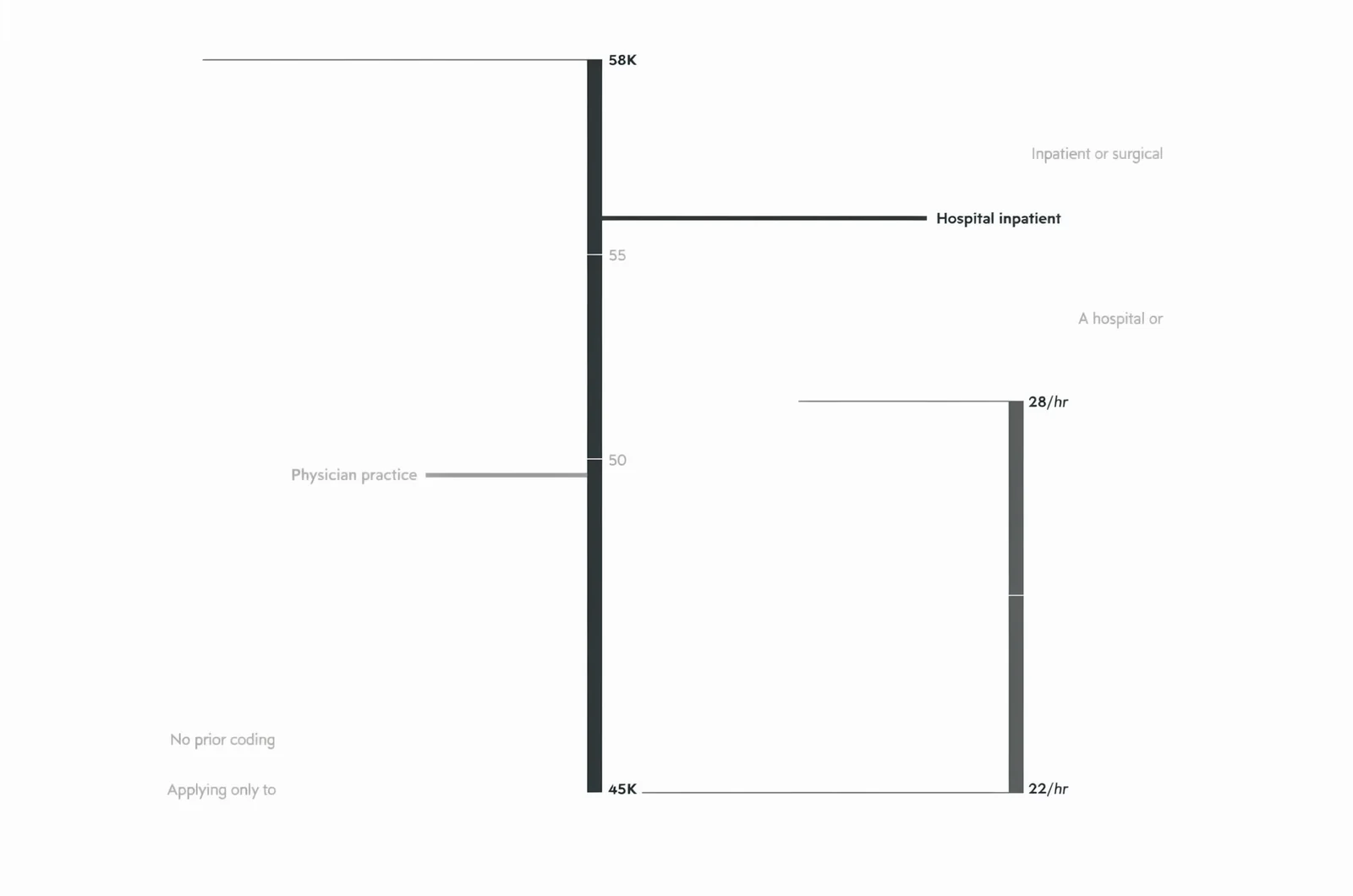
Hourly, that works out to somewhere near $22 to $28 for a first coding job. Payscale's Certified Coding Specialist (CCS) Hourly/Hourly_Rate) data tracks CCS holders in that range, and the pattern holds across most salary aggregators.
Two things push a new coder toward the bottom of the band:
- No prior coding work history, even with the credential in hand
- Applying only to physician offices, where volume is lower and pay scales are flatter
And two things push toward the top:
- A hospital or health system employer with a formal coding department
- Inpatient or surgical coding exposure, which is where CCS training actually points
For context, the Bureau of Labor Statistics groups coders under "medical records specialists," a category with a national median in the low $50,000s. That figure mixes certified and uncertified staff across every setting, so it is a floor-level reference, not a CCS-specific number.
How much more do you earn after two to five years?
The jump from year one to year five is the biggest single move in a coding career. Coders with two to five years of experience commonly report $55,000 to $72,000, with the upper end concentrated in hospital systems and specialty coding.
The reason is straightforward. After a couple of years you stop needing review on routine charts, you pick up a specialty, and you become the person who catches the DRG error before it goes out the door. Employers pay for that.
Specialty matters more than tenure at this stage. Coders working in these areas tend to sit above the general range:
- Inpatient facility coding
- Surgical and procedural coding
- Emergency department coding
- Risk adjustment and HCC coding
Certification stacking shows up here too. AAPC's salary research reports an average of $74,557 for members holding two or more credentials and $81,227 for those with three or more, against $67,147 for CPC holders with one. Those figures come from a different certifying body and a different survey population than CCS data, so do not merge them into a single number. The direction, though, is consistent: additional credentials correlate with higher pay, partly because people usually add them after they have already moved into more senior work.
Which states pay certified coding specialists the most?
California, New Jersey, Massachusetts, Connecticut, and Washington consistently sit at the top of state-level coding pay. California is the clearest outlier, with average CCS pay running well above the national figure.
ZipRecruiter's state-level data puts Ahima Certified Coding Specialist Salary in California at a median near $60,800 a year, with an average hourly rate around $29.69. Compare that to the national picture and the gap is real, though a chunk of it disappears once you account for cost of living in the Bay Area and Southern California metros.
At the other end, the lowest-paying states cluster in the South and parts of the Midwest. Rural markets pay less than metros in the same state, sometimes by $8,000 to $12,000 for the same job title.
A rough ranking of the drivers, in order of how much they move the number:
- Setting (hospital inpatient vs. physician office)
- State and metro
- Specialty
- Years of experience
- Credentials held
Notice that geography is second, not first. A coder in a mid-paying state working inpatient at a large health system will often out-earn a coder in a high-paying state working a small clinic.
Do remote coding jobs pay less?
Usually not less, and sometimes more. Remote coding has become the default in much of the field, and employers generally set remote pay against the same scale as on-site roles in the same system.
Where remote work does change the math:
- Location-based pay scales. Some large employers adjust pay to the cost of living where you live, not where the hospital is. If you live in a low-cost market and work remotely for a system in a high-cost one, you may get the lower scale.
- Contract and per-chart work. Some remote coding is paid per chart rather than per hour. Per-chart rates can beat hourly pay for a fast, experienced coder and fall well below it for a slow one.
- Fewer on-site premiums. Shift differentials and on-site bonuses disappear in remote roles.
Remote work also widens the map. A coder in a low-paying state can apply to systems in California, Washington, or Massachusetts without moving. That tends to pull pay up over time in markets that used to be capped by local employers.
Does the CCS credential itself raise your pay?
Yes, and the size of the bump is worth understanding before you spend money on the exam. Certified coders earn more than uncertified ones by a consistent margin across surveys. One 2026 analysis of the field puts certified medical records specialists at an average of $67,260 against $55,721 for non-certified peers, a gap of about 20.7%. A separate AAPC survey cited in the same reporting puts certified records specialists roughly 16.6% above uncertified peers.
The CCS specifically carries weight in hospital settings. AHIMA's Certified Coding Specialist (CCS) credential is built around inpatient and facility coding, which is exactly where the higher-paying coding jobs sit. Employers hiring for inpatient roles often list CCS as a requirement rather than a preference, which means the credential does not just raise your pay within a role, it opens roles that are closed to uncertified applicants.
What the credential does not do is guarantee a number. It gets you past the screening filter. Your offer still depends on setting, geography, and how you interview.
What does a CCS salary look like compared with CPC and CCS-P?
The three credentials point at different work, and the pay reflects that.
| Credential | Typical focus | Pay pattern |
|---|---|---|
| CCS | Hospital inpatient and facility coding | Higher end of coding pay, strongest in hospital systems |
| CPC | Physician and outpatient coding | Broadest job market, mid-range pay, strong in practices and billing companies |
| CCS-P | Physician-based coding | Similar to CPC, with a hospital-system flavor |
Payscale tracks Certified Coding Specialist/Salary)-Physician-based (CCS-P) Salary/Salary) separately from the CCS, and the two do not land in the same place. The CCS-P sits closer to the CPC band. The CCS sits higher because inpatient coding is harder to staff.
If your goal is the highest ceiling, CCS plus inpatient experience is the strongest combination. If your goal is the fastest route to a first job, CPC opens more doors because more employers hire for outpatient work. Plenty of coders hold both, and the stacking effect on pay is real.
How do you check what the job pays in your market?
Aggregator averages are a starting point, not an answer. The number that matters is what employers near you are posting right now.
A practical sequence:
- Search job boards for "CCS" plus your metro, and sort by date rather than relevance.
- Filter for hospital and health system employers specifically, since those set the top of the local range.
- Note whether postings list a range. More states now require it, which makes this easier than it used to be.
- Compare against the aggregator figures on this page to see whether your market runs above or below the national band.
- Check whether the roles are inpatient or outpatient. That single word often explains a $15,000 difference in the same city.
If you want a rough estimator: take the national entry band of $45,000 to $58,000, add 10 to 20 percent for a hospital inpatient role, subtract 5 to 10 percent for a small physician practice, then adjust for your state using the top-and-bottom patterns above. It will not be exact, but it will keep you from anchoring on a single national average that does not describe your market.
What should you do while you are still studying?
The salary question usually shows up before the exam does. If you are still preparing, the credential is the lever, and the exam is the gate.
The CCS exam is not a memorization test. It asks you to read documentation and assign codes correctly under time pressure, which is why practice with explained answers matters more than reading a review book cover to cover. Working through CPC practice questions alongside CCS material is a reasonable move if you are still deciding between credentials, since the two overlap on fundamentals and diverge on inpatient depth.
If you are weighing the CPC route instead, the CPC certification requirements walk through eligibility and what the exam expects. And if billing is the part of the workflow that interests you more than coding, the medical billing certification path is a separate track with its own pay curve.
One practical note on study costs, since they come out of the same budget as everything else: exam fees, prep materials, and a possible retake add up. Free sample question sets are worth using before you buy anything, and a timed practice run under exam conditions tells you more about readiness than a stack of notes does. Exam Dumpster's CCS and CPC sample banks open half their questions without an account, with explanations on every answer, so you can gauge where you actually stand before committing to a paid prep course.
The salary bands on this page are current as of 2026 reporting and will shift. Check them again before you negotiate.
Where to go next
- CPC Certified Professional Coder Sample Questions
- What It Takes to Be a CPC Certified Professional Coder
- Certified Professional Biller Certification: First Steps Checklist
Open a free sample set for their exam code, then create a free account to unlock the rest and save progress Get started |  |