Certified Professional Biller Certification: First Steps Checklist
By ExamDumpster Editorial Team· (updated Sep 26, 2026)

The CPB certified professional biller credential is the billing-side counterpart to AAPC's better-known coding certifications, and the path to it is a short sequence of decisions you can audit before you spend a dollar. Most people who stall out do so in the same two places: they buy prep material before confirming they qualify, or they book an exam date before they know how many CEUs renewal will demand. This checklist walks through eligibility, membership, application, study scheduling, and recertification in the order the steps actually happen, with the finished state for each one so you know when to move on.
Confirm You Meet the Eligibility Path Before You Pay for Anything
AAPC does not require a degree or a set number of work hours to sit the CPB exam. What it does require is a decision about how you'll satisfy the training expectation, because that choice changes your timeline and your budget more than any other step.
There are two common routes. The first is a formal medical billing training program, which typically runs several months and bundles exam prep into the coursework. The second is the experience route, where you already work in billing, claims, or revenue cycle and can document that background. If you're in the second group, you can move straight to scheduling. If you're in the first, finish the program before you book, because the exam assumes working familiarity with claim forms and payer rules rather than teaching them from scratch.
The eligibility question is really a readiness question in disguise. AAPC won't check your transcript at the door, but the exam will. A candidate who has never touched a CMS-1500 form outside a textbook tends to lose time on the scenario questions, not because the content is obscure but because the reasoning depends on having seen how a real claim moves through a payer. If you're choosing between a cheaper program that finishes fast and a slower one with a practicum or externship attached, the practicum is usually the better buy even at a higher sticker price.
One exception worth noting: if you're already certified as a CPC, the overlap in revenue cycle knowledge is real, and AAPC publishes guidance on holding both credentials together. That doesn't waive the CPB exam, but it does shorten your study runway. Coders who already read operative reports and apply modifier logic daily tend to clear the compliance and medical necessity sections with far less review than a newcomer.
Finished state: you can name which route you're taking and roughly when you'll complete it.
Join AAPC Before You Apply for the Exam
Exam registration and membership are separate purchases, and the order matters for one practical reason: your AAPC member number is what ties your exam result to your record and what you'll need at renewal.
Membership dues run annually, and the rate differs between individual and student memberships. Because AAPC adjusts dues periodically, confirm the current figure on the membership page at the time you enroll rather than trusting a number from an older guide. If you're enrolling through an approved program, ask whether a student rate applies to you before you pay the individual rate. The gap between the two rates is often enough to cover a study guide, so it's worth the email.
The exam itself is priced separately from membership. Published figures put a single attempt in the low $400s, with a two-attempt bundle priced higher but cheaper per attempt. If you're paying out of pocket, the bundle is worth a hard look, because a retake at full price is the single most expensive mistake in this process. Do the math on the worst case rather than the best one: if there's a realistic chance you sit the exam twice, the bundle costs less than two single attempts and removes the sting from a bad first sitting.
One more ordering detail that trips people up: register your membership under the exact legal name that appears on your government ID. The testing center checks identification against your registration, and a mismatched middle name or a maiden name still on file is a common reason candidates get turned away at the desk and lose a paid seat.
Finished state: active AAPC membership with a member number you can log in with.
Book the Exam and Understand What You're Sitting For
The CPB exam is 200 multiple-choice questions delivered over roughly five hours and forty minutes, and it's open-codebook. That last detail changes how you should prepare. You are not memorizing CPT, ICD-10-CM, and HCPCS Level II codes; you are learning where to find them fast and how to apply them to a scenario under time pressure.
Fifty of those 200 questions are pre-test items that don't count toward your score, which is standard practice across professional credentialing exams. You won't know which ones they are, so treat every question as scored. That also means a question that feels oddly worded or out of scope is not necessarily a signal that you've wandered off the outline.
The content spans the full revenue cycle: patient registration and data capture, insurance verification, medical necessity, claim submission, accounts receivable, and the compliance rules that sit over all of it, including HIPAA and consumer-driven health plans. AAPC's own Medical Billing Certification page lays out the credential's scope, and the Certified Professional Biller (CPB)® exam page covers the international sitting if you're testing outside the US.
Before you book, decide between an in-person testing center and a remote proctored sitting. Remote is convenient, but it comes with room requirements: a clear desk, a working webcam, and no interruptions for the full duration. If your home has thin walls, kids, or a doorbell that rings, the testing center is the lower-risk choice. Check your confirmation email for the specific rules on what you may bring, because the allowed-materials list is stricter than most candidates assume, and a prohibited item on your desk can end the session.
Finished state: a scheduled exam date and a confirmed testing format, in person or remote, that you've verified against your own confirmation email.
Build a Study Plan Around the Domains, Not the Calendar
The most common study failure is spreading effort evenly across the exam outline. It shouldn't be even. Claim submission, reimbursement methodologies, and compliance carry more weight than the administrative opening sections, and the questions you'll miss are usually the ones where two answers both look defensible until you apply the payer rule correctly.
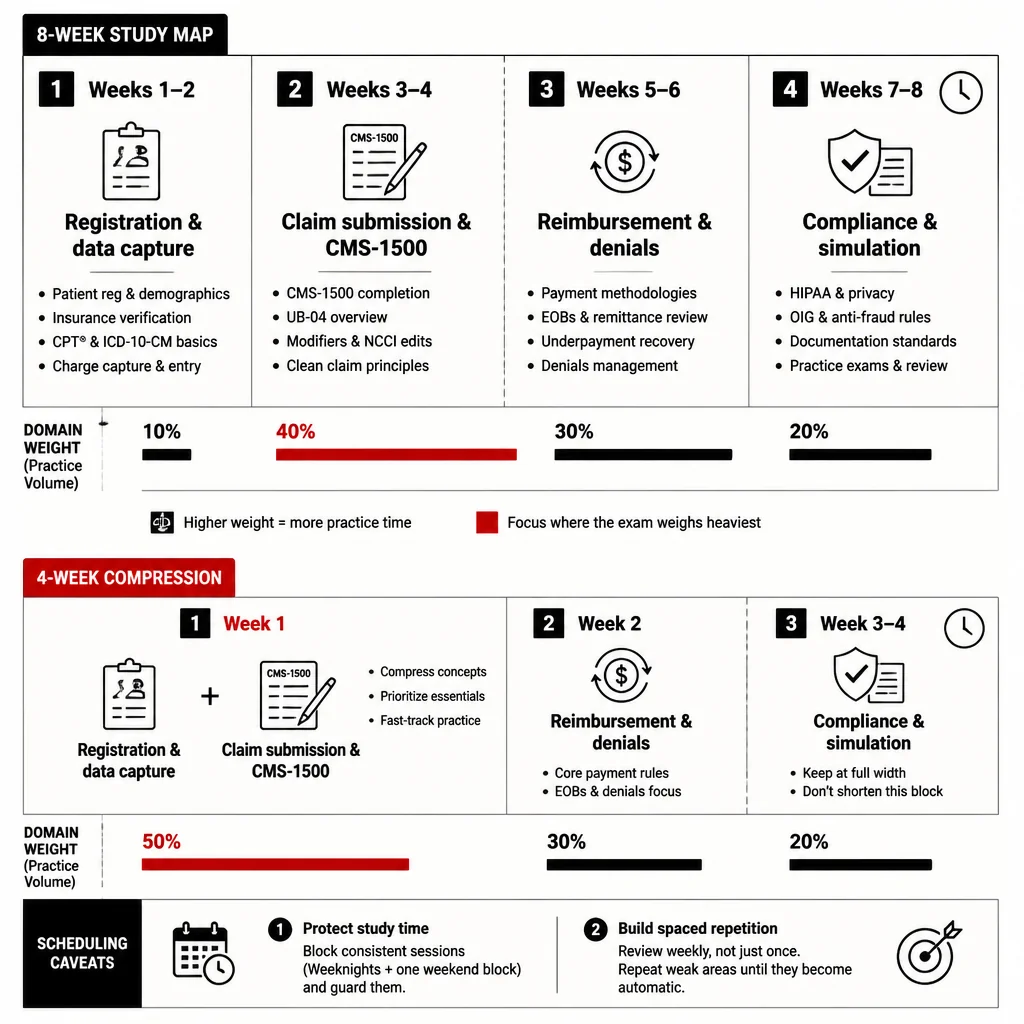
A workable eight-week structure for someone studying after work:
- Weeks 1–2: registration, data capture, and insurance verification. Low question volume, high terminology load.
- Weeks 3–4: claim submission and the CMS-1500 form. This is where most of your practice questions should go.
- Weeks 5–6: reimbursement methodologies, medical necessity, and denial management.
- Weeks 7–8: compliance, HIPAA, and full-length timed simulations.
If you're on a four-week timeline instead, compress weeks 1–2 into a single week and keep the compliance block intact. Compliance questions are the ones people skip and then miss.
Two scheduling caveats matter more than the plan itself. First, protect at least one long block per week, three hours or more, because a full-length simulation can't be chopped into twenty-minute pieces without losing its value. Second, build in a catch-up week if your job has a month-end close or a busy enrollment period, since billing departments rarely slow down on request. A plan with no slack is a plan you abandon in week five.
For practice, AAPC's CPB Coding Study guide runs 14 chapters mapped to exam sections with sample questions and test-taking technique. If you want a sense of the question style before buying anything, AAPC publishes Medical Billing Training sample pages you can read free. Read those pages early, before you commit to a study method, because the question format tells you more about how to study than any outline does.
An interactive readiness estimator would help here: a short form where you enter your weekly available hours, your start date, and your exam date, and it returns a week-by-week topic allocation with the compliance block locked in. That's the one calculation most candidates get wrong on their own.
Finished state: a written week-by-week plan with a named topic for each study block, not just "study billing."
Test Your Readiness With Timed Practice, Not Chapter Quizzes
Chapter quizzes tell you whether you understood the chapter. They don't tell you whether you can work 200 questions in under six hours with an open codebook and a clock running.
The readiness check that matters is a full-length, shuffled simulation under exam conditions: no notes, no pausing, codebook open exactly as it will be on test day. A certification exam simulator that saves your score history is more useful than a one-off practice run, because the trend across three or four attempts tells you more than any single result.
Two signals to watch. First, your accuracy on claim submission and reimbursement questions specifically, since that's where the exam concentrates. Second, your timing on the last 50 questions, because fatigue shows up there first. If you're finishing with less than 20 minutes to spare and your accuracy drops in the final quarter, you need another timed run before you sit.
There's a third signal that's easy to overlook: how often you change a right answer to a wrong one. Review your flagged and corrected questions after each simulation. If your first instinct is consistently better than your second, you have a test-strategy problem rather than a knowledge problem, and the fix is a rule about when to leave an answer alone.
Flashcards earn their place in the last week, when you're drilling terminology and code categories rather than reasoning through scenarios. They're a poor substitute for simulations earlier in the plan, because recall drills don't build the lookup speed the open-codebook format rewards.
Finished state: three consecutive timed simulations at or above your target score, with stable timing across all four quarters of the exam.
Know What Renewal Will Cost You Before You Celebrate
Passing is the midpoint, not the finish. The CPB renews on a two-year cycle and requires 36 continuing education units plus active AAPC membership for the full period. That works out to roughly 18 CEUs a year, which is manageable if you spread it and painful if you don't.
The trap is letting membership lapse. If your membership expires, you're not just paying a reinstatement fee; you may be looking at re-examination depending on how long the gap runs. Set a calendar reminder 90 days before your renewal date, and log CEUs as you earn them rather than reconstructing two years of certificates at the deadline. A simple spreadsheet with columns for date, provider, topic, and units takes minutes to maintain and saves a frantic weekend later.
CEUs are available from webinars, workshops, online courses, and professional development events, and a meaningful share of them are free or low cost. AAPC's How to become medical biller: step-by-step series is one example of the kind of free content that carries credit or builds toward it.
Watch the specialty rules as well. Some CEUs must fall within your credential's subject area, and a stack of unrelated credits won't clear the requirement even if the total hours look right. Read the renewal policy once, at the start of your first cycle, and file it somewhere you'll find it again.
Finished state: a renewal date on your calendar, a CEU tracking method you'll actually use, and membership set to auto-renew.
What the Credential Is Worth in the Current Market
AAPC's 2026 salary reporting puts CPB-certified professionals at an average of $63,874 in 2025 earnings, up 18.5% from $53,903 in 2020. That's a real increase, and it's worth weighing against total cost: membership, exam fee, study materials, and any retake.
The honest caveat is that the credential's value depends heavily on what you do with it. Billing roles that touch payer contracting, denial management, or compliance tend to pay above the administrative baseline, and those are the roles where the CPB carries the most weight. If your plan is to stay in a narrow claims-entry function, the return is thinner.
There's also a live industry argument about where billing work is heading. A Blue Cross Blue Shield Association study estimated that hospitals' growing use of AI-assisted billing tools added roughly $942 million in excess costs to the BCBS system over two years, with the share of inpatient cases billed as complex rising from about 37% in early 2023 to roughly 40% by late 2025. Whatever side of that debate you land on, it points the same direction for your career: the biller who understands compliance and payer rules is more durable than the one who only enters codes.
One more practical note on the salary figure. Averages blend every experience level and every market, so a new credential holder in a lower-cost metro should not expect to start at the average. The number is most useful as a trend line, not a starting offer.
Questions People Ask Before They Register
Do I need billing experience to sit the CPB exam? No. AAPC doesn't require documented work hours. What the exam assumes is working familiarity with claim forms and payer rules, which you can get from a training program or from time on the job.
How long should I study? Eight weeks of focused after-work study is a reasonable target for someone starting from a training program. Four weeks is workable if you already work in billing and compress the administrative sections.
What happens if I fail? You can retake, but you pay again unless you bought the two-attempt bundle up front. That's the main argument for the bundle if you're self-funding.
Can I hold the CPB and CPC at the same time? Yes, and AAPC publishes guidance on the dual-credential path. The two cover different parts of the revenue cycle, so the CEU load stacks rather than overlaps.
Is the exam open book? Open codebook, not open notes. You bring your coding manuals; you don't bring prepared notes or study guides.
Does the CPB expire if I stop working in billing? The credential follows your membership and CEU status, not your employment. Let the membership lapse and the clock starts working against you regardless of whether you're currently in a billing role.
Where to Go From Here
- CPC certification guide
- PROFESSIONAL-5 Sample Questions
- AICP Aicp Certification Exam Sample Questions
Open a free sample set for their exam code, then create a free account to unlock the rest and save progress Get started |  |