What It Takes to Be a CPC Certified Professional Coder
By ExamDumpster Editorial Team· (updated Sep 24, 2026)
Becoming a CPC certified professional coder is a sequence, not a single decision. You confirm you qualify, join AAPC, apply for the exam, learn three code sets well enough to use them under time pressure, then sit a proctored test that rewards speed as much as accuracy. Most people do this while working full time, which is why the order of operations matters as much as the hours you put in. This walkthrough covers the starting state, the prerequisites, the study sequence, how to tell whether you are ready, and what to do if the first attempt does not go your way.
What the CPC Credential Actually Covers
The CPC is a medical coding certification, not a clinical one. It tests whether you can read a patient encounter and assign the correct codes for the diagnosis and the services performed. AAPC, the organization that issues it, describes the credential as the most recognized medical coding certification in the healthcare industry, and the exam itself tests your ability to apply CPT, HCPCS Level II, and ICD-10-CM codes to professional medical services.
Three code sets sit at the center of the work:
- ICD-10-CM for diagnoses. This is the "why the patient was seen" side of the claim.
- CPT for procedures and services, maintained by the American Medical Association. This is the "what was done" side.
- HCPCS Level II for supplies, drugs, and services that CPT does not cover.
You also need working knowledge of modifiers, coding guidelines, and the regulatory rules that decide when a code is payable. Anatomy and physiology show up constantly because you cannot assign a diagnosis code to a body system you cannot identify.
One detail that surprises new candidates: passing the exam earns you the CPC-A, with the "A" standing for apprentice. The full CPC designation comes after you document real coding work experience. The exam is the gate, but the credential has a second stage.
The code sets themselves change every year, and that affects what you study. The AMA released the CPT 2027 code set with 299 new codes, 74 revisions, and 80 deletions, part of 453 total editorial changes. The CPT 2026 set added 288 new procedure codes, deleted 84, and revised 46. AAPC exams are based on the current calendar year's code sets, so a study guide built around last year's books is already behind.
Before You Apply: Eligibility, Membership, and Cost Planning
You cannot schedule the exam until you are an AAPC member. If you have never joined, you must do so before booking a seat, and renewing members also need a current membership to sit for a certification exam. Treat membership as a prerequisite, not an optional add-on.
AAPC does not require a formal coding course to sit the exam, but it does expect you to demonstrate proficiency across evaluation and management, anesthesia, surgery, radiology, pathology, and medicine, plus a sound grasp of guidelines and regulations. In practice, most candidates arrive through one of three routes:
- A structured CPC preparation course. AAPC sells its own, and third-party programs exist. MedCerts, for example, lists its Professional Coder online training at $3,500, which bundles materials and the certification exam fee.
- Self-study with code books and a question bank. Cheaper, but you own the pacing and the risk of studying the wrong material.
- On-the-job exposure. Common for people already working front desk, billing, or claims roles who want the credential to move up.
Budget beyond the exam fee. You need current-year CPT, ICD-10-CM, and HCPCS Level II books, and you may need a retake. The books alone run into the hundreds of dollars, and they must be current. AAPC allows books from the preceding year, the current year, or a mix, but only one copy of each book is permitted in the exam room, and anything older than one year is not allowed.
A practical cost check before you commit: add membership, exam fee, current code books, and one retake buffer. If that total is uncomfortable, self-study with a free sample bank is the lower-risk entry point, and you can upgrade later.
Building a Study Sequence That Survives a Full Work Week
The failure mode here is not laziness. It is studying in the wrong order and running out of time on the sections that carry the most questions. Build the sequence around how the exam is weighted, not around which chapter is easiest.
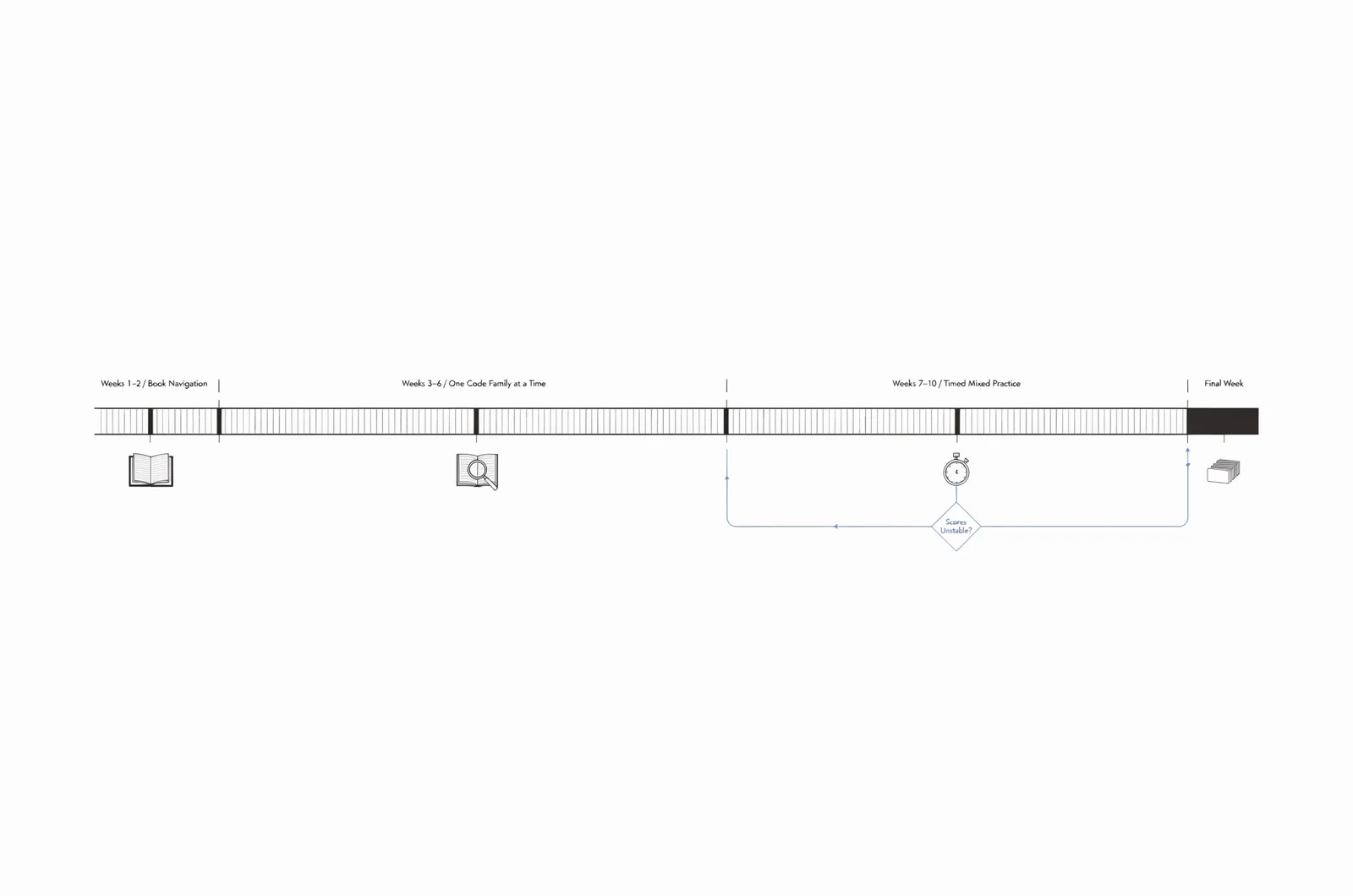
Weeks 1-2: Learn the books before the codes
Spend the first stretch learning how to navigate the code books, not memorizing codes. You will look up nearly everything during the exam. What you need is speed at finding an entry, reading the tabular list, and following the index without losing your place.
Practice this deliberately. Pick ten random diagnoses, time yourself finding each one in ICD-10-CM, then repeat until the lookup is automatic. This is the single highest-return drill in the early weeks.
Weeks 3-6: Work one code family at a time
Take ICD-10-CM first, then CPT, then HCPCS Level II. Within CPT, work in the order the exam tests: evaluation and management, then anesthesia, surgery, radiology, pathology, and medicine. E/M questions tend to be dense with documentation, so give them extra repetitions.
After each block, do a short set of questions on that block only. The goal is not a score. The goal is to notice which guideline you keep misapplying.
Weeks 7-10: Switch to timed, mixed practice
Once the code families are familiar, stop studying them in isolation. Run mixed sets under a clock. The exam gives you roughly two minutes per question on average, and that average hides the fact that some questions eat five minutes while others take thirty seconds.
This is where a question bank with an explanation on every answer earns its place. Knowing a question was wrong is useless. Knowing the guideline you skipped is what moves your score. Exam Dumpster's banks are mapped to published exam objectives and attach an explanation to each answer, which is the format that turns a missed question into a corrected habit.
The final week
Drop new material. Run flashcards on modifiers and high-frequency guidelines, review your saved notes, and do one full timed simulation two or three days out. Then stop. Cramming new code families in the last 48 hours mostly adds anxiety.
How to Tell You Are Actually Ready
Readiness is a pattern, not a feeling. Look for these signals before you book.
Your timed scores are stable, not spiking. A single 85% after three 60% attempts is noise. Three consecutive timed runs in the same band is a signal.
You can explain your misses. If you can say why the right answer is right and where your reasoning broke, you are learning. If you are guessing and moving on, you are not.
You finish with time left. Running out of time on a practice simulation usually means you will run out on the real thing.
Your weak domains have narrowed. Track misses by domain. If surgery is still your worst area after four weeks of practice, that is the section to drill, not the one to hope does not appear.
A useful tool idea while you are at this stage: a simple readiness estimator that takes your last three timed scores, weights them by domain, and flags any domain below a threshold you set. You can build it in a spreadsheet in twenty minutes, and it removes the temptation to book the exam because you had one good night.
Sitting the Exam: What the Day Demands
The exam is proctored and open-book, which changes how you prepare. You are not memorizing codes. You are demonstrating that you can find and apply them correctly under a clock, with only the approved books in front of you.
Bring the current-year books, and bring only one copy of each. Confirm the format and current requirements through the CPC Exam page before you travel, because scheduling rules and exam logistics are set by AAPC and can change.
Two habits separate candidates who pass from those who run out of time:
- Answer the easy questions first. If a question requires three lookups, flag it and move. Come back with the time you saved.
- Read the documentation fully before opening a book. Half of wrong answers come from coding a detail the question did not actually state.
If you want a sense of how a healthcare certification exam paces its questions, the healthcare quality certification exam sample set runs a similar timed format and is a low-stakes way to rehearse the rhythm.
If the First Attempt Does Not Go Your Way
A failed attempt is a data problem, not a verdict. The overall pass rate for the CPC exam fluctuates between 70% and 80% depending on the preparation path, and first-time test takers without structured preparation struggle more. If you are in the group that missed, the fix is usually specific.
Pull your score report and identify which domains cost you the most questions. Then rebuild the study sequence around those domains only. Do not restart from week one. If surgery and E/M were your weak areas, four weeks of targeted drilling will do more than ten weeks of general review.
Check the retake window and any waiting period before you rebook, and confirm whether your code books are still current for the new exam date. A retake that crosses into a new calendar year may require new books.
One more thing worth knowing if you are weighing this credential against others: the CPC is not the only path into medical coding, and the CPB certified professional biller track covers the revenue-cycle side rather than the coding side. Coders and billers work the same claims from different ends.
Questions Candidates Ask Before Booking
Do I need a degree to sit the CPC exam? No. AAPC does not require a formal degree, but you do need current membership before you can schedule, and you need to demonstrate proficiency across the coding sections the exam covers.
How long should I study? Ten weeks of dedicated preparation is a reasonable floor for someone studying around a full-time job. Candidates with prior billing or coding exposure often need less.
Can I use last year's code books? AAPC allows books from the preceding year, the current year, or a combination, but only one copy of each. Books older than one year are not allowed in the exam room.
What is the difference between CPC-A and CPC? Passing the exam earns the CPC-A, or apprentice designation. The full CPC comes after you document qualifying coding work experience.
Is the exam open book? Yes. You bring approved code books and use them during the exam. The skill being tested is accurate, fast lookup and correct application, not recall.
What happens if I fail? You can retake the exam after any required waiting period. Review your domain-level score report, drill the weak areas, and confirm your books are still current before rebooking.
Where to Go From Here
The sequence is fixed: confirm eligibility, join AAPC, get current code books, study in exam-weighted order, prove readiness with timed mixed sets, then sit the exam. The variable is how efficiently you use the hours you have.
Start with the code books and a timed baseline. If you want a low-commitment way to see where you actually stand, open a free sample set for your exam code and run a timed block before you buy anything else.
References
How to get CPC certified? — The Certified Professional Coder (CPC) credential is the most recognized medical coding certification in the healthcare industry. Employers value individuals who demonstrate
Certified Professional Coder (CPC) Online — CPC® Preparation Course – Pass CPC® Exam - AAPC Pulling your records... ### #### ### CPC® Preparation Course – Pass CPC® Exam - AAPC
Open a free sample set for their exam code, then create a free account to unlock the rest and save progress Get started |