Free GCP-PMLE sample questions
Real questions from the Professional Machine Learning Engineer practice bank, with the correct answer and an explanation for each one. No junk, no filler.
Try them in the simulator Same questions, with study, timed and flashcard modes.
Showing 10 of 20 free sample questions.
You have trained a deep neural network model on Google Cloud. The model has low loss on the training data, but is performing worse on the validation data. You want the model to be resilient to overfitting. Which strategy should you use when retraining the model?
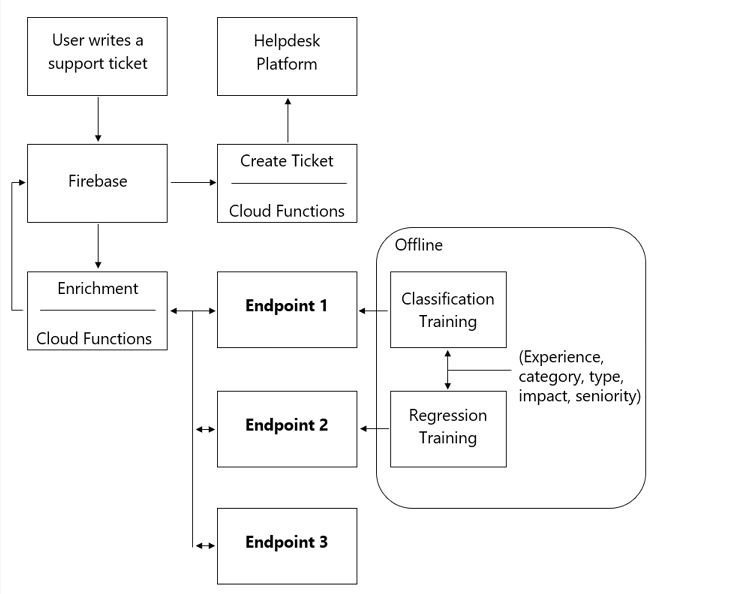
You are designing an architecture with a serverless ML system to enrich customer support tickets with informative metadata before they are routed to a support agent. You need a set of models to predict ticket priority, predict ticket resolution time, and perform sentiment analysis to help agents make strategic decisions when they process support requests. Tickets are not expected to have any domain-specific terms or jargon. In the proposed architecture, new tickets trigger enrichment Cloud Run functions that call three endpoints: endpoint 1 predicts ticket priority, endpoint 2 predicts ticket resolution time, and endpoint 3 performs sentiment analysis. The enriched tickets are then routed to support agents. Which endpoints should the enrichment functions call?
You work for a credit card company and have been asked to create a custom fraud detection model based on historical data using AutoML on Gemini Enterprise Agent Platform (formerly Vertex AI). You need to prioritize detection of fraudulent transactions while minimizing false positives. Which optimization objective should you use when training the model?
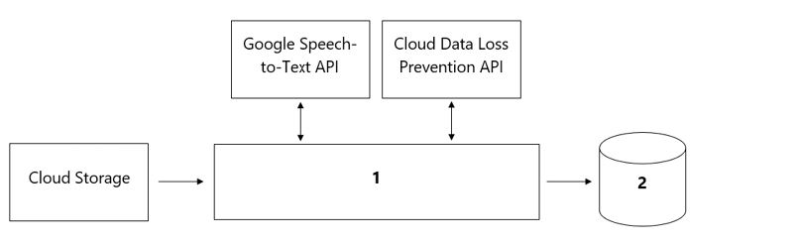
Your organization’s call center has asked you to develop a model that analyzes customer sentiments in each call. The call center receives over one million calls daily, and data is stored in Cloud Storage. The data collected must not leave the region in which the call originated, and no Personally Identifiable Information (PII) can be stored or analyzed. The data science team has a third-party tool for visualization and access which requires a SQL ANSI-2011 compliant interface. You need to select components for data processing (component 1) and for analytics (component 2). How should the data pipeline be designed?
You are developing ML models with Gemini Enterprise Agent Platform (formerly Vertex AI) for image segmentation on CT scans. You frequently update your model architectures based on the newest available research papers, and have to rerun training on the same dataset to benchmark their performance. You want to minimize computation costs and manual intervention while having version control for your code. What should you do?
You work for an advertising company and want to understand the effectiveness of your company’s latest advertising campaign. You have streamed 500 MB of campaign data into BigQuery. You want to query the table, and then manipulate the results of that query with a pandas dataframe in a Gemini Enterprise Agent Platform Workbench instance (formerly Vertex AI Workbench). What should you do?
You are developing a Kubeflow Pipelines (KFP) pipeline that runs on Gemini Enterprise Agent Platform Pipelines (formerly Vertex AI Pipelines). The first step in the pipeline is to issue a query against BigQuery. You plan to use the results of that query as the input to the next step in your pipeline. You want to achieve this in the easiest way possible. What should you do?
You are building a model to predict daily temperatures. You split the data randomly and then transformed the training and test datasets. Temperature data for model training is uploaded hourly. During testing, your model performed with 97% accuracy; however, after deploying to production, the model’s accuracy dropped to 66%. How can you make your production model more accurate?
You need to train a computer vision model that predicts the type of government ID present in a given image using a GPU-powered virtual machine on Compute Engine. You use the following parameters: • Optimizer: SGD • Image shape = 224*224 • Batch size = 64 • Epochs = 10 • Verbose = 2 During training you encounter the following error: ResourceExhaustedError: Out Of Memory (OOM) when allocating tensor. What should you do?
10 more free samples are waiting
Create a free account to unlock the whole GCP-PMLE sample bank, or get full access to all 241 practice questions in the simulator.