Free ASP sample questions
Questions from the Associate Safety Professional® (ASP®) practice bank, with the correct answer and an explanation for each one. No junk, no filler.
Try them in the simulator Same questions, with study, timed and flashcard modes.
Showing 6 of 12 free sample questions.
A competent person performs soil testing on an 8-foot-deep utility excavation. Initial pocket penetrometer tests indicate cohesive clay soil with an unconfined compressive strength of 1.9 tons per square foot (tsf). However, heavy dump trucks operate within 10 feet of the excavation crest, and distinct vertical tension cracks are visible along the trench walls. Under OSHA 29 CFR 1926 Subpart P, how must this soil be classified?
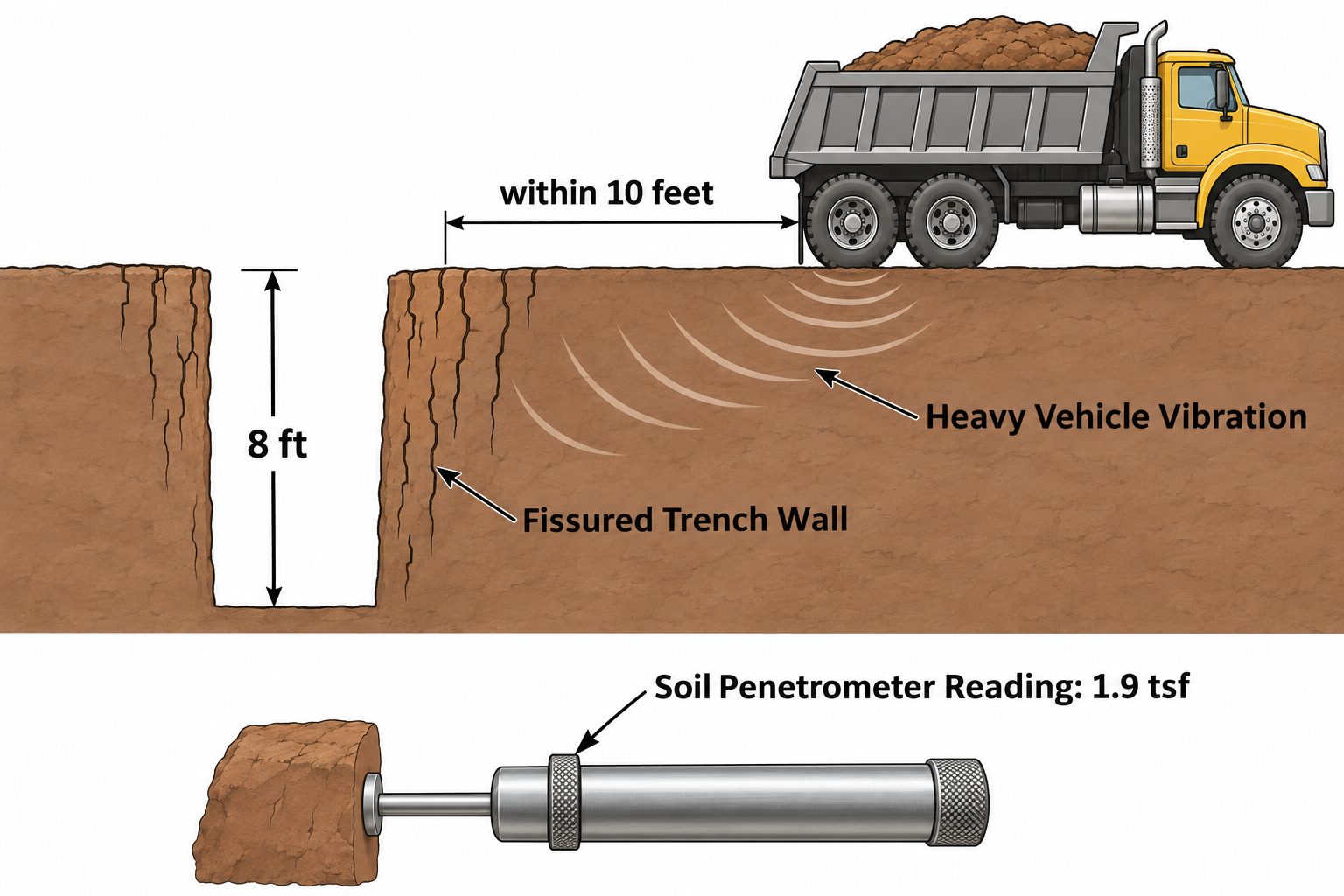
A civil utility contractor is excavating an 8-foot-deep, 5-foot-wide linear trench spanning 100 feet in cohesive Type B soil to install a municipal sewer lateral. Workers must enter the trench bottom to grade aggregate and assemble pipe couplings. During an unannounced safety inspection, the safety professional observes that excavated spoil piles are deposited 14 inches from the trench lip, and a single extension ladder is positioned at the far eastern terminus of the 100-foot trench run. No trench boxes, shoring struts, or sloping benches are in place because the foreman claims the soil is stiff and dry. The safety professional immediately stops all work within the trench. To achieve full regulatory compliance under OSHA 29 CFR 1926 Subpart P before employees re-enter, which set of corrective actions must the contractor implement? flowchart TD A[Excavation Depth >= 5 ft] --> B[Competent Person Soil Analysis] B --> C{Soil Classification} C -->|Type B Soil| D[Install Protective System: Trench Box or Sloping 1:1] D --> E[Set Spoil Piles Back >= 2 ft] E --> F[Provide Egress Ladder Every 25 ft Lateral Travel]
Under OSHA 29 CFR 1926 Subpart P, excavated spoil piles and other loose materials must be placed at least _____ from the edge of the excavation to prevent cave-in hazards and material rollout.
A packaging engineer conducts an ergonomic assessment of a manual depalletizing station using the Revised NIOSH Lifting Equation. The baseline Load Constant (LC) is 51 lb (23 kg). Analysis of the lifting task yields the following multipliers: Horizontal Multiplier (HM) = 0.85, Vertical Multiplier (VM) = 0.90, Distance Multiplier (DM) = 0.95, Asymmetric Multiplier (AM) = 0.80, Frequency Multiplier (FM) = 0.70, and Coupling Multiplier (CM) = 1.00. What is the calculated Recommended Weight Limit (RWL) for this task?
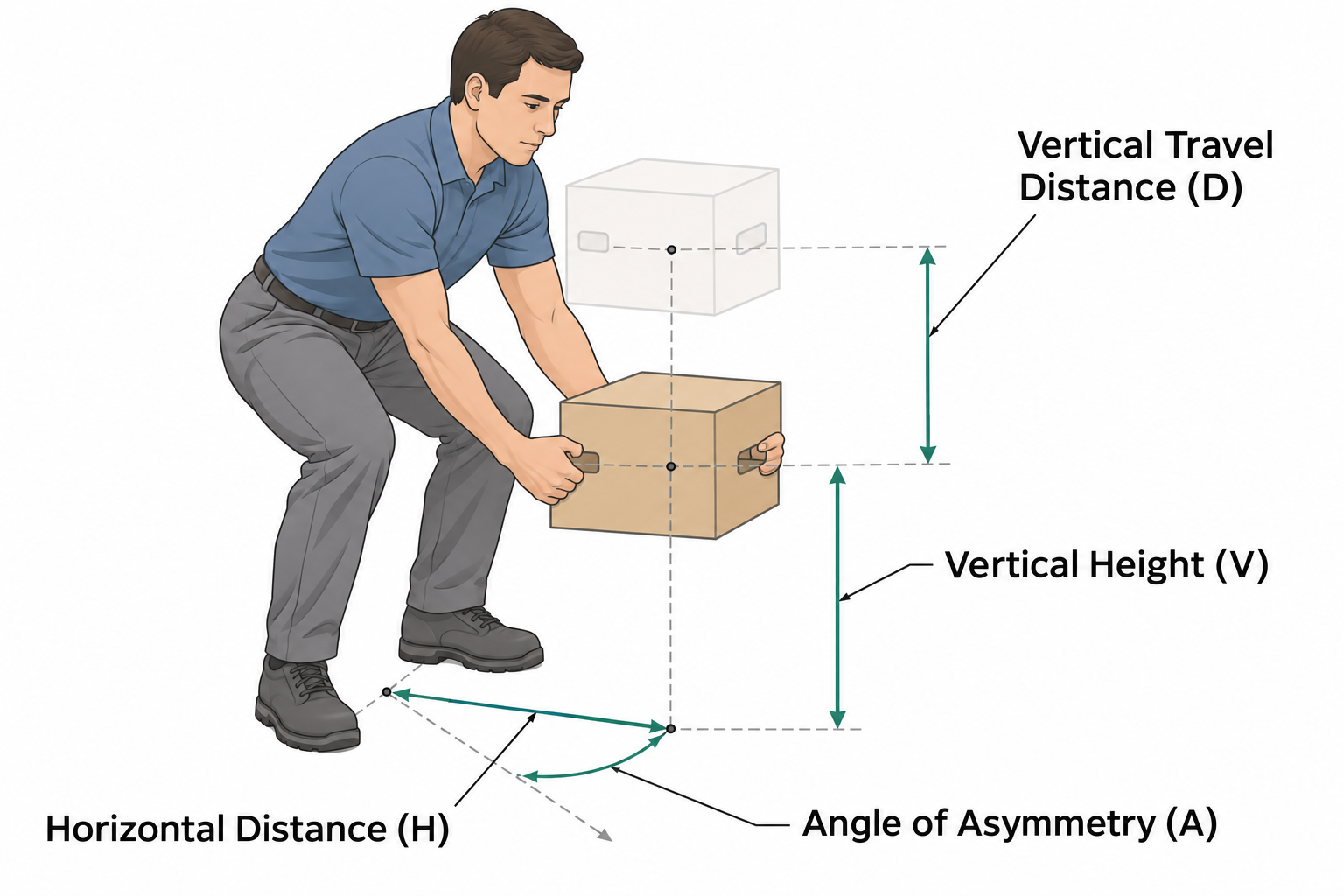
During a workstation ergonomic review in an e-commerce fulfillment warehouse, an analyst calculates a Recommended Weight Limit (RWL) of 18 pounds for an order-picking station. Workers at this station routinely lift totes weighing 36 pounds throughout their shift. What is the Lifting Index (LI), and how should the safety professional interpret the result?
6 more free samples are waiting
Create a free account to unlock the whole ASP sample bank, or get full access to all 141 practice questions in the simulator.