Free CTRN sample questions
Questions from the Certified Transport Registered Nurse (CTRN) practice bank, with the correct answer and an explanation for each one. No junk, no filler.
Try them in the simulator Same questions, with study, timed and flashcard modes.
Showing 6 of 12 free sample questions.
A critical care transport nurse prepares to perform Rapid Sequence Induction (RSI) on an adult trauma patient with impending respiratory failure. A team member suggests applying continuous cricoid pressure (Sellick maneuver) during laryngoscopy. Based on current airway resuscitation guidelines, what is the primary reason this practice is no longer routinely recommended?
The transport team is preparing to intubate a 4-year-old child in severe septic shock. A local provider suggests administering atropine 0.04 mg IV as routine premedication to prevent vagally mediated bradycardia. What is the transport nurse's most appropriate response regarding this intervention?
The transport team is initiating invasive mechanical ventilation on an intubated 45-year-old male with acute respiratory distress syndrome (ARDS) secondary to severe sepsis. The patient is 5 feet 10 inches (178 cm) tall with an actual weight of 120 kg (264 lbs). His calculated predicted body weight (PBW) is approximately 73 kg. Referring to the lung-protective ventilation curve in the figure, which initial tidal volume setting adheres strictly to evidence-based ARDS protocols?
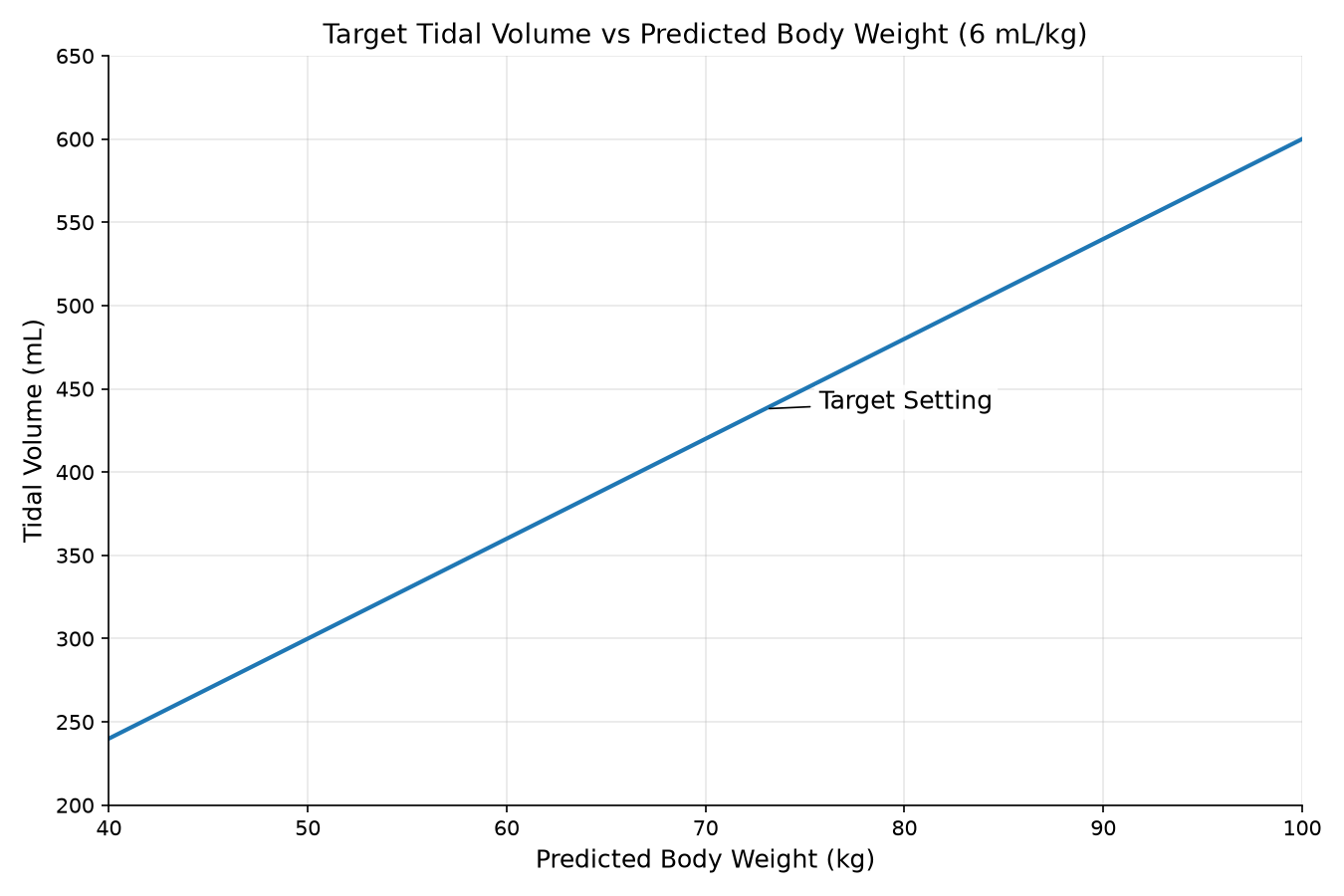
When managing an intubated critical care patient receiving invasive mechanical ventilation for severe acute pulmonary injury during ground transport, the inspiratory plateau pressure (Pplat) should be maintained below which threshold to minimize barotrauma and volutrauma?
A critical care transport team is conducting a 90-minute ground transfer of a 52-year-old female with moderate acute respiratory distress syndrome (ARDS) secondary to viral pneumonia. The patient is intubated, paralyzed, and receiving volume-controlled ventilation: tidal volume 360 mL (6 mL/kg PBW), respiratory rate 26 breaths/min, PEEP 14 cm H2O, and FiO2 0.80. An arterial blood gas drawn prior to departure shows: pH 7.31, PaCO2 48 mm Hg, PaO2 96 mm Hg (PaO2/FiO2 ratio 120), and HCO3 23 mEq/L. During transport, the patient's SpO2 drops from 95% to 88%. Peak inspiratory pressure is 34 cm H2O, and plateau pressure is measured at 27 cm H2O. Which ventilator adjustment is most appropriate for this patient with moderate ARDS during transport?
6 more free samples are waiting
Create a free account to unlock the whole CTRN sample bank, or get full access to all 154 practice questions in the simulator.