Free CFRN sample questions
Questions from the Certified Flight Registered Nurse (CFRN) practice bank, with the correct answer and an explanation for each one. No junk, no filler.
Try them in the simulator Same questions, with study, timed and flashcard modes.
Showing 6 of 12 free sample questions.
A 3-year-old child with severe croup and worsening respiratory failure requires emergent rapid sequence intubation (RSI) by the flight team. Which statement reflects evidence-based best practice regarding airway adjuncts and pharmacologic pretreatment during pediatric emergent intubation?
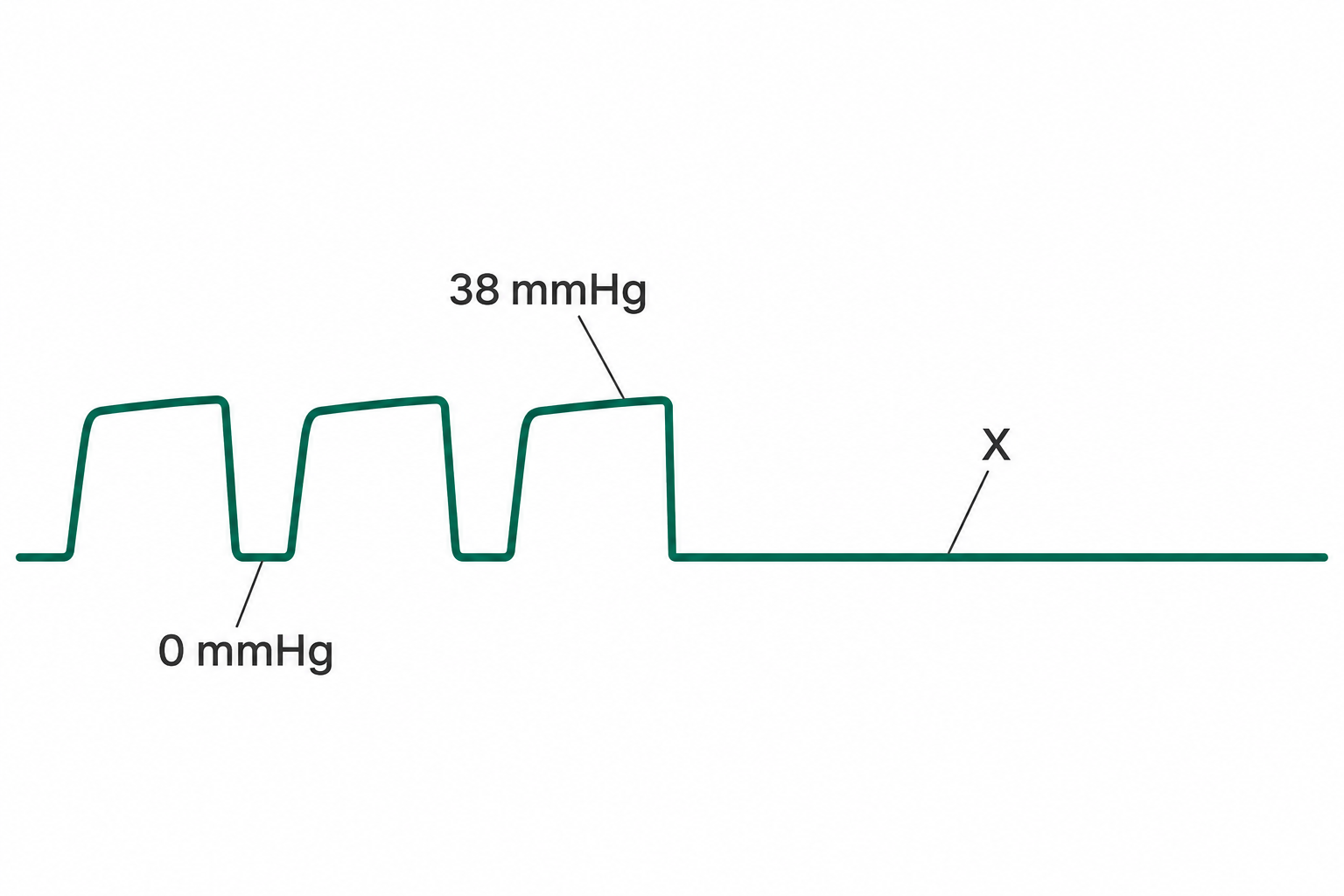
During critical care air medical transport of a paralyzed, mechanically ventilated adult patient with ARDS, the flight nurse observes the capnography monitor trace shown in the figure. The continuous waveform capnography suddenly drops from an EtCO2 of 38 mmHg directly to 0 mmHg. In this clinical setting, this sudden change indicates _____ until ruled out by direct assessment.
A 64-year-old male with septic shock refractory to an initial 30 mL/kg crystalloid bolus is being transported via critical care rotorcraft. According to the Surviving Sepsis Campaign guidelines, which clinical rationale supports selecting norepinephrine as the first-line vasopressor over dopamine? flowchart TD A[Fluid-Refractory Vasodilatory Shock] --> B{Select First-Line Vasopressor} B -->|Preferred: Alpha-1 >> Beta-1| C[Norepinephrine: Lower Arrhythmias & Lower Mortality] B -->|Avoid: Excess Beta-1 Stimulation| D[Dopamine: Doubled Tachyarrhythmias & Higher Mortality]
A 52-year-old female with septic shock secondary to acute pyelonephritis is being transferred via helicopter air ambulance to an academic intensive care unit. The patient is intubated, sedated, and has received 4 liters of balanced crystalloids. Upon flight crew arrival, norepinephrine is infusing at 0.45 mcg/kg/min via a central venous catheter. Invasive arterial line blood pressure monitoring demonstrates a blood pressure of 78/44 mmHg with a mean arterial pressure (MAP) of 55 mmHg and a heart rate of 124 beats/min in sinus tachycardia. Point-of-care ultrasound demonstrates a hyperdynamic left ventricle and an inferior vena cava with minimal respiratory variation. To restore vascular tone, achieve the target MAP of 65 mmHg, and reduce adrenergic catecholamine burden, which second-line vasoactive infusion should the flight nurse initiate next?
While managing an adult patient with mixed septic and cardiogenic shock requiring an epinephrine infusion titrated up to 0.15 mcg/kg/min, the flight nurse notes that the patient's arterial line blood pressure is 108/64 mmHg (MAP 78 mmHg), urine output is 0.7 mL/kg/hr, and extremities are warm with a capillary refill time of 2 seconds. However, serial point-of-care blood gases show that serum lactate has risen from 2.2 to 4.9 mmol/L. What physiologic mechanism best explains this elevation in serum lactate?
6 more free samples are waiting
Create a free account to unlock the whole CFRN sample bank, or get full access to all 165 practice questions in the simulator.