Free MFT sample questions
Questions from the AMFTRB Marital and Family Therapy National Examination practice bank, with the correct answer and an explanation for each one. No junk, no filler.
Try them in the simulator Same questions, with study, timed and flashcard modes.
Showing 6 of 12 free sample questions.
During an intake assessment of a family where an adult member is entering outpatient treatment for alcohol use disorder, the clinician evaluates the family's 'recovery capital.' What does recovery capital specifically assess within a systemic framework?
A married couple presents to an outpatient clinic seeking conjoint family therapy. The husband completed medical detoxification for severe alcohol dependence three weeks ago. The wife reports feeling emotionally exhausted, hypervigilant, and distrustful after years of covering up his missed work and managing family finances alone. The husband states he wants his wife to stop 'monitoring and interrogating' him so he can focus on his recovery. During individual pre-screening, the wife discloses that two weeks prior to detoxification, during an argument over his drinking, the husband pushed her against a wall, held her by the shoulders, and threatened severe violence if she disclosed his drinking to his employer. The husband acknowledges this incident, expresses remorse, and claims that alcohol intoxication was entirely responsible for his actions. The therapist reviews evidence-based screening guidelines for systemic substance use treatment, as diagrammed below: flowchart TD Screening[Intake Screening of Couple System] --> AssessFactors{Assess Safety & Contraindications} AssessFactors -->|Active Physical Violence / Threats| Separate[Exclude Conjoint Therapy: Safety Planning & Separate Services] AssessFactors -->|Substance Remission & Safety Verified| Conjoint[Initiate Recovery-Oriented Conjoint Therapy] Based on these screening standards, what is the therapist's MOST appropriate clinical action?
A systemic therapist is treating a client who has expressed passive suicidal ideation. The clinician is deciding between having the client sign a 'no-suicide contract' or collaborating on an empirical safety plan. What does current clinical evidence indicate regarding these two clinical tools?
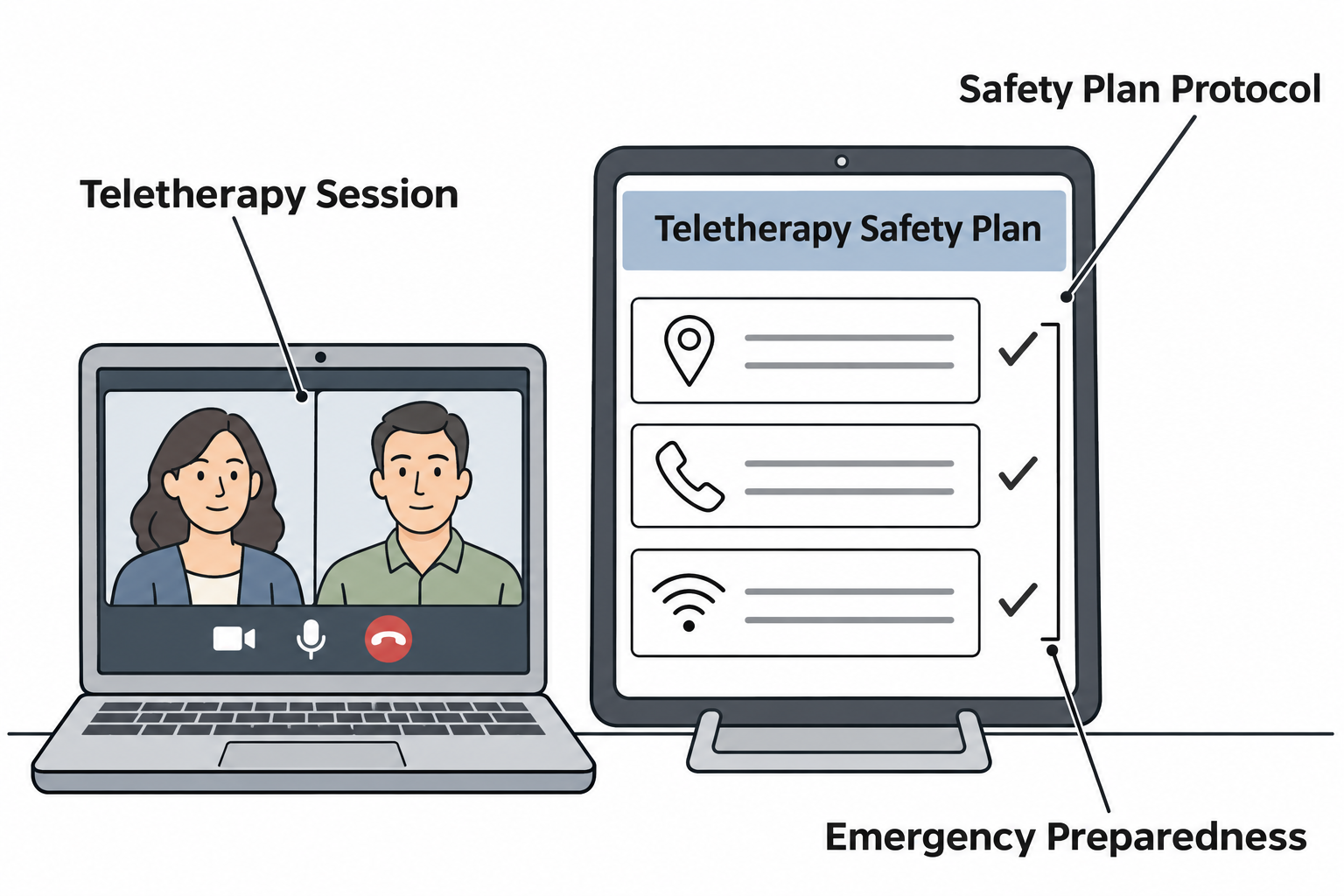
When developing an ongoing safety plan for a client receiving services exclusively via teletherapy, which protocol is essential to ensure emergency responsiveness during an acute crisis? (Refer to the figure for an overview of key teletherapy emergency components.)
A 15-year-old adolescent who experienced a violent community assault is referred to family therapy for cannabis use disorder, high-risk delinquent behaviors, and trauma symptoms. Which evidence-based integrative family treatment model is specifically designed to address co-occurring adolescent substance misuse, post-traumatic stress, and high-risk behaviors through caregiver involvement and trauma exposure processing?
6 more free samples are waiting
Create a free account to unlock the whole MFT sample bank, or get full access to all 141 practice questions in the simulator.