Free CLEP-CHEMISTRY sample questions
Questions from the CLEP Chemistry practice bank, with the correct answer and an explanation for each one. No junk, no filler.
Try them in the simulator Same questions, with study, timed and flashcard modes.
Showing 6 of 12 free sample questions.
In the van der Waals equation of state for real gases, [P + a(n/V)^2](V - nb) = nRT, which statement accurately identifies the physical correction represented by the constant 'a' and specifies the conditions under which gases deviate most markedly from ideal behavior? flowchart TD RealGas[Real Gas System] --> Stress[High Pressure & Low Temperature] Stress --> Attract[Intermolecular Attractions Become Significant] Stress --> Volume[Excluded Molecular Volume Becomes Significant] Attract --> CorrA[Pressure Deficit Corrected by Parameter a] Volume --> CorrB[Free Volume Deficit Corrected by Parameter b]
Under identical conditions of temperature and pressure, an unknown gaseous hydrocarbon effuses through a pinhole aperture at a rate that is exactly 0.500 times the rate of effusion of methane gas (CH4, molar mass = 16.04 g/mol). According to Graham's law of effusion, what is the molar mass of the unknown hydrocarbon?
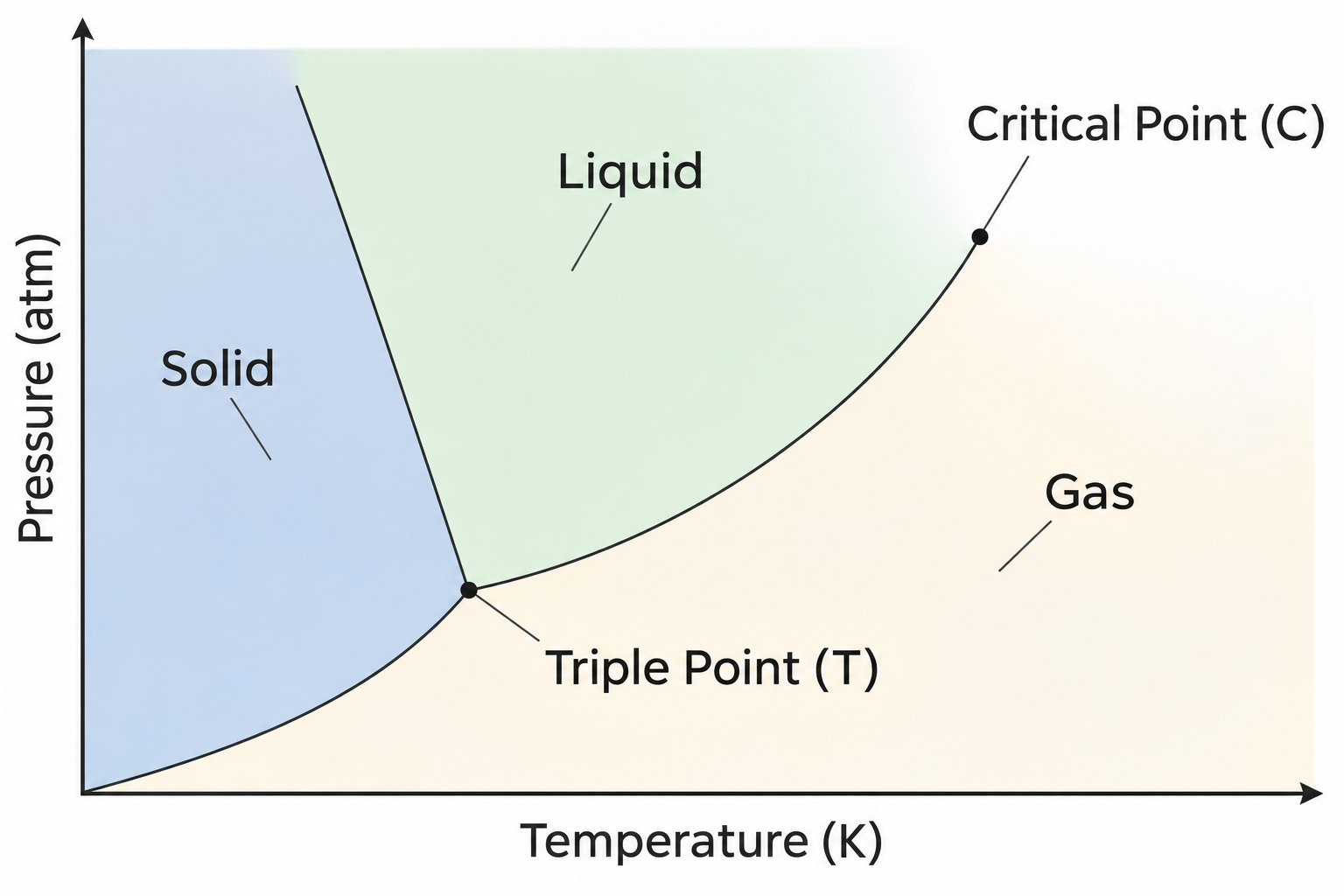
A physical chemistry research group evaluates the one-component phase diagram of Substance X shown in the figure. Substance X exhibits three stable phases: solid, liquid, and gas. The triple point (T) is located at 0.006 atm and 273 K, and the critical point (C) is located at 218 atm and 647 K. Notably, the solid-liquid coexistence boundary curve extending from the triple point exhibits a distinct negative slope (dP/dT < 0). A 10.0 g sample of solid Substance X is placed inside a variable-pressure piston chamber at a constant temperature of 272 K and an initial pressure of 0.50 atm. The piston is then compressed isothermally until the pressure reaches 50 atm. Based on the phase diagram in the figure, what phase change occurs during this compression, and what fundamental property of Substance X is revealed by the negative slope of the melting line?
Assuming complete electrolyte dissociation and ideal solution behavior, which of the following aqueous solutions has the LOWEST freezing point?
At 25 °C, pure liquid water has an equilibrium vapor pressure of 23.8 mmHg. A solution is prepared by dissolving 0.200 mol of a nonvolatile, nonelectrolyte solute in 1.800 mol of pure water. Assuming the solution behaves ideally according to Raoult's law, what is the vapor pressure of water above this solution at 25 °C?
6 more free samples are waiting
Create a free account to unlock the whole CLEP-CHEMISTRY sample bank, or get full access to all 163 practice questions in the simulator.