GED Sample Questions Worth Checking Before Test Day
By ExamDumpster Editorial Team· (updated Oct 4, 2026)
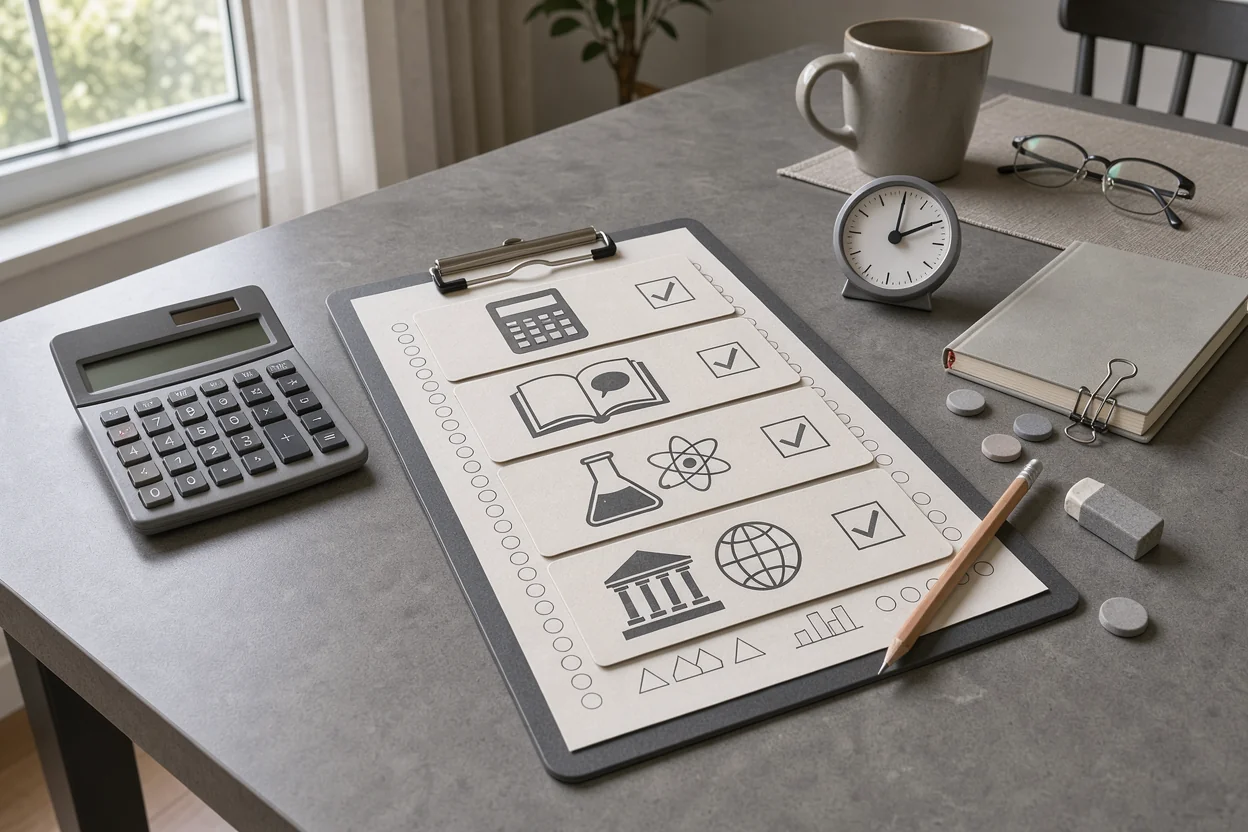
If you are a week or two out from booking a GED seat, the most useful thing you can do with ged test sample questions is not answer more of them. It is audit the ones you have already answered. Most candidates who fail a subject test do not fail because they never saw the material. They fail because they practiced against outdated questions, skimmed answer keys instead of explanations, or never ran a timed set under real conditions. This checklist walks through what to verify in each of the four subject tests, how to read your misses properly, and the score signal that means you are genuinely ready to book. Each item is something you can confirm in a single sitting.
Confirm you are practicing against the current exam
The GED has been a four-subject exam since 2014: Reasoning Through Language Arts (RLA), Mathematical Reasoning, Science, and Social Studies. That sounds stable, but sample material online is a mixed bag. Plenty of free PDFs and quiz sites still circulate questions written for the 2002 series, or generic "reading comprehension" items that never match the technology-enhanced formats the current test uses.
Before you drill anything, run these checks:
- The set names the four current subjects and nothing else. If it mentions a separate writing test with a standalone essay paper, it is old material.
- It includes more than multiple choice. The current exam uses drop-down, fill-in-the-blank, drag-and-drop, hot spot, and select-an-area items, which the official GED test previews show in their sample tutorial.
- RLA includes an extended response (the essay). A sample set with no essay task is not modeling the real 150-minute RLA test.
- Math reflects the two-part structure: a short no-calculator section, then a longer section where the on-screen TI-30XS MultiView calculator is available.
- The source is dated or versioned. If the page cannot tell you when the questions were written or last reviewed, treat it as suspect.
The official preview tests are worth your first hour. They are roughly a quarter the length of the real exam, free, and built by the same people who write the scored items, so the question phrasing and difficulty calibration are the most honest baseline you will find. Use third-party sets after that to add volume, not to set expectations.
This is the same problem IT candidates hit with retired exam versions, and it is why Exam Dumpster marks retired exams instead of hiding them and maps every question bank to the vendor's published objectives. Whatever source you use for GED practice, the same rule applies: if you cannot verify what version the questions target, do not spend your limited evening study hours on them.
Run one sample set per subject, in one sitting each
A scattergun approach, ten math questions here and five science questions there, tells you almost nothing. Each subject test has its own pacing, its own question formats, and its own way of disguising what it is actually asking. The audit that matters is one uninterrupted set per subject, scored honestly.
Reasoning Through Language Arts
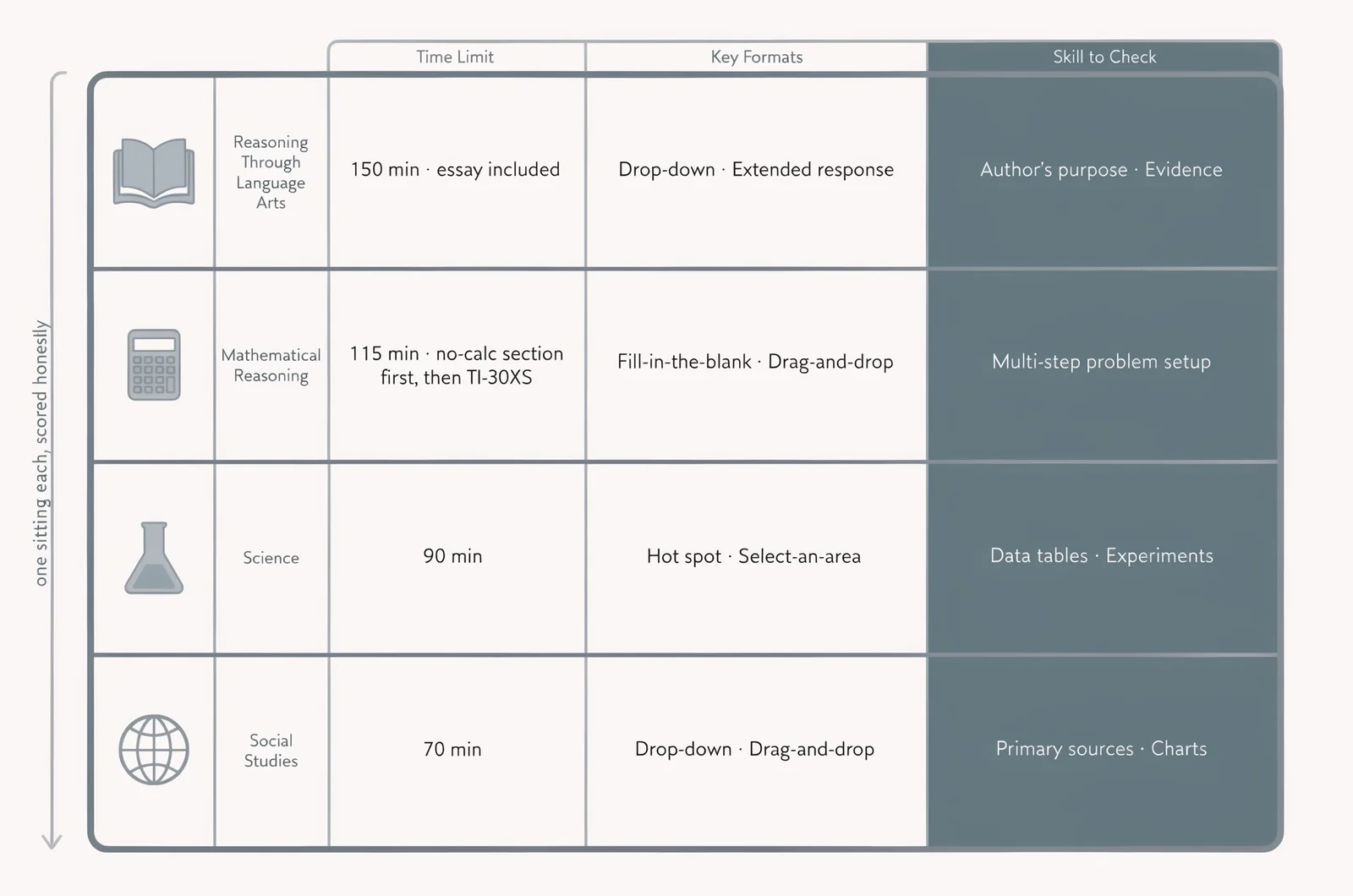
The RLA test gives you 150 minutes including the extended response. When you run a sample set, check three things. First, can you identify an author's purpose and evidence, not just summarize the passage. Second, can you handle the language items, which test grammar in context by asking you to correct sentences inside a passage rather than in isolation. Third, can you produce a structured essay in about 45 minutes that analyzes two opposing arguments and picks the better-supported one.
The official language arts study guide lays out these skills against the current content, and it is the right document to check your sample set against. If your practice questions never ask you to evaluate evidence across two texts, they are under-testing you.
Mathematical Reasoning
The math test is 115 minutes. The content skews toward algebraic problem solving (roughly 55 percent) over quantitative problem solving (roughly 45 percent), and a formula sheet is provided. The trap most adult learners fall into is grinding arithmetic drills when the real test asks them to set up equations from word problems, work with graphs and functions, and interpret data.
Your one-sitting check: did you finish within the time, and did the no-calculator section cost you more than two or three items? If mental arithmetic is the bottleneck, that is a fast fix with daily fifteen-minute drills. If setting up the equation is the bottleneck, that is a content gap and needs real study time. These are different problems with different timelines, and only a full sample set separates them.
Science
The science test is 90 minutes and roughly 34 questions. The single most important thing to understand about it is that it is a reading-and-reasoning test wearing a lab coat. You are given passages, graphs, tables, and experiment descriptions, then asked to interpret them. The official science item examples show how heavily the items lean on data interpretation rather than memorized facts.
In your sample run, count how many misses came from misreading a graph or table versus genuinely not knowing the science. Most candidates find the ratio is three or four to one. That is good news, because graph reading improves fast with practice, and every GED science sample set doubles as graph-interpretation training.
Social Studies
The social studies test runs about 70 minutes. Content weighting matters here: civics and government carries roughly half the test, with US history, economics, and geography splitting the rest. If your sample set is mostly history trivia, it is badly weighted compared to the real thing.
The formats mirror science: read a primary source, a political cartoon, a chart of economic data, then reason about it. Memorizing dates helps far less than practicing how to pull an argument out of a document. Check that your sample questions include document-based items and at least a few drop-down or drag-and-drop formats, not just plain multiple choice.
Grade every miss against the explanation, not the answer key
This is the checklist item that separates people who improve from people who plateau. An answer key tells you that you were wrong. An explanation tells you why the right answer is right, which is the only information that transfers to a question you have never seen.
For every miss in your four sample runs, write down one of three causes:
- Content gap: you did not know the underlying fact or method. Fix: targeted study on that topic.
- Question-reading error: you knew the content but misread what was asked, especially "which is NOT" stems and two-part questions. Fix: slow down on stems, underline the operative word.
- Format fumble: the technology-enhanced item type confused you, like a drop-down you answered partially. Fix: more reps with the official preview tutorial until the formats feel boring.
If your sample source has no explanations, or explanations that just restate the answer, replace it before you draw any conclusions from your scores. Peterson's sample GED questions are one example of a set that walks through the reasoning per item, and there are others. The pattern to look for is an explanation that names the distractor logic, meaning it tells you why the tempting wrong answers are tempting.
The same standard applies everywhere in exam prep. Exam Dumpster puts an explanation on every answer in its question banks for exactly this reason, and study modes in any decent exam simulator tool let you keep the explanation one tap away while you drill. If you are juggling GED prep alongside other academic tests, the format of a good academic sample questions page, questions plus per-item explanations, is the baseline to hold any source to.
Run one timed simulation before you decide anything
Untimed accuracy lies. Most people score 10 to 20 percent higher with no clock, and the GED's time pressure is part of what is being tested. So the second half of this checklist is one full timed run per subject, or the closest you can get with sample material.
Set a kitchen timer. Scale the question count and time proportionally if your set is shorter than the real thing: a quarter-length preview should take about a quarter of the real time. No phone, no pausing, no checking the formula sheet for math until you would be allowed to on test day (you always are, but know what is on it before you sit).
Two things to record beyond the raw score. First, your pace per question. RLA allows roughly two to three minutes per item once you reserve 45 minutes for the essay. Science allows about two and a half minutes per question. If you are consistently blowing past those marks, timed practice is the fix, not more content review. Second, your energy curve. If your accuracy collapses in the final third of the set, that is stamina, and stamina only improves by doing full-length sittings.
If you want a simple way to make this repeatable, a basic readiness tracker helps: one row per subject, columns for untimed score, timed score, top miss cause, and date. An interactive version of that tracker, where you log each sample run and it flags when two consecutive timed runs clear the bar, would be a natural fit for a study tool, and you can approximate it in a spreadsheet in five minutes.
Read your scores the way the GED does
Each subject is scored from 100 to 200. The numbers that matter:
- 145 is the passing threshold per subject. You need it on all four.
- 165 is GED College Ready, which some colleges accept as evidence you can skip placement tests or remedial courses.
- 175 is GED College Ready Plus Credit, which can earn actual college credit at participating institutions.
The go/no-go rule for this checklist: book your seat when your timed sample scores sit comfortably above 145 in a subject, with a margin for a bad day. A single 146 on an untimed set is not a pass signal. Two timed runs at 155 or better is. And because you can schedule and pay for subjects individually, you do not need all four ready at once. If math is at 158 and social studies is at 138, book math now and keep drilling social studies.
One caveat on sample scores generally: unofficial question banks are not calibrated to the real 100-200 scale, so treat third-party percentages as directional and reserve the scaled-score judgment for the official GED Ready practice test, which is the only practice product that produces an actual predicted score and a "likely to pass" or "too close" call. If your sample results are borderline, the GED Ready fee is cheaper than a retake.
Questions readers ask about GED sample questions
Are free GED sample questions good enough to pass with?
For diagnosis and format practice, yes, especially the official previews. For volume, you will likely want a larger bank with explanations. Free sets answer "where am I weak" well; they answer "am I ready" only partially.
How many sample questions should I do per subject?
Enough to cover every content area at least twice, which usually means 60 to 100 per subject across a few weeks, plus one full timed run. Past that point, extra volume without explanation review stops helping.
Do sample questions repeat on the real exam?
No. Sample items are retired or parallel forms. What repeats is the skill being tested, which is why explanation review matters more than memorizing items you have seen.
Should I study all four subjects at once?
Only if your timeline is short. If you are studying after work, one subject at a time with a booked test date at the end of each block works better for most people, because sample scores tell you clearly when each subject is done.
Keep practicing with these
- NextGen Bar Exam Sample Questions Worth Practicing Before Test Day
- 7 Free GMAT Exam Sample Questions Sets, Ranked by Realism
- Free CPA Test Sample Questions That Still Match the Exam Blueprint
Open a free sample set for their exam code, then create a free account to unlock the rest and save progress Get started |  |