AICP Exam Cost for Candidates vs Regular Applicants
By ExamDumpster Editorial Team· (updated Nov 16, 2026)

If you searched for “aicp aicp certification exam” while budgeting for certification, you probably want a straightforward answer: does the Candidate route cost less than applying as a regular applicant? The comparison needs to cover more than the first payment. Membership, later charges, preparation, and a possible retake can change the total.
Current official fee amounts are not verified here, so this article does not quote APA prices or declare either route cheaper. Candidate and regular applicant are the comparison labels used below; their availability, eligibility rules, and charges must be confirmed against the American Planning Association’s current requirements.
What you can compare is the complete financial commitment. Separate the amount needed to register, the amount needed to reach your intended certification milestone, and the money you would need if the first attempt does not go as planned.
Confirm that both application routes apply to you
An AICP cost comparison starts with eligibility. A lower advertised fee has little practical value if its conditions do not match your education, experience, membership category, or intended application date.
Route names alone do not establish separate prices. Avoid assuming that Candidate status automatically means a student discount, a reduced exam charge, or a different qualification standard.
If you are considering Candidate status
Establish what Candidate status means under the rules that apply to your application. Check which requirements must be met before registration and which, if any, remain afterward.
The financial question is whether the route reduces a charge, postpones it, or changes the sequence of payments. Those outcomes have different effects on your budget.
A postponed payment can help with cash flow. It still belongs in the full cost of the route. Record its expected due date alongside the amount so that a manageable first payment does not conceal a difficult later one.
Also check whether any benefit depends on retaining a particular membership category. Your budget should reflect the category you expect to hold when the payment becomes due.
If you are considering a regular application
Apply the same scrutiny to the regular route. Identify what the initial payment includes and whether another assessment, registration, or credential-related payment could follow.
If you already have an APA account, distinguish charges you would pay anyway from charges created by your certification plans. This prevents your personal comparison from overstating the additional cost.
Keep a dated record of the applicable eligibility description and fee terms. If the two labels do not represent separate current options for you, compare the available payment stages instead.
Build two budgets with the same finish line
Candidate and regular applicant costs are comparable only when both budgets end at the same milestone. An exam-registration subtotal cannot fairly compete with a budget that includes later certification expenses.
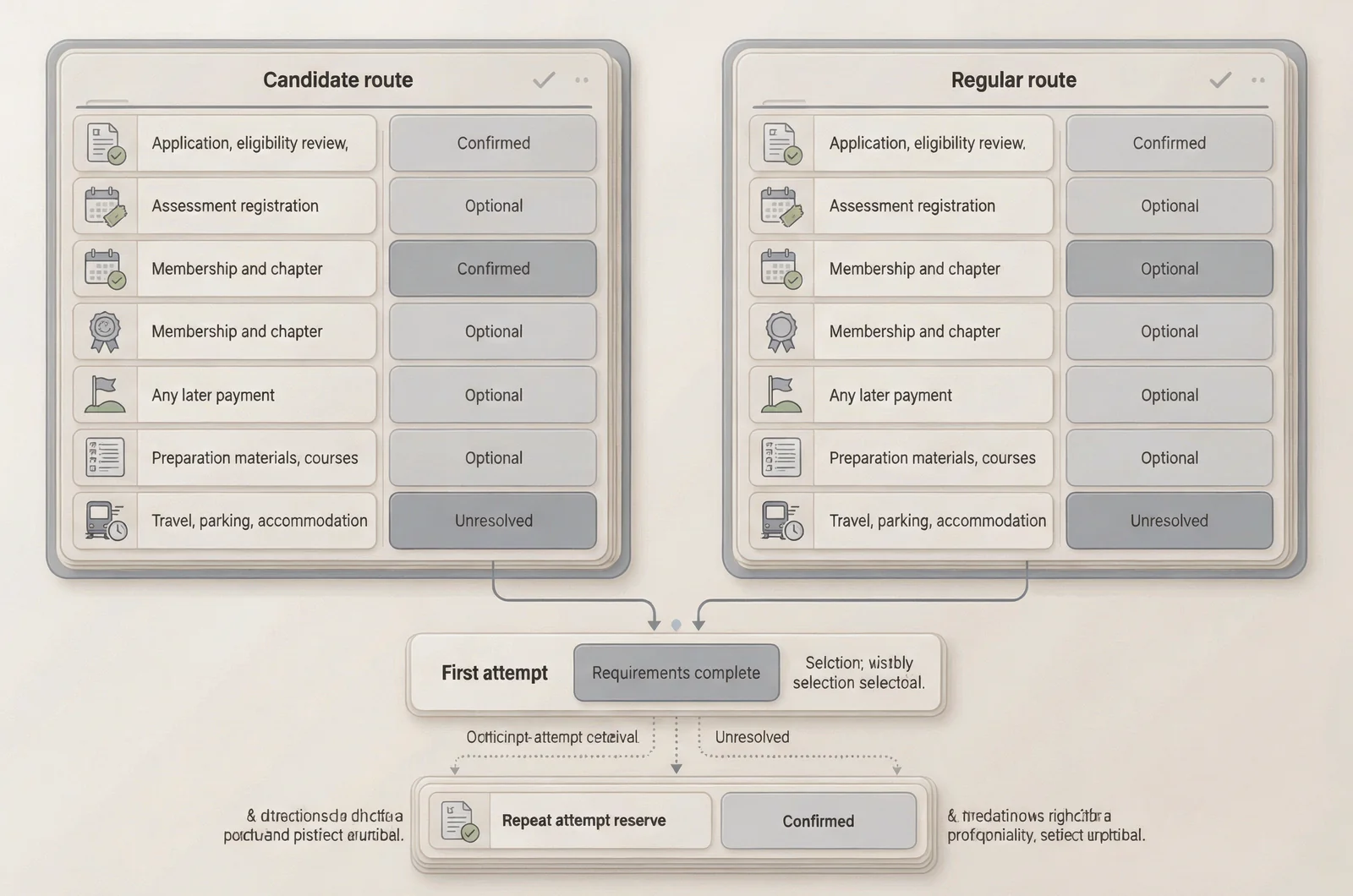
Choose your endpoint before adding figures. For example, you might budget through the first exam attempt or through completion of all applicable certification requirements. Label that endpoint clearly.
Separate official charges from study choices
For each available route, record the following categories wherever they apply:
- Application, eligibility review, or assessment charges.
- Exam registration and any separately listed administrative charges.
- Membership and chapter dues required for the period being compared.
- Any later payment needed to reach your chosen endpoint.
- Preparation materials, courses, and practice questions.
- Travel, parking, accommodation, or unpaid time away from work.
These are budgeting categories, not a claim that APA charges every item separately. An included service should not become a second expense in your worksheet.
Give each amount a status: confirmed, conditional, or unknown. An unknown amount should remain visibly unresolved rather than silently becoming zero.
Record payment dates too. Two routes can have the same total while requiring very different amounts before your first sitting.
Calculate a first-attempt total and a contingency total
Use the same calculation for both routes:
First-attempt total = applicable official charges + additional membership costs + preparation + attendance expenses.
Then calculate a separate contingency:
Contingency total = first-attempt total + applicable repeat-attempt costs + additional study and attendance expenses.
Keep reimbursement separate from both gross totals. Otherwise, an expected employer payment can make an unaffordable upfront expense look manageable.
For subscriptions, count the months you realistically expect to use. For a one-time purchase, check whether access lasts through your intended exam date and any possible rescheduling.
A useful budget calculator would accept confirmed charges, payment dates, membership renewals, study subscriptions, and one optional retake. Its results should show both total spending and the largest payment due in a single month.
Before comparing totals, make sure neither worksheet contains an unresolved official charge.
Test membership savings against the dues you would add
APA membership belongs in the comparison wherever it changes your actual spending. A discount and a saving are different calculations: the saving depends on what you must spend to receive it.
Do not assume that a particular membership category qualifies for reduced charges. Establish the applicable terms first.
Compare the additional membership expense
If you already intend to maintain membership regardless of certification, your decision may concern only the difference between applicable exam-related charges.
If you would join specifically for a verified discount, include the additional dues in the calculation:
Net saving = confirmed fee reduction − membership spending added to obtain it.
A positive result indicates a saving within that calculation. It does not establish that every other cost is equal.
Timing matters as well. Check whether the expected certification schedule crosses a renewal date. If continued membership is necessary for your chosen route, an additional renewal belongs in that route’s budget.
Keep optional benefits separate. You may value professional resources or networking, but those benefits should not be presented as cash recovered from an exam fee.
Account for reimbursement without hiding the upfront cost
Employer support can change your personal expense without changing the route’s published price.
Confirm which categories are reimbursable and when payment occurs. An employer might treat membership, preparation, and registration differently; use the written reimbursement terms rather than an informal expectation.
Also establish whether reimbursement depends on passing or requires advance approval. Record the amount you must pay before reimbursement arrives.
Your worksheet should show three figures separately: gross cost, expected reimbursement, and your remaining expense.
Price a repeat attempt before committing the first payment
A possible AICP retake deserves its own budget because the first payment may not tell you what another attempt would cost. Avoid assuming that a repeat attempt is free, discounted, or covered by a previous application.
No current retake amount or repeat-attempt policy is established here. Treat those details as unresolved until they match the terms applicable to your registration.
Identify what would need to be paid again
Check whether another attempt would require only an exam payment or whether other charges could also apply. Establish any relevant validity periods, scheduling conditions, and limits before counting on the original payment.
Keep a retake separate from a reschedule, cancellation, or missed appointment. They are different events and may have different financial consequences.
Your contingency should also include expenses outside registration. Another sitting could mean additional travel, another subscription month, or more time away from paid work.
Give the reserve a realistic purpose
A contingency fund protects the rest of your budget if another attempt becomes necessary. It is not a reason to book before you are ready.
If your available money covers only registration, assess whether a later sitting would leave room for targeted preparation and unexpected expenses. A short delay may be financially easier than replacing several exhausted resources after an unsuccessful attempt.
Write down the repeat-attempt terms and the amount you could fund without borrowing. Use that figure when deciding whether the first booking fits your budget.
Spend on preparation that addresses a demonstrated weakness
Preparation is the part of an AICP budget where you have the most purchasing discretion. Start by identifying a learning gap, then choose a resource that addresses it.
A large question count alone tells you little about whether a purchase will help. Relevance, explanations, access terms, and your ability to use the material matter more to the spending decision.
Assess your starting point before buying
Start with the applicable exam outline and any official preparation material available to you. Establish the subjects you need to study before comparing commercial packages.
A diagnostic exercise should produce more than a percentage. Record whether each missed answer came from a knowledge gap, confusion between plausible options, misreading, or time pressure.
Those problems call for different responses. More timed questions may help you examine pacing, while a weak subject may need structured reading and explanation.
Later in that assessment, Exam Dumpster’s AICP sample questions can provide another practice option to inspect. Evaluate the material’s relevance and reasoning before treating it as part of your study plan.
A sample result is a limited diagnostic. It should not become a prediction of your official outcome.
Compare access terms against your study calendar
Before paying, inspect enough material to judge whether the explanations resolve your mistakes. A useful explanation should help you understand the correct choice and distinguish it from plausible alternatives.
Check whether access expires, renews automatically, or depends on a subscription. Include the full expected usage period in your budget.
Avoid buying several overlapping resources before finishing the first. Additional spending is easier to justify when you can name the unresolved gap.
For someone studying after work, usability matters too. A resource that fits short evening sessions may receive more use than a longer course you repeatedly postpone.
Set an initial spending limit and a review point. Increase the budget only after identifying what the current materials leave unresolved.
Choose between lower total spending and easier payment timing
The better AICP route for your circumstances depends on both the complete expense and the payment schedule. A smaller first payment can be useful even when it does not reduce the eventual total.
Judge each eligible option on the same four attributes: confirmed cost, payment timing, remaining requirements, and financial exposure if your schedule changes.
When an earlier payment stage could help
Suppose you are eligible for a route that lets you begin earlier and spread applicable payments across different dates. That arrangement may fit a limited monthly budget.
Its value depends on what follows. Include any later charges and any additional membership or preparation spending caused by the longer timeline.
Choose that arrangement for its cash-flow benefit only after you can identify the remaining obligations. Describe a deferred payment as deferred, even if it makes the initial booking easier.
When waiting could be more affordable
Suppose you need more preparation time or cannot yet establish your applicable charges. Waiting can give you time to resolve those uncertainties and save for the complete commitment.
The tradeoff is a later exam or certification milestone. Consider whether that delay affects an employer requirement or another concrete deadline.
Waiting does not establish a cheaper future fee. Base the decision on money you can retain, resources you can use, and requirements you can confirm.
When neither label changes your budget
If the currently available process produces the same applicable charges for you, the Candidate-versus-regular distinction may not create a meaningful price choice.
Your practical decisions then concern preparation spending, attendance expenses, reimbursement, and timing. Remove an unavailable route from the comparison rather than assigning it an attractive hypothetical total.
Questions to settle before paying AICP fees
The remaining budget questions should close specific gaps in your comparison. Keep the answers with the dated fee information so you can distinguish an assumption from a confirmed term.
Is the Candidate route cheaper?
That is not established without current applicable charges and eligibility terms. Compare complete totals through the same endpoint, including any membership spending added by each route.
A lower initial payment establishes a cash-flow difference. It establishes a saving only if the complete comparison also costs less.
Does an application payment include the exam?
Do not infer that from the label. Check the payment description, included services, and any later registration requirement before entering the amount.
If the terms remain unclear, leave the exam charge unresolved in your worksheet.
Should I join APA specifically for a discount?
Only a confirmed discount supports that calculation. Subtract the membership spending you would add, then account for any renewal required during the relevant period.
If membership has separate professional value to you, record that as a separate reason for joining.
How much should I reserve for preparation?
Use the resources you need, their access terms, and your study calendar to set the amount. There is no supported universal preparation budget here.
Resolve the official charges first, retain an affordable contingency, and purchase additional material only when you can name the learning gap it addresses.
AICP practice material to assess for your budget
Open a free sample set for their exam code, then create a free account to unlock the rest and save progress Get started |  |